


On a multi-head double-sided tape pasting machine, sheets move forward along the conveyor as the pasting heads apply tape at set positions. In a vertical sticking configuration, the tape strips run parallel to the sheet’s direction of travel. This arrangement determines the orientation of each strip on the finished sheet and how the sheet must be positioned during feeding.
Vertical Sticking and Cross-Direction Sticking
Tape can be applied either parallel or perpendicular to the sheet's direction of travel, and each arrangement places different demands on the machine. For cross-direction strips, placement along the feed direction depends on the timing and positioning of tape application relative to the sheet's leading edge. For strips running parallel to sheet travel, the strip extends along the sheet as it moves beneath the pasting head, making lateral positioning and stable feeding the main factors in placement accuracy.
Vertical sticking follows the second arrangement. With the pasting head fixed and the sheet moving underneath, the tape is applied continuously along the direction of travel. This configuration suits long strips used on card boxes, cartons, envelope bags and document bags, particularly when tape follows an edge, a flap or a bonding line. During production, the head's lateral setting determines the strip's distance from the sheet edge, while consistent sheet feeding helps maintain that position throughout the run.
Why Lateral Position and Straight Travel Matter So Much
In vertical sticking, the distance from the tape to the sheet edge is set by the left-right position of the pasting head. That setting is a fixed reference, and once it is correct, it holds for every sheet that follows the same path. The weak point is therefore the sheet's path, and not the head.
A sheet that enters the pasting position at a slight angle carries that angle along the full length of the strip. At the start of the sheet, the strip may sit at the intended distance from the edge, while at the far end it has drifted toward or away from it. The longer the strip, the larger the effect. For this reason, feeding straightness matters more under vertical sticking than most operators expect, and it explains why smooth, evenly gripped feeding is the foundation of tape placement on this type of machine.
Two practical habits follow from the geometry. The first is to confirm the head position against the product drawing, measuring from the same edge the drawing references. The second is to check the first sheets of every run along their full length, and not only at one point, since a skewed sheet reveals itself at the far end of the strip. A short check at the beginning of each job costs little and prevents a drifting strip from running through a whole batch.
What Our Machines Bring to Lengthwise Taping
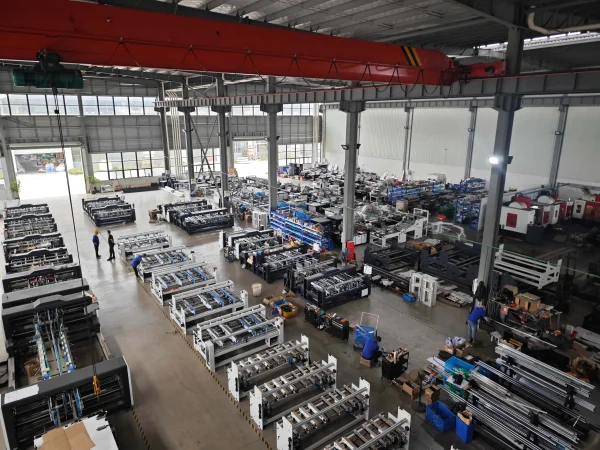
Our automatic multi-head double-sided tape pasting machines are built around vertical sticking, and every major section of the machine supports the same goal: a strip that keeps its direction and its distance from the edge from the first sheet to the last.
The feeding section comes first. A high-friction belt system carries sheets forward smoothly and delivers them in an orderly way, so the sheet passes under the pasting heads on a straight path. For card boxes, gift boxes and corrugated cartons, where long strips follow a panel edge or a bonding line, this steady path keeps the strip running parallel to the edge along its whole length. The same feeding design handles cardboard, card stock and E, B and C flute corrugated board, so the direction of the strip stays consistent when the material changes.
The multi-head design is the second advantage. Products with more than one strip receive all of them in a single pass, and every strip is referenced to the same feeding path. The strips therefore run parallel to one another and keep an even spacing, without the repeated loading and re-alignment that separate passes would bring. For gift boxes and cartons with strips at several positions, this means one setup routine and one inspection point for the whole sheet.
Position adjustment is the third. Envelope bags and document bags usually carry easy-tear tape close to the edge, where the lateral setting of the head counts most. On our triangle tape machine, the adhesive head can be moved left and right with a handwheel against a steel ruler, which gives operators a clear, visible reference when a new product needs the strip somewhere else. Combined with PLC control, which coordinates feeding, tape pasting and collection as one sequence, the pace and the position set at the start of a run hold across the batch.
Changeover is the fourth. Plants that make many formats spend a good share of the day switching tape and position. The adhesive head on our machines rotates at the press of a key, and a tape change takes about 30 seconds. A short reset leaves time for the check that matters most under vertical sticking, which is a look at the first sheet along its full length before the batch begins.
The exit is the fifth. A straight-out fish-scale collection belt, running on its own belt, delivers finished sheets in a tidy overlapping order, so the direction of each strip and its distance from the edge can be inspected as the sheets arrive. An optional counting function supports batch quantity checks for orders with fixed counts. Inspection and counting happen at one point, directly after pasting, and not at a later stage when a drifting strip would already have run through the batch.
Keeping Every Strip Parallel and in Place
Vertical sticking gives the tape the same direction as the sheet, which puts the weight of accuracy on straight feeding and on the lateral setting of the head. Our multi-head machines are designed around exactly that: steady belt feeding for a straight path, multiple heads that share one reference, quick tape changes, PLC-coordinated operation and orderly collection with an optional count. They are available in several series and working widths for cardboard, card boxes, corrugated cartons, envelope bags and document bags, so the configuration can be matched to your products. If your products carry long tape strips, send us your drawings, sheet sizes, tape specifications and typical batch quantities, and our team will suggest a configuration that fits.
 Application Scenarios