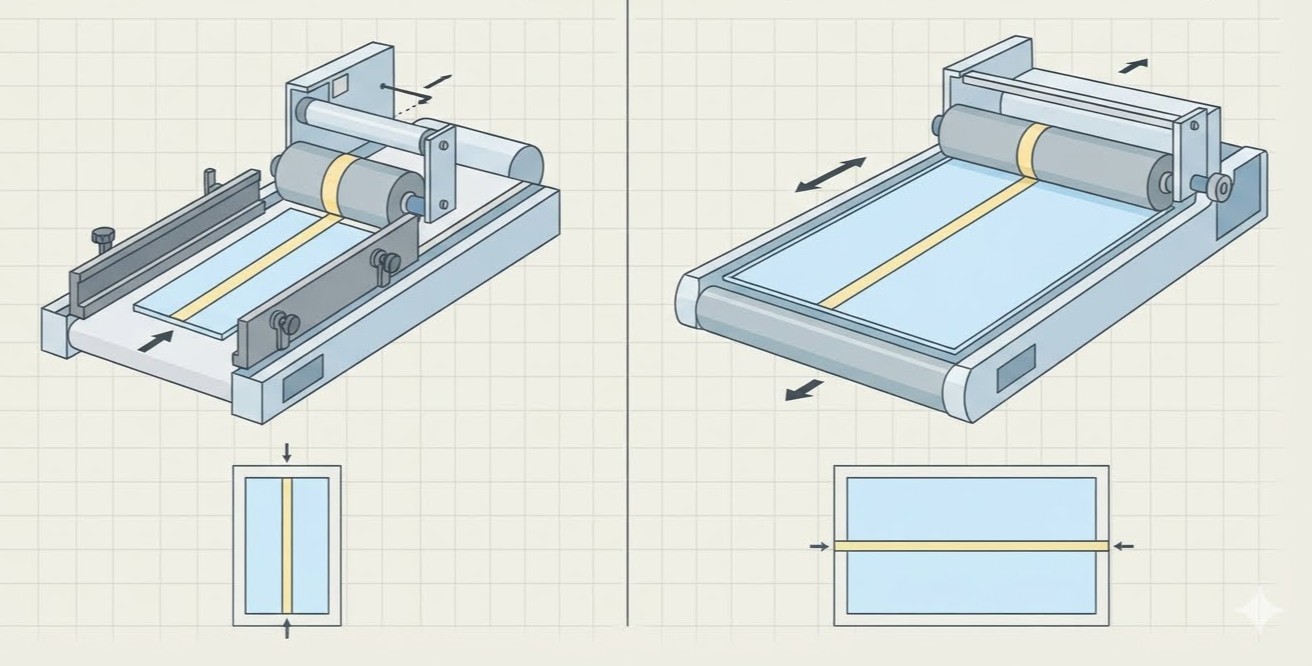


Paperboard and corrugated cartons are widely used for dry pet treats, chews, and gift assortments. A finished box usually consists of several parts: an outer carton, an inner tray, dividers, and sometimes a reinforcing board beneath the contents. Each part has to stay attached to the next. A double-sided tape applicator supports this step by placing adhesive tape on each panel at a defined position before the box is assembled.
What Treat Box Panels Need from a Bond
A treat box carries real weight. Bags, pouches, or loose pieces press down on the base panel, and the box is then stacked in cartons, moved on pallets, and hung or shelved in stores. The bond between panels has to hold under this load without lifting at the edges. A divider that peels away or a base board that curls leaves the contents unsupported and can distort the carton.
Appearance matters as well. Pet treat packaging competes visually on the shelf, and printed surfaces, matte laminations, and spot finishes are common. Visible adhesive marks, creases, or misaligned panels detract from that work. The bonding method should therefore be secure and also leave the surfaces clean.
Variety is the third factor. A single manufacturer may produce small trial boxes, standard retail boxes, and larger gift sets, each with different panel sizes and bonding areas. Seasonal assortments and new flavours bring further versions. Order sizes move up and down, so the equipment must adapt to frequent changes.
The Weak Points of Common Bonding Methods
Bond quality in a layered carton is decided along the panel edges. Each panel meets its neighbour on a narrow strip, and that strip carries the weight of the contents. When tape is cut and placed by hand, the length and the offset from the edge change from one panel to the next. Some strips sit close to the edge and others stop short of it. Edges are where lifting begins, and a panel that lifts can no longer support what rests on it. Manual work also scales poorly. Every additional box repeats the same steps, so output rises only as fast as the number of hands on the line.
Wet adhesives shift the difficulty rather than remove it. Glue has to be metered with care, because too much travels onto the printed face and too little leaves a thin bond. Setting time also holds panels at the bonding station when they could already be moving to packing. Fully automatic taping lines handle long runs of one format well, but treat boxes change often, and each change brings resetting work that a smaller operation may not recover over a short run. Each method has a place, and the choice comes down to how stable the box format is and how many pieces are made per run.
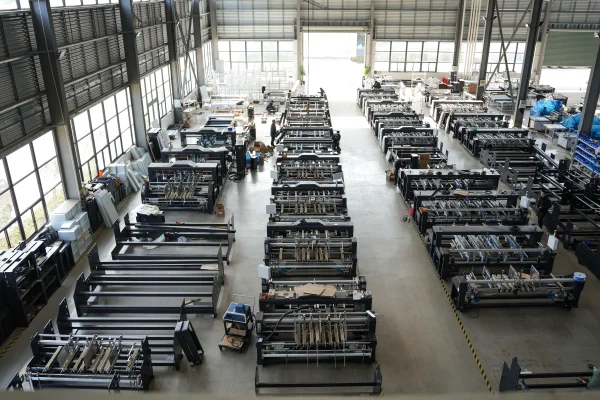
How the Machine Fits into Box Panel Production
A manual double-sided tape applicator divides the work between operator and machine. The operator places each panel on the feed table. The machine carries it forward, applies tape at the set position, and passes it on. Tape line, length, and spacing are set in advance and repeat from one panel to the next.
This arrangement suits box production well. The operator handles every piece and can remove a damaged or misprinted panel before it receives tape. The machine takes over the task that is hardest to repeat by hand, which is laying a straight strip at the same location on every panel.
Assembly becomes simpler as a result. The operator peels the release liner from a taped panel and presses it against the mating part. No glue needs to be applied, and no waiting period follows. Since the adhesive comes on a carrier tape of fixed width, it remains inside its own strip. Printed surfaces and box interiors therefore stay free of marks, which is useful for boxes that customers see closely on a shelf.
Matching the Tape Applicator to Each Type of Treat Box
Treat boxes differ most in panel size, so the machine is best judged by how it handles each type. Inner trays and dividers come first. Their bonding edges are narrow, and a strip that wanders even slightly can end up on the visible side of the panel. Our manual double-sided tape applicator places tape within about ±1 mm, which keeps the strip on its intended line. Compartment boxes add a further requirement, since their panels need short, separate strips. The gap between two tape ends can be as small as about 10 mm, so these panels can be taped without compromise.
Gift sets sit at the other end of the range. Their base boards and lid panels are large, and the same machine accepts sheets up to roughly 700 × 600 mm. The small panels of a compact sample box, starting at around 100 × 140 mm, run on that equipment as well. A packaging plant therefore does not need one machine for small boxes and another for large ones.
Production rhythm is the final consideration. A new flavour or seasonal edition usually begins with a short run, and the line speed can be set low while the operator checks tape position against the finished box. Once the layout is approved, the speed can be raised for the repeat order. Because panels are loaded by hand, switching to the next box style means moving the tape position and continuing. No full line reset is needed in between.
Better Treat Boxes Start with Consistent Tape Placement
Pet treat boxes sell on the shelf first, so the cartons need to look orderly and stay intact through stacking and transport. Neat panel bonding supports both, and it starts with tape that lands in the same place on every piece. Our manual double-sided tape applicator is built for that job. It pairs accurate tape placement with a wide sheet range and adjustable speed, so one machine can cover everything from compact sample boxes to large gift sets and take on a new flavour or seasonal edition without a lengthy changeover. Behind it stands a manufacturer with a full double-sided tape pasting range, from manual to semi-automatic and automatic models, each matched to a different production profile. Send us your panel sizes and tape layout, and our team will help you find the right fit for your treat box range.
 Technical Encyclopedia