


Meta Title: Photoelectric Switches in Corrugated Folder Gluer Machines: Detecting Sheet Position and Material Gaps
Meta Description: Sheet position and spacing sensing decides how consistently a corrugated folder gluer machine glues, folds and splices. Here is where photoelectric detection fits and what it means for carton production.
URL Slug: photoelectric-switches-corrugated-folder-gluer-machine
Photoelectric Switches in Corrugated Folder Gluer Machines: Detecting Sheet Position and Material Gaps
A corrugated folder gluer machine converts flat blanks into folded, bonded cartons, and every stage depends on knowing where each blank is. Photoelectric switches provide that information. They read the position of a sheet and the distance between consecutive sheets, then pass the signal to the control system. Without reliable detection, even a well-built machine drifts out of register, and the cost appears as misaligned glue lines, skewed folds and stoppages.
Why Sheet Position and Gap Control Matter in Carton Production
A folder gluer asks a great deal of a corrugated blank. The sheet must enter the gluing section square, travel through the folding belts without shifting, and reach the splicing and stacking stages at a predictable moment. When the position of a blank is uncertain, the glue flap may receive its adhesive off the intended line, or the folded panels may close with a visible offset.
Spacing between sheets is equally important. If the gap between two blanks varies, the downstream sections cannot keep a steady rhythm. Blanks may crowd one another at the stacking stage, or leave long empty intervals that waste machine capacity. Operations such as e-commerce shipping cartons, bagged food cartons and household goods packaging run in large batches with frequent size changes, so inconsistency in position and spacing is multiplied across thousands of boxes.
Limitations of Traditional Machines
Conventional folder gluers rely heavily on fixed mechanical guides and operator judgment. Setting up a new carton size involves adjusting side guides and stops by eye, and the quality of that setup depends on the experience of whoever runs the shift. Two operators can arrive at slightly different positions for the same job, and the difference appears later as inconsistent gluing or folding.
Feedback is the second weakness. A machine without sensing cannot distinguish between a sheet that has arrived and one that has not. A missing blank, a jam or two overlapped sheets may pass unnoticed until the damage is visible at the output. Stopping, clearing the line and restarting consumes time, and the rejected cartons add to material loss. For plants serving packaging customers with tight delivery windows, these interruptions are a practical constraint rather than a minor annoyance.
The Role of Photoelectric Detection Along the Line
A photoelectric switch emits a beam of light and responds when a sheet interrupts or reflects it. The control system turns that response into a timing reference. In a folder gluer, such references are useful at several points: confirming that a blank has been fed, measuring the interval before the next one, and coordinating the moment when the carton reaches the splicing mouth.
The splicing section is where this matters most. In our machine, the splicing mouth applies hot and cold dual coating, and a photoelectric device guides the stage while servo motors drive the belts that bring the carton to the joint. Because the servo drive can respond to the detected position, the carton is brought to the splicing point with more consistent accuracy than a purely mechanical stop would allow. The result is a closer, more uniform bond along the joint, which supports squareness in the finished box.
Detection also supports the stages around splicing. Upstream, the friction feeder with servo motor drive and air suction separates blanks for steady delivery. Downstream, the patting and conveyor sections stack and move finished cartons in a controlled manner. Sensing at these points helps keep the spacing between boxes regular, so the output remains orderly for packing.
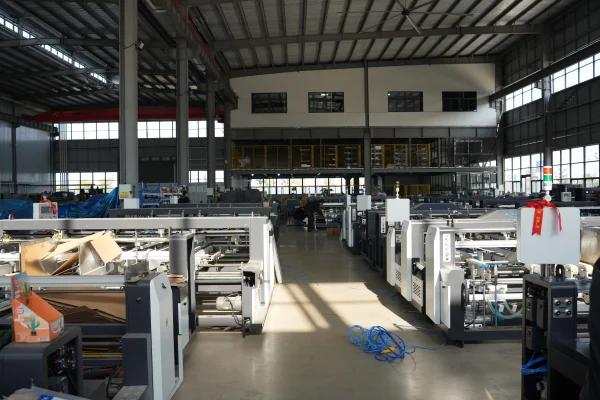
How Our Corrugated Folder Gluer Machine Applies This in Real Production
Our design philosophy is to let sensing and servo control share the work of positioning. In the splicing section, the guide plates are adjustable by lead screw with electric control, and a memory mode stores the settings for repeat jobs. When a customer returns to a carton size that has run before, the operator can recall the setting instead of rebuilding it by hand. This is particularly useful for corrugated plants that produce shipping cartons for online retailers, where the same dimensions recur across weekly orders.
The blocking material in the splicing section is controlled by four independent servo systems, so the carton is held and aligned in a steadier manner as it reaches the joint. For beverage, edible oil and household chemical cartons, which are often produced in long continuous runs, steadier alignment reduces how often the line must stop to correct a drifting blank. Operators can then focus on supervision rather than constant manual adjustment.
The electrical components supporting this detection are selected for dependable continuous operation. The optical switch in our standard configuration is from Schneider, working alongside a Delta PLC and servo system, so the sensing signals feed a control platform designed for consistent response. We describe these components as practical choices for industrial duty. Actual performance still depends on carton material, print surface, and how well the line is maintained.
It is worth noting that photoelectric detection is not a replacement for good machine structure. Sensing tells the machine where a sheet is, but the frame, belts and folding assembly must carry the sheet accurately in the first place. Our machine uses a 16 mm cold heat treated frame plate and independent motor drives in the folding section, with the left and right belts adjustable in speed, so the mechanical base supports what the sensors report. Detection and mechanics work together; neither compensates fully for a weakness in the other.
Building Corrugated Folder Gluer Machines Around Dependable Sensing
Accurate position and gap detection helps keep carton feeding synchronized, minimize sheet overlap and maintain a steady flow through each production stage. In a corrugated folder gluer machine, photoelectric sensors work alongside servo drives and mechanical components to support precise sheet handling from feeding and gluing to folding, conveying and stacking. The effectiveness of this coordination depends on how well these systems are matched to the cartons being produced. For manufacturers handling different box dimensions, board specifications or production speeds, choosing a machine with the right sensing and control configuration can make a measurable difference in daily operations.
 Application Scenarios