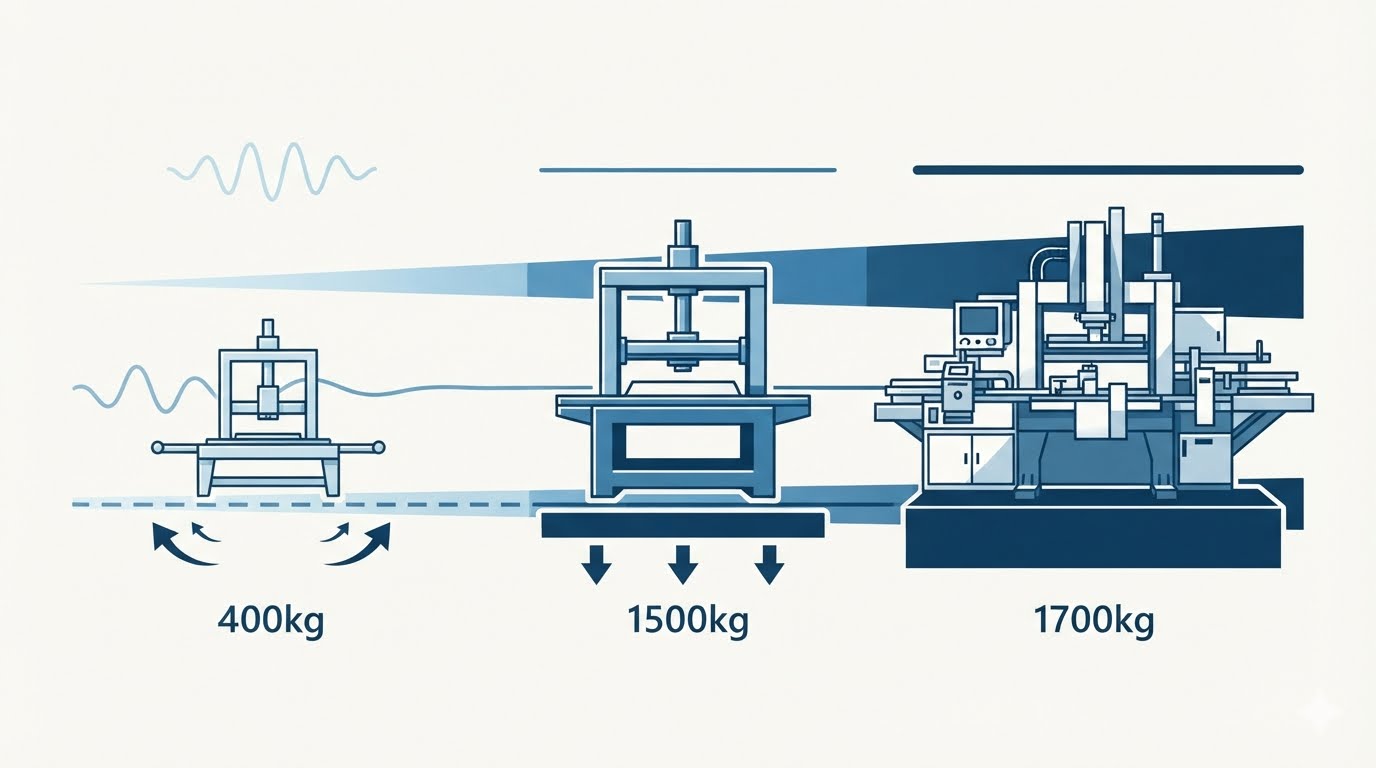


Cardboard above 200 gsm is widely used for rigid packaging, including gift boxes, product cartons and presentation boxes. Its greater stiffness and weight make feeding and tape placement more demanding than when working with thinner paper. An automatic multi-head double-sided tape applicator must handle each sheet steadily while keeping the tape in the correct position, ensuring consistent bonding without slowing down production.
What Sets Heavy Card Stock Apart
Stiffness is the first difference. A rigid sheet keeps its shape as it moves, which is an advantage at the pasting position, since the surface stays flat and the strip lies on a stable plane. The same rigidity means the sheet does not adapt to the belt, so grip depends on friction and not on flexibility.
Mass is the second. A heavier sheet carries more momentum, so it resists changes of speed and direction. At start-up, at a change of running speed or when a sheet enters at a slight angle, it is slower to correct itself, and the position error it picks up stays with it for the full length of the strip. Hard edges add a third factor, since they wear belts and guide surfaces more quickly than the soft edges of thin paper. These features explain why settings that suit light stock cannot be assumed to suit heavy board.
Where Feeding and Bonding Run into Trouble
Insufficient grip is the problem that appears first. When the feeding belt cannot hold a heavy sheet firmly, the sheet slips, drifts sideways or turns slightly, and the tape lands at an angle to the edge. Because long strips run the whole length of the sheet, a small angle becomes a visible offset at the far end.
Products with several strips raise a second difficulty. Card boxes, gift boxes and cartons often need tape at more than one position, and taping them in separate passes means loading, stacking and feeding the same heavy sheets repeatedly. Each pass adds handling effort and a new chance for misalignment, so the spacing between strips becomes harder to keep consistent.
Variety in the order book is the third. Heavy-board work often involves many sizes, tape widths and strip positions in a single week, and every change of board or tape calls for a new check of position. Where changeovers are slow, operators are tempted to shorten the check, and drift goes unnoticed until the cartons are formed. Inspection is a further challenge, because a stack of heavy sheets is awkward to sort through, and a fault found late can mean a large quantity of weighty material to handle again.

Stable Feeding and Precise Tape Placement on Heavy Card Stock
Cardboard above 200 gsm requires stable feeding and accurate tape placement throughout the pasting process. Our automatic multi-head double-sided tape pasting machines use high-friction feeding belts, coordinated PLC control and a multi-head layout to handle rigid cardboard as well as E, B and C flute corrugated board.
At the feeding section, high-friction belts help carry heavier sheets forward without unnecessary slipping or misalignment. Keeping each sheet on a straight, stable path helps maintain consistent tape placement along the intended edge. This is particularly important for long strips used in card boxes, gift boxes and corrugated cartons, where even a small deviation can affect subsequent folding, assembly or bonding.
The multi-head configuration allows several tape strips to be applied in one pass. Instead of feeding the same sheet through the machine multiple times, operators can position the required heads to match the product layout. Applying all strips along the same feeding path helps maintain parallel alignment and consistent spacing, while PLC control coordinates feeding, taping and collection for a more continuous production flow. This arrangement is especially useful for high-volume orders that require multiple adhesive strips on each sheet.
Quick adjustments also help reduce downtime between jobs. The adhesive head can be rotated at the press of a key, with tape changes taking approximately 30 seconds. After changing the tape or switching to a new product, operators can run test sheets and verify the strip positions against the production drawing before starting the full batch. On the triangle tape machine, lateral head positioning can also be adjusted with a handwheel and checked against a steel ruler, providing a practical reference when returning to a previously used setting.
At the collection stage, a separately driven fish-scale belt arranges finished sheets in an orderly overlapping sequence. This makes heavier cardboard easier to collect and allows operators to inspect tape placement as sheets leave the machine. If a strip begins to drift, the deviation can be identified early rather than after a large stack has accumulated. An optional counting function also helps verify batch quantities for orders with fixed sheet counts, reducing the need for manual counting.
These features support a range of packaging jobs, from long-strip applications on card boxes and gift boxes to tape bonding on corrugated cartons. They also accommodate other products, including envelope bags and document bags that require easy-tear tape strips. By combining stable feeding, multi-strip application and accessible adjustment, the machine helps packaging plants maintain consistent placement while managing different board formats and production volumes.
Matching the Machine to Your Board and Production Needs
Processing cardboard above 200 gsm calls for stable feeding, accurate tape placement and efficient changeovers. Our automatic multi-head double-sided tape pasting machines combine these functions with coordinated PLC control and orderly sheet collection, supporting a range of applications from card boxes and gift boxes to corrugated cartons, envelope bags and document bags.
Since material thickness, sheet dimensions and tape layouts vary between jobs, the suitable configuration depends on the board being processed and the required production output. Share your board weight, sheet size, tape specifications and typical batch quantities with our team, and we can recommend a machine configuration suited to your materials and production requirements.
 Application Scenarios