


Corrugated board is sold by flute type, and the letters A, B, C, E and F tell carton designers a great deal about strength, print surface and cushioning. These differences also affect folding and gluing performance. Each flute profile gives the board its own thickness, stiffness and creasing behavior, requiring a corrugated folder gluer machine to handle these properties consistently as each blank passes through the line. Choosing the suitable flute type and matching it to the folding process helps carton manufacturers achieve clean folds, reliable bonds and consistent carton quality.
What Flute Height Changes in the Board
The five standard flute types each occupy a specific performance band, and choosing the wrong one can cost a buyer in product damage, freight charges or print appearance. Height is the main variable, and the effects follow from it. Taller flutes, such as A, give board with high top-to-bottom compression and good cushioning, with relatively low flat crush. Thinner profiles trade cushioning for a smoother surface. Among them, B flute resists crushing well, offers an excellent printing surface, and scores easily, which suits automatic folding and sealing equipment. C flute sits between these, with almost twice the flat crush strength of B but less top-to-bottom compression strength. It is also the profile that carton makers meet most often, as C is the most frequently used flute in boards and boxes.
Double-wall constructions combine two profiles and change the picture again. An E-flute and B-flute pairing, for example, is described as giving a smooth printable surface together with added rigidity and impact resistance. For the folding line, the practical consequence is simple. Thickness, stiffness and surface character all vary from one board to the next, and each of them affects how the board behaves when it is scored, folded, glued and pressed.
Where Board Thickness Causes Trouble on a Folding Line
Equipment is usually tuned to a familiar board, and trouble starts when the board changes. One technical guide notes that many case erector lines are set up for standard C-flute single wall, and that changing caliper affects scoring, run speed and tooling. The same logic applies to folding and gluing. A thick board resists folding more strongly, springs back at the crease and can crush if pressing pressure is set too high. A thin board folds sharply but may show crease lines or surface marking if handled roughly, which matters for printed cartons. Glue behaves differently as well. Board thickness and surface change the contact area at the seam, and a glue line suited to one board can be too thin or too heavy on another.
Traditional manual and basic semi-automatic equipment leaves these adjustments to the operator. Pressure, guide position and glue volume are set by feel, so results depend on experience, and returning to a previous setting is largely a matter of memory. Printing and coatings add a further variable, because ink types, varnishes and barrier coatings can influence glue performance. Carton plants that run several flute types in one week therefore meet the same set of problems repeatedly: uneven folds, inconsistent seams and long resets between jobs.
Matching Flute Types to the Cartons They Usually Serve
Different flutes tend to serve different kinds of cartons, and each pairing places its own demand on the folding line. Fine flutes such as E and F are typical for retail and printed cartons, where surface quality matters and the folded result must look clean. B and C flutes cover most shipping cartons, which are produced in large volumes and judged mainly on seam reliability and consistent squareness. Thicker and double-wall boards appear in larger and heavier cartons. A-flute board, for instance, has been used for furniture, appliances and inner packing of various kinds.
The flute direction also matters in design. Specifiers note that flute orientation relative to load influences stacking and die-cut strength. A folder gluer does not change this orientation, but it must handle blanks in whichever direction the design requires. In every case the machine's role is the same. It does not choose the flute, the board grade or the carton style, which remain decisions for the carton maker and the customer. Its task is to fold and bond the chosen board consistently, so that a carton made today matches one made last month from the same specification.
How Our Corrugated Folder Gluer Machine Handles Changing Boards
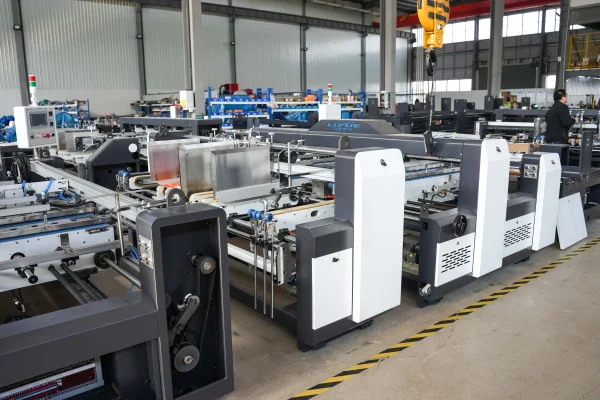
Changing boards is mostly a matter of changing settings, and this is where our machine's adjustment system earns its place. The guide plates are driven by electric leading screws with a memory function, so a board and carton combination that has been run before can be recalled from stored settings instead of being rebuilt by hand. For a plant that alternates between thin printed stock and thicker shipping board, stored settings reduce preparation time and keep results repeatable from one return to the next.
The gluing section supports the second half of the task. Adhesive is applied by mechanical rollers, and the machine can run hot glue or cold glue, with a spray glue system available as an option. Because boards of different flute types present different surfaces and bonding conditions, the carton maker can choose the method that suits each one, and the section's purpose is a glue line of steady thickness whichever board is running. At the splice, servo-driven belts and photoelectric guidance align the two boards, and hot and cold double coating with steel-ball board pressing reinforces the seam. These stages help larger cartons keep their shape, which becomes more important as board stiffness increases.
The suitability of a particular board for a particular machine depends on its caliper and construction, so carton makers should compare their intended boards with the machine's specifications before committing to production. Stable suction feeding at the entry and regular folding and patting at the exit keep each carton in a uniform condition throughout.
Keeping Results Consistent as the Board Changes
Flute type will keep shifting from order to order, and the corrugated folder gluer machine on the floor has to cope with each change without drawing on operator guesswork. Our design work centers on three points: stored guide settings that bring a familiar board back to a known setup, a choice of hot glue, cold glue or optional spray application, and servo-driven alignment at the splice for larger cartons. We manufacture the machine as one coordinated system, so that these features work together on every board a carton plant brings to it.
 Application Scenarios