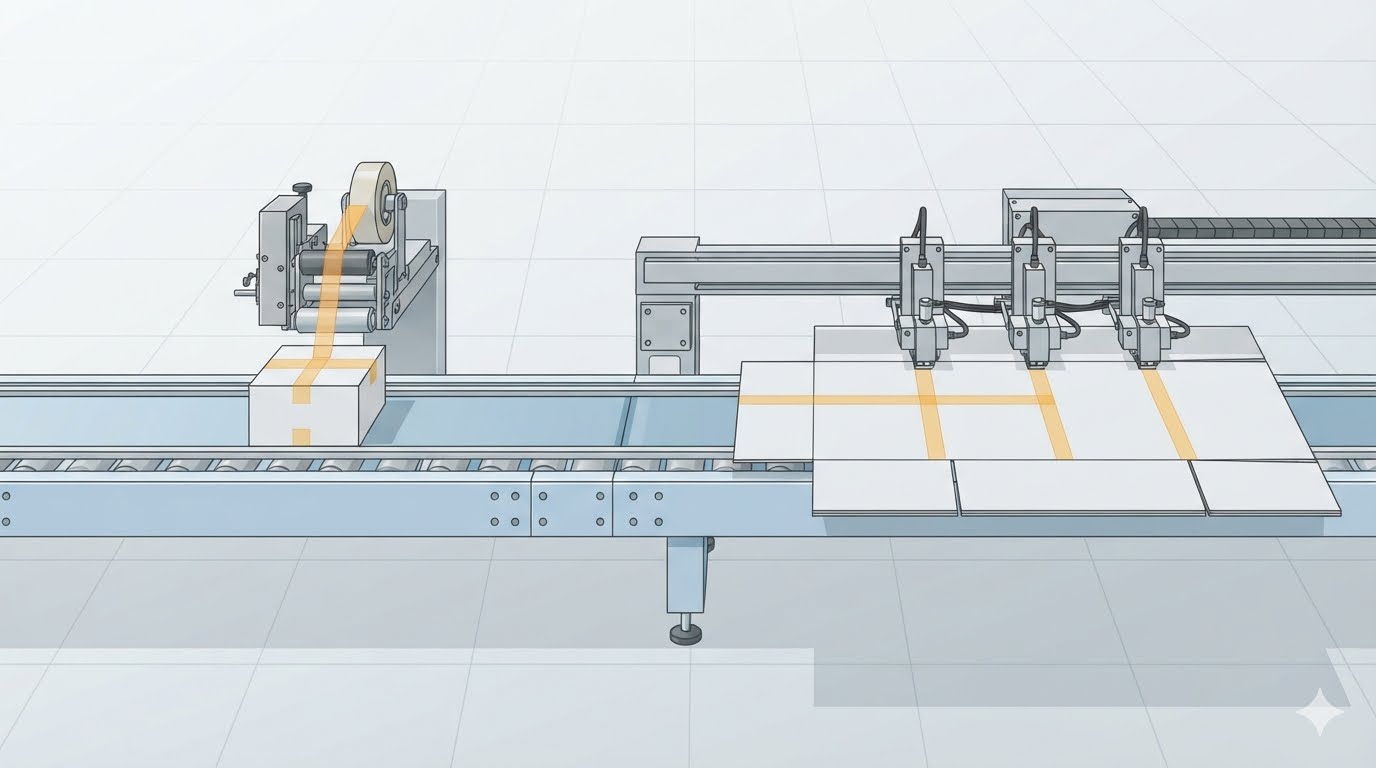


Tape application sits in the middle of the converting sequence for card boxes, cartons, envelope bags and document bags. Sheets arrive from cutting or printing, receive their double-sided tape, and move on to folding, forming and packing. Because later stages depend on what this station delivers, its pace and consistency carry through to the shipping date, even though the station itself rarely appears in a delivery schedule.
When a Small Taping Fault Becomes a Late Shipment
A tape strip that lands a few millimeters off its position seems minor at the machine. The consequence usually appears later, when the sheet is folded and the strip falls on a crease, protrudes from an edge or fails to close a flap evenly. By then, a full batch may already have passed through the station, and the affected sheets must be sorted out, reworked or replaced. The time spent on this is taken from the next order in the queue, so one fault delays more than one job.
Stoppages work in a similar way. Unstable feeding calls for frequent adjustment, and every tape change that takes longer than necessary subtracts minutes from the shift. Individually these pauses are short. Over a week of mixed orders, they add up to a meaningful gap between planned and actual output, which supervisors then try to close with overtime or a rushed final run.
Counting errors complete the picture. When quantity is checked by hand at the end of a run, a shortfall is discovered at packing, when the machine may already be set up for something else. A supplementary run then requires another changeover, and the delivery plan absorbs the delay. Conventional setups make all three problems more likely, since they rely on manual adjustment, on the experience of individual operators, and on inspection after the batch is finished.
How Stability Turns Into a Predictable Schedule
Delivery planning depends on predictability more than on peak speed. A line that runs at a steady rate with few surprises is easier to schedule than one that is faster on paper but frequently interrupted. Stable tape application supports this in three connected ways.
First, repeatable placement reduces the share of sheets that need rework. When feeding is smooth and the pasting position can be set and reproduced, the output of a shift matches the plan more closely, and downstream stations receive material they can process without sorting. Second, short changeovers add productive time. In workshops that run many sizes and tape types, changeover accounts for a visible share of the working day, and shortening it increases usable capacity without adding a machine. Third, checking and counting at the exit bring problems to light inside the batch. A drift in tape position seen on the first sheets can be corrected before the run is half finished, and a count taken at the moment of collection removes the surprise at packing.

What Our Machines Do for Production Planning
Our automatic multi-head double-sided tape pasting machines are built around exactly these three points, and each feature maps to a situation that production planners know well.
For large batches of envelope bags and document bags, the priority is a steady rhythm. A high-friction belt feeding system carries sheets forward smoothly and delivers them in an orderly way, while PLC control coordinates feeding, tape pasting and collection as a single sequence. The operator works with one connected process, and the pace set at the start of the run holds from the first sheet to the last. Easy-tear tape on a closing flap leaves little room for deviation, so a stable feeding stage matters most here.
For card boxes, gift boxes and cartons produced in many sizes and short runs, changeover speed is the deciding factor. The adhesive head on our machines rotates at the press of a key, so a tape change takes about 30 seconds. On our triangle tape machine, the head can also be moved left and right with a handwheel against a steel ruler, which gives operators a visible reference for repositioning when the next order has a different tape position. Shorter resets also make it easier for operators to recheck placement after each change, which protects the quality of the first sheets of every new job.
At the exit, a straight-out fish-scale collection belt delivers finished sheets in a tidy overlapping sequence. Staff can see tape placement as the sheets arrive and lift a batch without sorting a loose pile. An optional counting function is available for orders where batch quantity must be checked, so the count is known when collection ends and packing does not turn into a second inspection. This suits orders with fixed quantities and tight shipping windows, where a shortfall found late is expensive.
Taken together, these features give a production manager more control over the variables that move a delivery date. Feeding stability narrows the spread in placement, quick head changes protect available hours, and orderly collection with optional counting closes the loop at the end of the run. The result is a station whose output is easier to forecast, which is the practical meaning of stable tape application.
What a Dependable Tape Station Means for Your Schedule
Stable tape application comes down to a few connected points: smooth feeding keeps placement repeatable, short changeovers protect productive hours, and checking and counting at the exit keep problems inside a single batch. Each removes a known source of delay, and together they make a production schedule easier to plan and easier to keep.
Our automatic multi-head double-sided tape pasting machines are built around these points. A high-friction belt feeding system delivers sheets smoothly, PLC control coordinates the whole sequence, the one-key rotating adhesive head brings a tape change down to about 30 seconds, and the fish-scale collection belt, with an optional count, returns finished sheets in a tidy order. Our range covers several series and working widths for card boxes, cartons, envelope bags and document bags. If you are planning a new line or reviewing your current tape station, send us your products, sheet sizes, tape specifications and typical order pattern, and our team will suggest a configuration that fits the way you work.
 Application Scenarios