


The squareness of a two-piece carton is settled at the splice, where two boards meet and are glued into one blank. If their relative position holds until the adhesive takes, the carton comes out true. If the boards shift, the error stays in the box. Steel-ball board pressing is one of the elements of the splicing section that helps keep the boards in place, and its effect is easier to judge once the larger problem of squareness is clear.
Where Squareness Is Tested in Real Applications
Squareness matters because cartons are handled, stacked and filled by machines that expect consistent geometry. Appliance cartons show the stacking consequence most clearly. A carton for a major appliance must be strong enough for vertical stacking, often five or more units high, so that warehouse and vehicle space is used efficiently. When a carton leans, the load stops traveling straight down the walls. Packaging literature describes off-stacking, where forces no longer pass vertically through the corner posts, as a cause of crimped corners at best and a collapsing stack at worst. A box that leaves the folder gluer with a built-in twist starts every stack with a small lean, and that lean grows with height and storage time.
Automated packing lines raise a different concern. Industry guidance on case packing states that the squareness of a case is critical for proper conveying and palletizing downstream. A bagged food carton that is slightly out of square can slow an erecting or sealing station, even though the carton itself is structurally adequate. Printed gift cartons bring appearance into the picture. Seasonal tea and coffee sets, for example, are described as built from durable corrugated board and designed to be visually appealing and structurally reliable, and a skewed fold or an offset seam undermines both goals at once.
What Board Pressing Does at the Splice
At the splice, two boards travel toward a joint, receive adhesive and are brought together. Several things can disturb their position along the way, including slight board warp, friction against the conveying surface and the small forces created as the boards meet. A pressing element that holds the board gently against its path reduces the freedom of the board to lift or wander before the joint is made. Steel-ball board pressing is one way of providing that contact. In general terms, rolling steel balls apply downward pressure while allowing the board to keep moving, so the board is held without being dragged.
The contribution to squareness follows from this. With the boards held flat and steady, the servo-driven belts and photoelectric guidance can bring them into alignment and keep that alignment through the coating and joining steps. Pressing at the joint also helps the glued surfaces contact each other, which supports the bond itself. These effects are supportive and cumulative, so they are best described as helping squareness rather than guaranteeing it. The effect depends on board type, glue, machine settings and the condition of the equipment, and no single component controls the result on its own.
Other Factors That Affect Carton Squareness
The steel-ball pressing element plays an important role in the splicing section, but it is not the only factor that determines whether a finished carton is square. Blank quality also matters. If a blank is not cut accurately by the die-cutting machine, the edges may not align properly when the carton is folded. The folder gluer can help correct some alignment issues, but it cannot fully compensate for inaccurate blanks. Checking the dimensions and cutting quality before production helps prevent these problems from carrying through the line.
Machine settings also affect the final result. Guide positions, conveying speed and pressing pressure need to match the board thickness and carton design. A setup that works well for one carton may not produce the same results with another. Temperature, humidity and adhesive setting time can make a difference, too, as changes in board moisture affect how the material folds, while the glue needs enough time to hold the joint securely. Keeping these factors under control helps maintain carton squareness throughout production, with the splicing section working as one part of the overall process.
How Our Splicing Section Serves These Applications
Our corrugated folder gluer machine handles the splice as a coordinated group of functions. Two servo-driven belt conveyors carry the boards toward the joint, and photoelectric guidance supports accurate alignment as they meet. Steel-ball board pressing steadies the boards during the joining stage, and hot and cold double coating at the splice reinforces the seam where the carton carries its load. The guide plates are driven by electric leading screws with a memory function, so a known setup can be recalled when an order returns.
These features help address different needs on the production floor. Large appliance cartons need well-aligned joints and reliable bonding to withstand stacking during storage and transport. For food cartons running through automated packing lines, consistent carton dimensions help keep conveying and palletizing on track. Gift cartons produced for seasonal orders benefit from the guide plates' memory function, which allows operators to recall previous settings instead of adjusting the machine from scratch each time. The final result still depends on the carton maker's choice of board grade and adhesive, as well as the quality of the incoming blanks. With these factors properly matched, the splicing section can help maintain reliable carton shape and joint quality throughout the run.
A Folding Line Built Around Accurate Joints
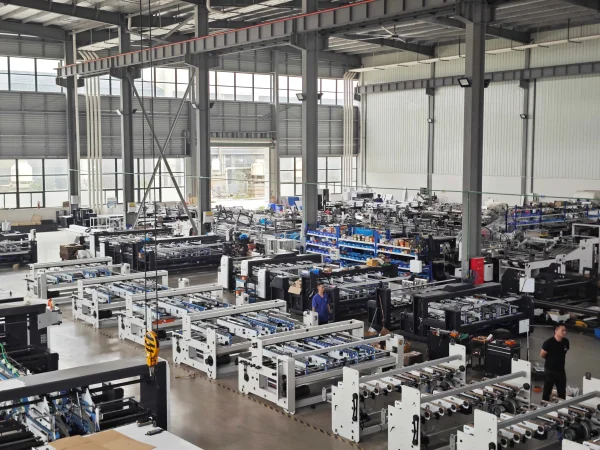
Carton squareness depends on how well the boards align, how firmly the splice holds and how consistently the machine handles each blank. Our fully automatic two-piece corrugated folder gluer machine brings these steps together, from stable suction feeding and accurate splicing to folding, patting and conveying, with hot or cold roller gluing and an optional spray glue system. We build our machines around the practical needs of carton manufacturers, helping them maintain reliable joints and consistent carton shapes across different orders. Our in-house design and manufacturing capabilities also allow us to provide equipment suited to real production requirements.
 Application Scenarios





