

Batteries, screws, wall anchors and similar small hardware are usually sold from retail display boxes that stand on a shelf or counter. Such a box is both a package and a piece of shelf fixture, so it must look orderly and keep its shape under the weight of its contents. Double-sided tape is widely used to join the flaps, trays and dividers of these boxes. How that tape is applied across a full production batch largely determines how uniform the finished boxes turn out.
What Retail Display Boxes Demand From a Tape Line
A display box faces the customer directly. A lid that sits slightly crooked or a tray that rides at an angle is noticed at once, and on a shelf of identical boxes, a single misaligned unit stands out. Tape position is therefore a visible quality factor rather than a hidden construction detail. It decides whether panels meet squarely, whether a front flap closes flush and whether the box reads as finished when it is placed on display.
Structure matters as much as appearance. Packs of cells and boxed fasteners can be dense for their size, and the load usually rests on the base panel and the internal dividers. The adhesive joints under that load need to be placed consistently, because a strip that sits too close to a fold or too far from an edge bonds less reliably than one set at the intended position. Display boxes also tend to be complex. A single blank may carry a hinged lid, an insert tray, a front retaining panel and sometimes a hanging tab, which means several tape positions on one sheet of board. Each position must hold its tolerance, and each must do so from the first blank of a run to the last.
Why Manual and Single-Head Methods Struggle With Batch Volume
Manual taping suits prototypes and very short runs. In a long batch, the position of every strip depends on the operator's eye and hand, and small variations accumulate as attention drifts. The consequences usually surface later, as flaps that do not seat evenly, and they often lead to sorting, rework or rejected lots rather than a problem caught at the source.
Single-head equipment brings better repeatability for each individual strip, yet it leaves the multi-position problem untouched. A blank that needs four strips has to pass through the machine several times, or the head has to be reset between strips. In a batch of thousands, those extra passes add up to extra handling, extra time and additional opportunities for misregistration. Changeovers compound the delay. Battery and hardware brands typically sell many sizes and pack counts, and the display boxes follow suit, so a line that needs a lengthy re-setup for each variant loses capacity every time the product mix changes.
| Production Aspect | Manual Taping | Single-Head Machine | Multi-Head Machine |
|---|---|---|---|
| Strips Applied per Pass | One, by hand | One | Several together |
| Position Consistency Over a Batch | Depends on the operator | Sound per strip, cumulative across passes | Fixed within a single pass |
| Effort for Multi-Position Blanks | High | Repeated passes | One pass |
How Retail Packaging Requirements Have Evolved
Retail assortments have widened. A single battery brand may offer several chemistries and pack sizes, and a hardware supplier may carry dozens of fastener types, each needing its own display carton. The outcome is a growing number of box styles, run in smaller and more frequent batches than a decade ago. Packaging converters respond to this by looking for equipment that changes over quickly while keeping results stable from one order to the next.
Retailers also expect consistency across a product line. When several boxes from one range are placed side by side, differences in closure and panel alignment become obvious, and buyers who manage large shelf programs increasingly treat that uniformity as part of packaging quality. At the same time, converters are under pressure to raise output per shift without letting quality slip. These demands point toward processes that remove manual judgement from the repetitive steps and make tape placement a settings-driven, repeatable operation.
Putting a Multi-Head Machine to Work on Battery and Hardware Boxes
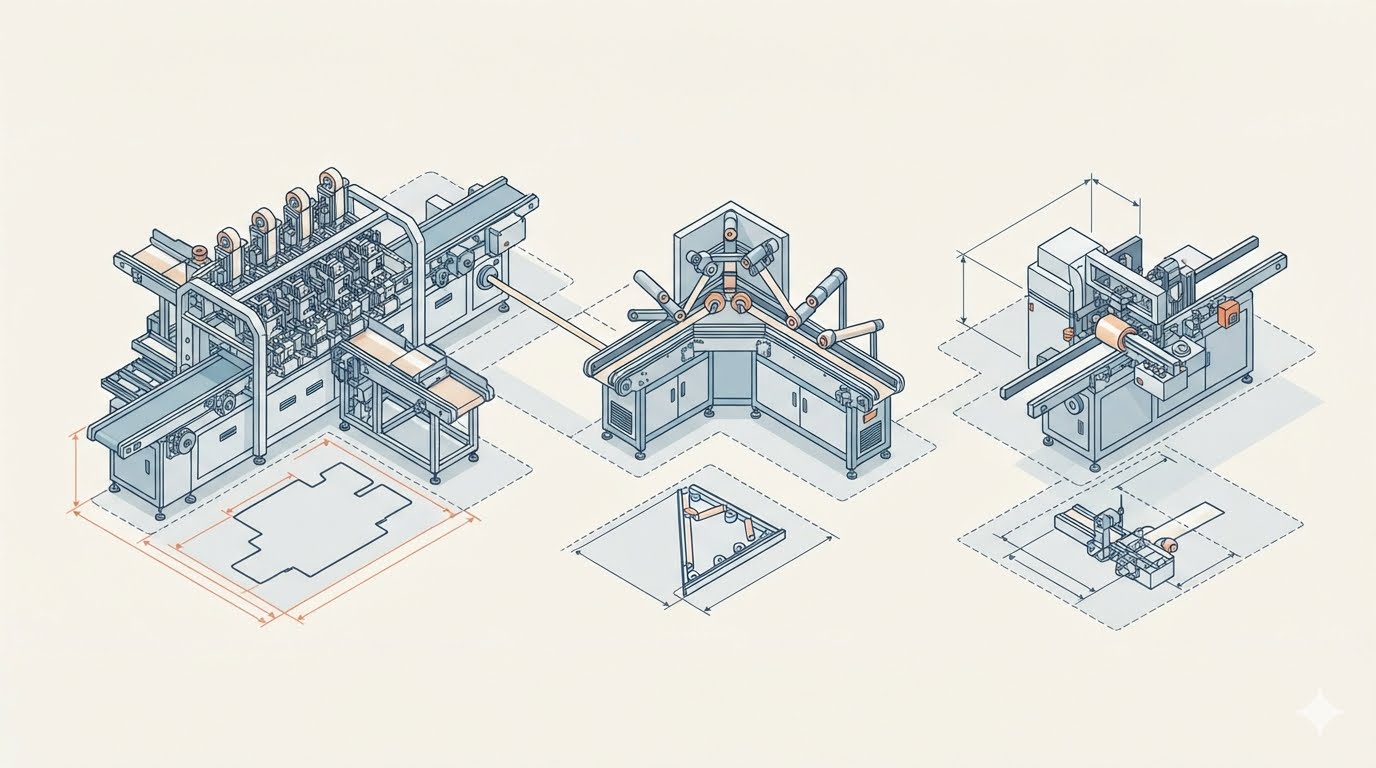
An automatic multi-head double-sided tape pasting machine answers the batch problem by changing what happens in a single pass. Several tape heads act on the blank together, so the strips for a lid flap, an insert tray and a front panel are applied in one movement. The blank is fed once, the distance between strips is fixed by the machine, and the same arrangement is repeated for every sheet that follows. For a display box with several bonding points, this removes the cumulative error that multiple passes create and keeps the batch uniform from start to finish.
Material range is the second consideration. Display boxes for hardware and multi-packs are often made from corrugated board or heavier cardboard so that they can carry their contents, and the machine is built to feed and tape those grades, including the common flute types, along a conveyor that keeps the sheet moving steadily. Tape is applied lengthwise in the direction of travel, and the width range is broad enough to cover both narrow strips for edge joins and wider strips for load-bearing panels.
Changeover is the third. Because head positions are adjusted to the box style, a switch from a compact battery carton to a deeper hardware tray is a matter of resetting the heads rather than rebuilding the process. That suits converters who run many box styles for the same customer. The machine works on flat blanks, so it sits ahead of the folding and gluing stage, and its job is to make sure the adhesive is in the right place before the carton takes shape.
Matching the Machine to the Display Box
Retail display boxes for batteries and small hardware combine visible quality requirements, load-bearing joints and a steady stream of new box styles. A multi-head tape pasting machine fits that combination because it reduces passes, holds strip positions across a batch and adapts to the board grades these cartons use. We build our machine as part of a broader family of tape pasting equipment, with triangle, semi-automatic and manual machines alongside the multi-head version, so each box type can be paired with the right level of automation.
For a converter planning a display box line, the useful starting points are the number of tape positions per blank, the board grade and the typical batch size. Those three factors show quickly whether a multi-head line is the right step. Our team can go through them with you and discuss how the machine would work with the carton styles you run.
 Technical Encyclopedia