

Double-sided tape is a pressure-sensitive adhesive, and its bond depends largely on how firmly it is pressed onto the substrate. On a double-sided tape applicator, the pressing roller is the last component to touch the tape before the sheet leaves the pasting position. Its setting influences whether the tape lies flat, stays in place and holds after the carton is folded, stacked and shipped.
Where Hand-Set Pressing Falls Short
Many workshops still adjust the pressing roller by feel, or press the tape by hand after placement. This approach offers no repeatable reference. Two operators, or the same operator on two shifts, can arrive at different pressures for the same job. Roller surfaces also wear and pick up dust or adhesive residue, and the effect on pressure across the sheet width is seldom visible until the tape begins to fail.
The resulting faults are familiar. Too little pressure leaves partial contact, which appears as lifted tape ends, curling edges or air channels beneath the tape. Too much pressure crushes the flutes of corrugated board, leaves impressions on the print side and squeezes adhesive past the tape edge. On wide sheets with several tape positions, uneven pressure between heads allows one strip to hold while another lets go. Because these defects often surface only after cartons are folded or stacked, they are usually found late, when rework costs more than an adjustment at the machine would have.
A Practical Method for Setting Roller Pressure
A sound procedure begins with the materials. Before changing the roller setting, confirm the board type (rigid cardboard, or E, B and C flute corrugated board), the surface (plain, coated or laminated) and the tape type (soft or hard adhesive, standard or easy-tear). Dusty, oily or damp surfaces weaken the bond regardless of pressure, so they should be dealt with first.
Next, start from a light setting and run a few sheets. Raise the pressure in small steps until the tape shows even wet-out across its full width, with no silvery air channels and no flute crush when the reverse side or a cross-section is inspected. Peel a sample after a short rest, then test again after a longer interval, since adhesion keeps building for a day or more. A tape that peels easily at once but holds well after resting does not necessarily point to a pressure fault. Recording the final setting for each board and tape pairing turns a one-time adjustment into a reference for later jobs.
| Board or Application | Suggested Starting Direction | What to Check |
|---|---|---|
| Rigid cardboard and card stock | Moderate pressure, raised gradually | Full wet-out, flat tape edges |
| Corrugated board | Lighter start, small increments | Flute crush on the reverse side |
| Coated or laminated surfaces | Moderate pressure, clean the surface first | Adhesion after a rest period |
| Envelope and bag flaps with easy-tear tape | Enough to bond without hindering the peel | Peel feel when the tape is opened |
On a multi-head machine, each pasting head should be checked on its own, including positions near both edges of a wide sheet. Routine care supports the same goal: keep roller surfaces clean, inspect them for wear at regular intervals, and let board and tape reach workshop temperature before production starts.
How Our Machines Support Stable Pressing
Steady pressure only helps if the sheet reaches the pasting position in a steady way. Our automatic multi-head double-sided tape pasting machines use a high-friction belt feeding system, designed so that sheets travel smoothly and arrive square to the feed direction. A pressing roller performs best on a sheet that is already well aligned, which makes feeding quality the foundation of consistent results.
Changeovers are where settings are most often disturbed. The adhesive heads on our machines rotate through 45 degrees at the press of a key, so a tape change takes about 30 seconds. On our triangle tape machine, the adhesive head can also be moved left and right with a handwheel against a steel ruler, with positioning accuracy down to 0.5 mm. Short changeovers make it easier to run a pressure check after every material or tape change, because the check no longer costs a long stoppage.
Output handling also supports quality control. Our multi-head machines can be fitted with a straight-out fish-scale collection belt, which delivers sheets in a neat sequence and lets staff see tape placement as the sheets arrive, with an optional counting function for batch tracking. These features suit the products our customers make, including card and gift boxes with long tape strips, corrugated cartons, and envelope or document bags that use easy-tear tape on the closing flap.
Matching a Double-Sided Tape Applicator to Your Production Needs
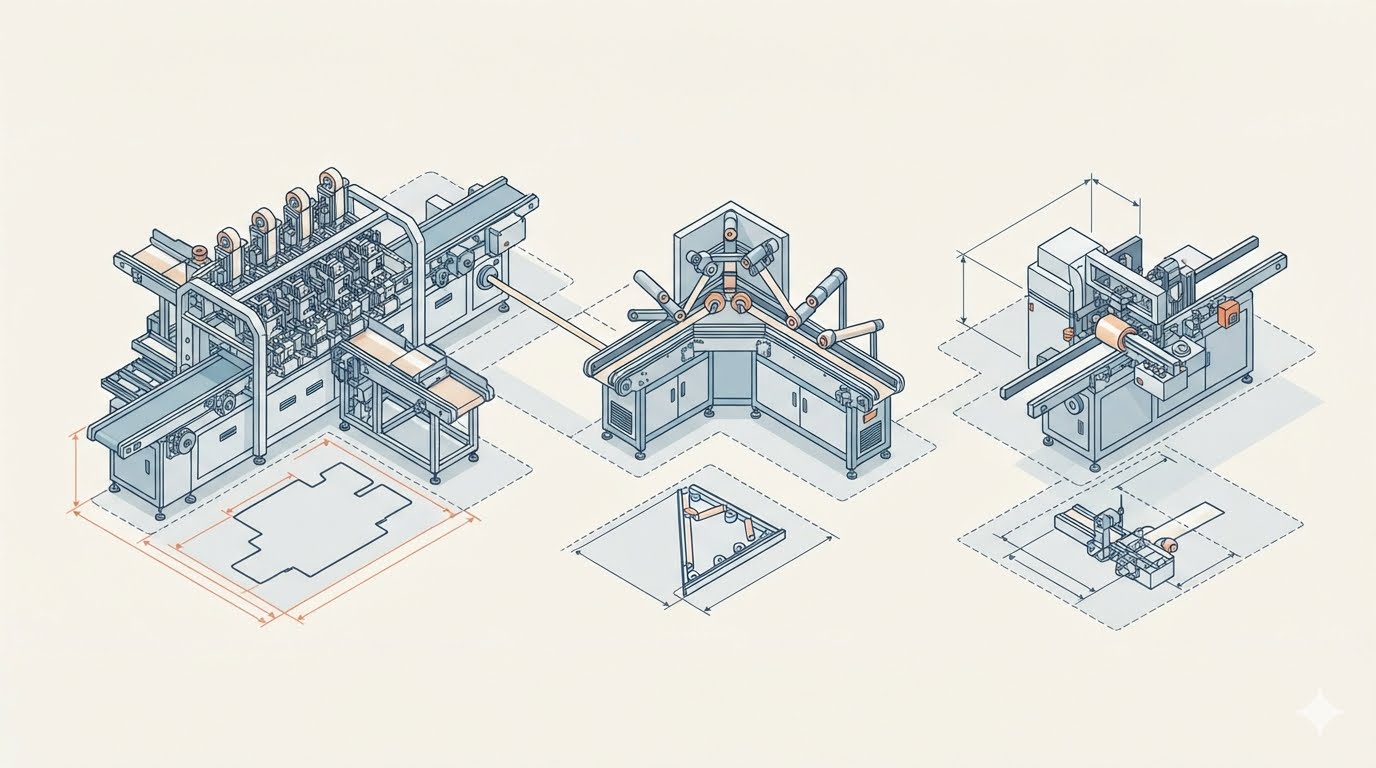
Choosing a machine starts with the materials and the finished product. Board type and thickness, sheet dimensions, tape width and tape position all affect which configuration will work best. Our range includes automatic multi-head machines for larger sheets and triangle tape machines for corner and flap applications, with different working widths available in each series. This makes it easier to find a suitable model for cardboard, card boxes, corrugated cartons, envelope bags and document bags, whether production involves one product type or a mix of orders.
In daily production, feeding, tape changes and sheet collection all affect how smoothly the machine runs. The high-friction belt feeding system helps keep sheets moving steadily and aligned at the pasting position. The one-key rotating adhesive head makes tape changes easier when switching between jobs, while the fish-scale collection belt arranges finished sheets in sequence for convenient checking and handling. These features help operators maintain consistent tape placement without adding unnecessary steps to the production process.
We build our double-sided tape applicators with different materials, sheet sizes and taping requirements in mind. If you are choosing a new machine or looking to improve an existing taping process, share your board specifications, sheet dimensions and tape type with our team. We can help you compare suitable models and find a configuration that works for your products and production needs.
 Application Scenarios