

Disposable paper cups and cutlery are commonly packed in corrugated cartons for storage, transport and distribution. These cartons need accurately positioned adhesive strips to ensure that flaps and panels align properly during folding and closure. Although tape application is only one stage of carton production, inconsistent placement can affect the finished box. A multi-head double-sided tape pasting machine allows several strips to be applied in one pass, helping manufacturers maintain consistent positioning across production runs.
Why Tape Placement Matters in Disposable Cup and Cutlery Cartons
Tape placement directly affects how a carton folds and closes. If a strip sits too close to a crease or too far from the intended bonding area, the flap may not align properly with the adjoining panel. Depending on the carton design, this can leave uneven edges, interfere with closure or reduce the effective bonding area.
Carton quality also matters during storage and distribution. Paper cups are usually packed in nested stacks, while disposable cutlery may be grouped into sets or bundles. Once packed, cartons are stacked, loaded and moved through distribution facilities. Poorly positioned tape can contribute to weak or uneven joints, although the overall result also depends on board quality, carton design and adhesive performance.
Different product formats require different carton layouts. A box for disposable cups may have different dimensions and closing flaps from one used for forks, spoons or mixed cutlery sets. Each layout can require its own tape positions, making flexibility important for packaging plants handling multiple product specifications.
Where Manual and Single-Head Taping Fall Short
Manual tape application can work well for prototypes, small orders and frequently changing carton designs. However, consistent positioning across a large production run depends on operator alignment and handling. When several strips must be applied to one blank, each additional placement creates another opportunity for variation.
A single-head double-sided tape pasting machine provides more controlled application, but cartons requiring several strips may need multiple passes or adjustments between applications. Repeated feeding takes additional time and introduces more opportunities for positioning errors. Handling the same corrugated blank several times can also complicate alignment, particularly when the sheet is wide or difficult to manage.
Changeovers add another consideration. When production switches between cup sizes or cutlery packaging formats, tape positions may need to be reset. A multi-head machine can apply several strips in one pass when the carton layout matches the head arrangement, reducing repeated handling and repositioning.
| Taping factor | Manual application | Single-head machine | Multi-head machine |
|---|---|---|---|
| Tape placement | Depends on operator alignment | Controlled per pass | Several positions applied in one pass |
| Repeated feeding | Depends on the number of strips | May be required | Reduced when the layout suits the setup |
| Position consistency | Can vary between blanks | Depends on handling across passes | Supports repeatable placement within one pass |
| Changeovers | Manual repositioning | Head or feed adjustments | Multiple heads can be adjusted for new layouts |
Packaging Requirements for Disposable Food Service Products
Disposable food service products come in different pack sizes and carton formats. Paper cup cartons vary according to cup capacity and order quantity, while cutlery packaging depends on the combination and quantity of utensils. Packaging manufacturers must accommodate these differences while keeping folding and closure quality consistent.
Cartons with aligned flaps and properly formed edges are easier to stack and handle. Achieving this result depends on several stages, including die-cutting, tape application, folding and bonding. Tape placement is one part of the process that can be standardized through a defined machine setup.
Repeatable application also helps quality teams inspect production samples. Once a suitable tape layout has been established, operators can check whether each strip remains aligned with the specified reference edges and fold lines. This makes placement easier to monitor than a process relying entirely on visual judgement during manual application.
How a Multi-Head Double-Sided Tape Pasting Machine Improves Placement
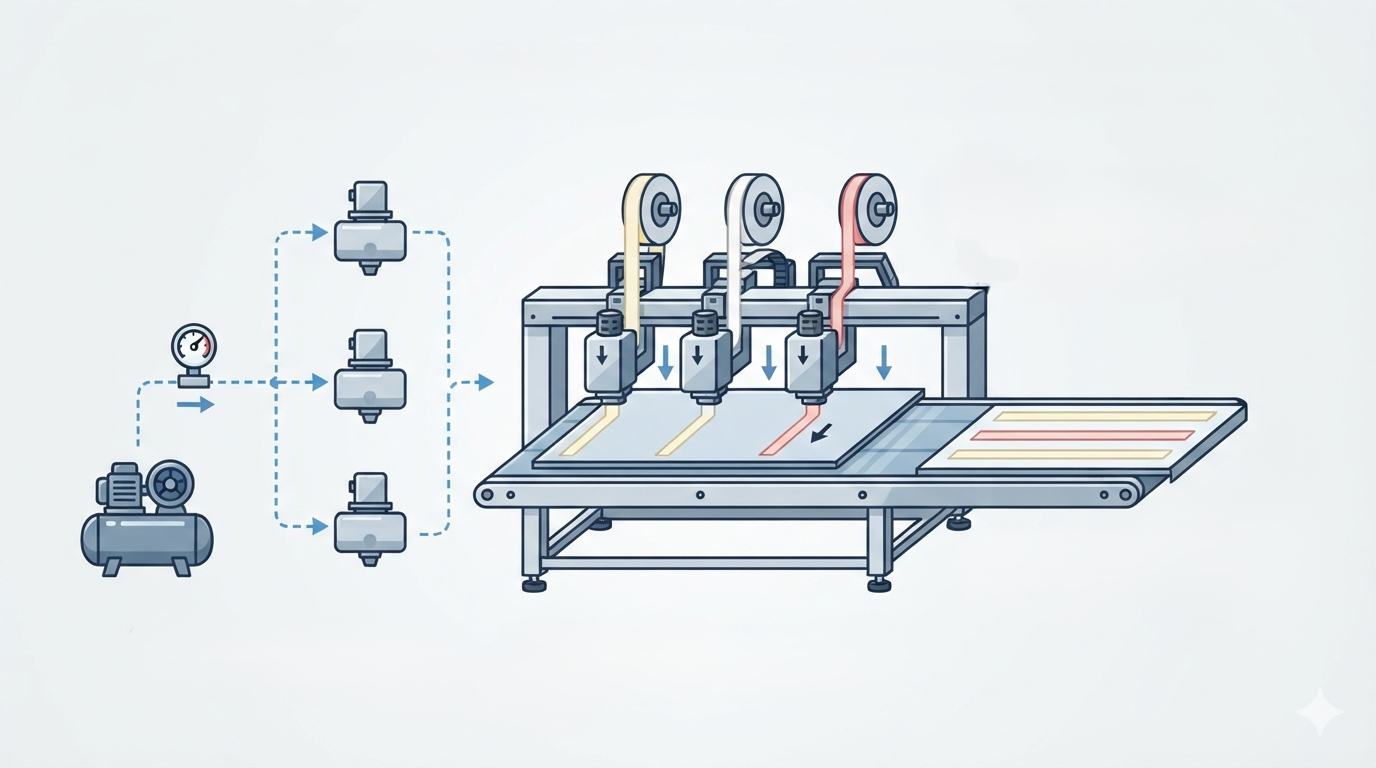
A multi-head double-sided tape pasting machine applies several tape strips to a flat paperboard blank during one pass. For disposable cup and cutlery cartons, the heads can be positioned according to the required bonding areas and carton design. Applying multiple strips in the same pass reduces repeated feeding and helps limit positioning differences caused by handling the blank several times.
Stable board transport is equally important. The conveyor supports the sheet as it moves through the application area, while proper feeding and alignment help maintain the relationship between the board's reference edge and each tape position. Results also depend on board flatness, dimensions and machine settings.
The machine can process suitable corrugated board, including commonly used E-, B- and C-flute materials, provided the board falls within its working range. Since flute structures and thicknesses differ, the actual material should be checked against the machine's specifications before production.
Tape width and head position must also match the carton layout. Different bonding areas may require different tape widths, depending on the available surface and the intended application. Adjustable head positions allow the setup to accommodate different carton formats. The time required for a changeover depends on the machine configuration and the extent of the layout change.
For production teams, the main advantage is a simpler application sequence. Once the heads are set, several strips can be applied in one pass, reducing repeated handling and providing a consistent setup for quality checks. The machine handles tape application on flat blanks before subsequent converting operations; it does not replace printing, die-cutting, folding or carton assembly.
Our Double-Sided Tape Pasting Machine for Cup Cartons Production
Our multi-head double-sided tape pasting machine is designed for packaging manufacturers applying tape at multiple positions on disposable cup cartons, cutlery cartons and other corrugated packaging blanks. We focus on practical production needs, including board dimensions, tape layout, feeding stability and adjustments between carton formats.
We manufacture a range of double-sided tape pasting machines, including manual, semi-automatic and automatic models for different applications. The appropriate configuration depends on the number of tape strips required, board construction, production volume and changeover frequency. Matching the equipment to the carton layout helps manufacturers establish a taping process that is easier to repeat and inspect across different packaging orders.
 Technical Encyclopedia