


Cycling helmet boxes often require large paperboard blanks to accommodate the helmet’s shape and provide enough room for protective inserts. Made from corrugated board or heavy cardboard, these cartons need to hold their shape during retail display and shipping. Double-sided tape is commonly used to secure flaps, reinforce bottom panels, and fix inner supports. With larger blanks, accurate tape placement becomes more important, as even small deviations can affect how the carton folds and fits together.
Why Large Helmet Boards Are Hard to Tape Accurately
Tape application looks simple on a small carton. On a helmet box, three conditions make it considerably harder. The first is sheer surface. A wide blank has a long unsupported span, and as it travels through a machine it can drift sideways or sag between the supports. A deviation that is invisible on a small blank becomes a visible misalignment when the board is large, because the tape sits further from the reference edge and any small angular error is magnified over the distance.
The second condition is material. Helmet cartons are frequently made from corrugated board in E, B or C flute, or from cardboard of substantial weight. These boards are stiff and slightly uneven across the flute direction, so the tape must be pressed on firmly and evenly to bond reliably. A strip that is only partly seated may look acceptable at the production line and then lift at a flap edge once the box has been folded, packed and handled.
The third condition is structural variety. A single helmet carton may need tape on a closing flap, along a lock-bottom panel and on an interior fixing tab, and the layout changes from one helmet model to the next. The result is a board that needs several strips in several positions, each of which has to be placed with consistent spacing from the folds and edges. The difficulty of large-board taping lies less in any one strip than in holding all of them to tolerance across a wide, heavy sheet.
Where Manual and Single-Head Taping Fall Short
Manual taping is still used for short runs, and it has a place there. Its limitation appears as soon as the board is large. An operator has to align a long strip against a wide panel by eye, and the consistency from the first blank to the thousandth depends on attention and fatigue. Variation in strip position tends to show up later, when flaps are glued or folded and the carton no longer closes squarely.
Single-head equipment improves repeatability but leaves a different problem. When a carton needs several strips, the blank must pass through the machine more than once, or the head must be repositioned between strips. Each additional pass adds handling time, and each repositioning introduces a new opportunity for error. On a large blank, handling itself becomes a burden, since the boards are awkward to stack, turn and feed again. Changeovers add further delay. Helmet cartons change with every model refresh, and a process that needs lengthy adjustment for each new layout slows the line precisely when the product range is widening.
| Process Aspect | Manual Taping | Single-Head Machine | Multi-Head Machine |
|---|---|---|---|
| Strips Placed per Pass | One, by hand | One | Several at once |
| Position Consistency | Depends on operator | Good per strip, cumulative across passes | Held within a single pass |
| Handling of Large Blanks | Frequent | Repeated | Minimal |
Changing Packaging Demands in the Cycling Helmet Market
Helmet packaging now serves two audiences at the same time. In a store, the carton is part of the presentation, so panels must sit flat and edges must close cleanly. In e-commerce, the same carton has to withstand sorting, stacking and transit, which places more demand on every adhesive joint. A tape line that was acceptable when cartons only had to reach a shelf is less forgiving when they also have to reach a doorstep intact.
Product ranges have widened as well. Brands commonly offer road, mountain, urban and youth helmets, each in several sizes, and the cartons differ accordingly. This favours production lines that can switch between layouts without a long adjustment period. It also favours equipment that places tape in the same positions every time, because consistent bonding is easier to verify and easier to defend when a customer asks about carton quality. Packaging buyers increasingly ask for repeatable results rather than for speed alone, and a process that depends on manual judgement is harder to describe in those terms.
How a Multi-Head Machine Handles Large Helmet Box Blanks
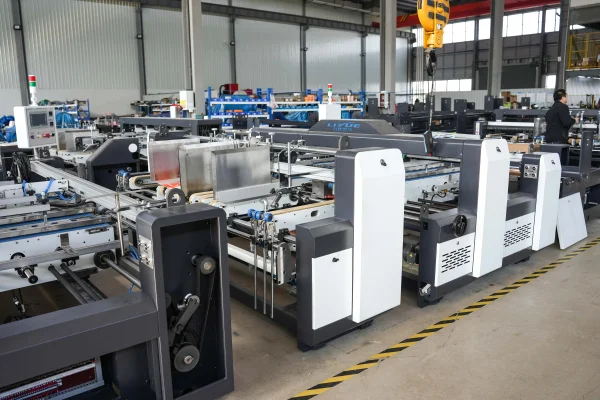
An automatic multi-head double-sided tape pasting machine can apply several tape strips to a large helmet box blank in a single pass. Depending on the carton design, different heads can apply tape to flaps, bottom panels and inner tabs without requiring the board to be fed through the machine multiple times. The head positions are set to match the required tape layout, helping maintain consistent spacing and reducing alignment errors during repeated handling.
Supporting large blanks is another important part of the process. A long conveyor keeps the board moving through the machine, helping it remain properly supported during tape application. The machine can handle suitable corrugated board and heavy cardboard used for helmet packaging, while adjustable tape heads accommodate different strip widths. This makes it possible to apply narrower strips to smaller joining areas and wider strips where the carton design requires more adhesive coverage.
For production teams, applying multiple strips in one pass simplifies the workflow. Operators do not need to repeatedly reposition and feed the same large blank to apply tape at different locations. When the carton layout changes, the tape heads can be adjusted to suit the new positions. Once the setup is correct, the same arrangement can be maintained throughout the production run, helping keep tape placement consistent from one blank to the next.
The machine handles tape application on flat blanks before the cartons move on to folding and gluing. It does not replace the folder gluer or complete the carton-forming process. Instead, it prepares the board for subsequent operations by placing double-sided tape where the design requires it. Accurate placement at this stage helps prevent problems such as misaligned joins, poorly secured flaps and interference with later folding operations.
Handling Large Blanks in Cycling Helmet Box Production
Large cycling helmet boxes often require several tape strips across a single blank, making accurate placement and efficient handling important to the production process. Our automatic multi-head double-sided tape pasting machine applies multiple strips in one pass, helping packaging manufacturers maintain consistent tape positions while reducing repeated feeding and manual repositioning. Adjustable tape heads also make it easier to accommodate different carton layouts as product sizes and packaging requirements change.
Our automatic multi-head double-sided tape pasting machine is built to handle the large blanks and multiple tape positions common in cycling helmet box production. Our equipment focus on stable feeding, flexible tape-head adjustment and consistent application across different carton layouts. Whether your production involves wide corrugated sheets or frequent changes in box specifications, we can help you identify a suitable machine configuration for your materials and taping requirements.
 News