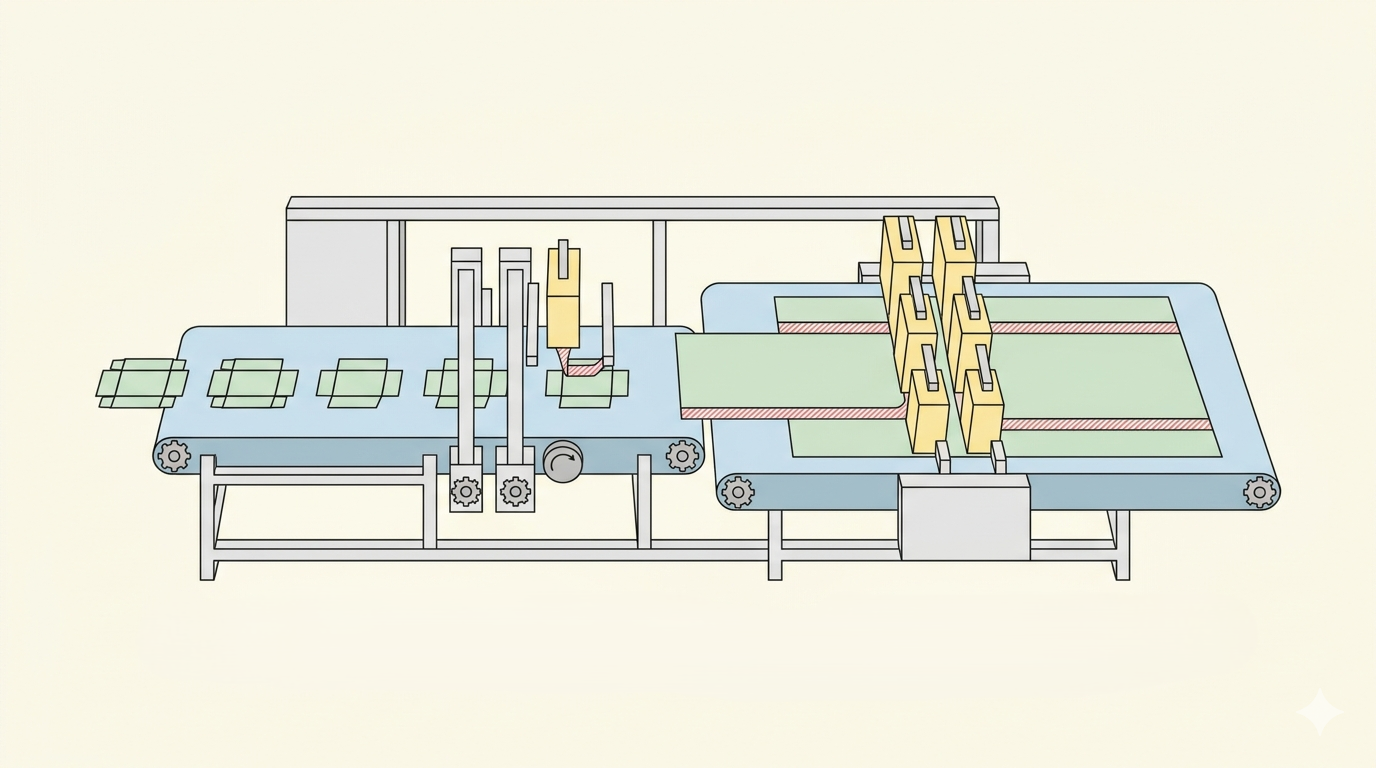
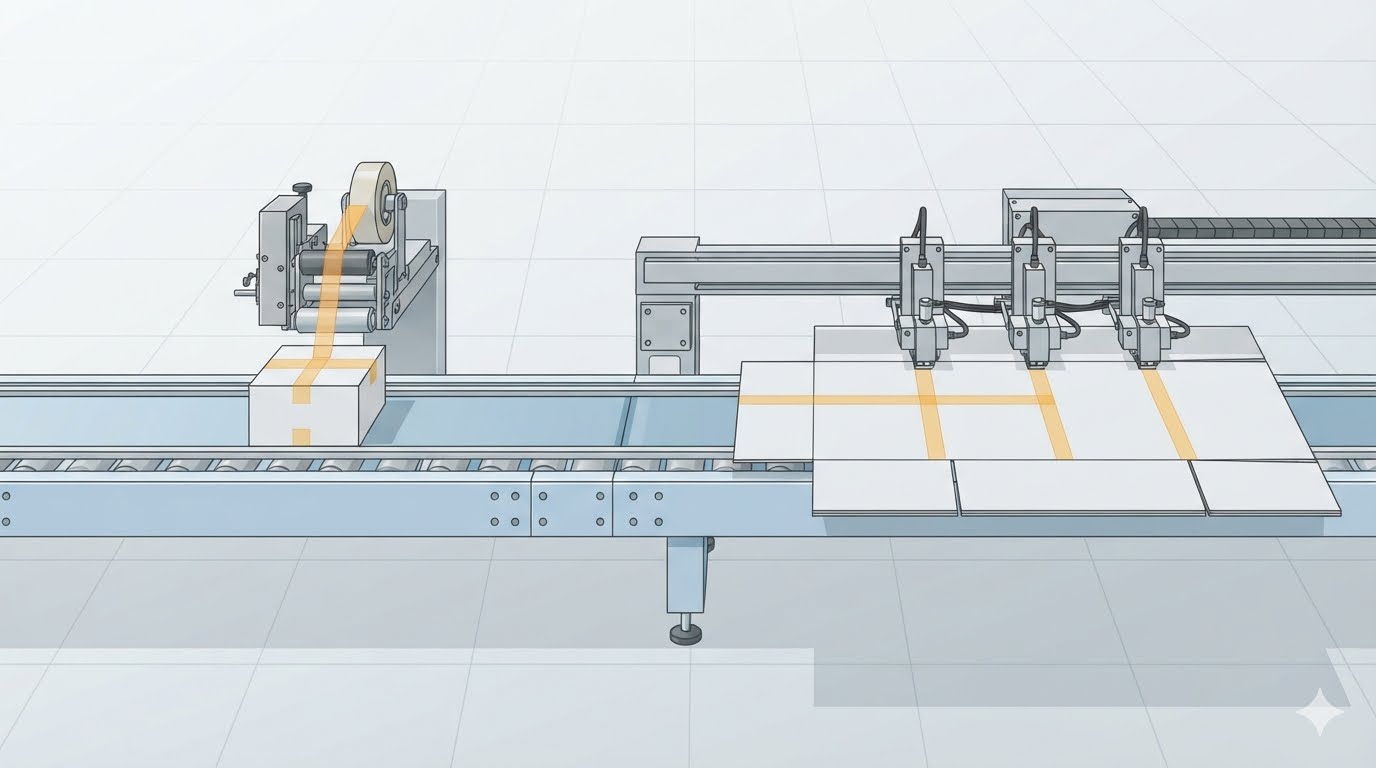
A multi-head double-sided tape applicator needs a suitable power supply to run properly. Before installation, it is worth checking whether the workshop’s electrical system matches the machine’s requirements, including the number of phases, voltage, frequency and total power consumption. Getting these details right beforehand helps avoid installation delays and unexpected electrical work.
What Three-Phase Supply and Total Power Mean in Practice
Three-phase alternating current is delivered through three live conductors, each carrying a voltage offset in time from the others. This arrangement suits motors and other larger loads, which is why most converting machinery uses it. The supply type should be read together with voltage and frequency, since all three must match the workshop supply. A match on voltage alone is not enough, because a 50 Hz machine connected to a 60 Hz supply, or a three-phase machine connected to a single-phase line, will not run as designed.
Total power is a different kind of figure. It expresses the electrical power the machine draws when its sections operate together, and it is used to judge whether the supply, the distribution board and the cabling have enough capacity. The value differs between models, so it should always be taken from the data sheet of the model being ordered. The workshop supply also varies by region, and even within one factory a distant hall may be configured differently from the main building, so the data sheet should be read against the real supply and not against an assumption of what is normal locally.
Where Electrical Mismatches Cause Trouble
Mismatches usually show up in one of three ways. The first is a basic incompatibility of voltage, frequency or phase count. The machine either fails to start or runs in a way that stresses its electrical components, and the remedy is far easier to arrange before the order is finalized than after delivery.
The second is insufficient supply capacity. A line or protective switch sized too closely to the machine's total power may trip under load, or the voltage may drop when other equipment starts. Intermittent stops of this kind are hard to diagnose, and each one interrupts a run and can disturb the tape placement on sheets in progress.
The third is incorrect earthing or phase sequence. Poor earthing is a safety risk and can introduce electrical noise into control circuits, while a reversed phase sequence can make a motor turn in the wrong direction. These issues are not unusual in new installations, and all of them are avoidable with a short check done in the right order.
A Practical Order for Checking the Workshop Supply
A sensible check starts with the data sheet. Confirm the phase count, voltage and frequency stated for the model and compare them with the supply at the intended location. If any of the three differs, raise it with the manufacturer before delivery.
Using the stated total power, a licensed electrician can confirm that the supply line, distribution board and protective devices suit the machine together with the other loads on the same circuit. Cable size and switch ratings depend on cable length, installation method and local code, so we leave generic figures out and leave them to the electrician. For general reference, the standard IEC 60204-1 describes electrical equipment of machines.
What Our Machines Deliver Once the Power Is in Place
A correct supply is the starting point, and what the machine does with it is what matters in daily production. Our automatic multi-head double-sided tape pasting machines are built so that every section of the line works toward the same result: tape in the right position, on every sheet, at a steady pace.
Production begins at the feeding section, where a high-friction belt system moves sheets smoothly and delivers them in an orderly way. Stable feeding is the foundation of accurate tape placement, and it is the reason our machines handle cardboard, card stock, corrugated board, envelope bags and document bags with the same consistency. The whole sequence runs under PLC control, which coordinates feeding, tape pasting and collection as one process, so operators work with a single, connected system and not three separate stations.
Changeovers are where many lines lose time, and our adhesive head design is aimed at exactly this. The head rotates at the press of a key, so a tape change takes about 30 seconds. For workshops that run many sizes and tape types in a week, shorter changeovers mean more of the shift is spent producing. On our triangle tape machine, the adhesive head can also be moved left and right with a handwheel against a steel ruler, which gives operators a clear reference when repositioning for a new product.
At the exit, a straight-out fish-scale collection belt delivers finished sheets in a tidy overlapping sequence, with an optional counting function for batch checks. Workers can inspect tape placement as the sheets arrive and collect them without sorting a loose pile. Together, these features suit the work our customers do: long-strip tape on card boxes and cartons, easy-tear tape on envelope and document bags, and short runs of many sizes where quick, repeatable setup counts most.
Planning Power for Different Workshop Situations
The same checks apply in several common situations. A new production line gives the most freedom, since supply routing and protective devices can be designed around the machine from the start. Relocating equipment to another hall or site means the supply cannot be assumed to match, and the data sheet should be checked against the new location in full. A workshop that already runs a folder gluer, a stapling machine or other converting equipment needs to consider the combined demand on the main supply and not only the figure for the new machine.
As a manufacturer, we state the electrical conditions of each double-sided tape pasting machine clearly in its technical data, and our range of automatic multi-head machines and triangle tape machines, in several working widths, lets a production manager choose the machine for the product first and then check it against the workshop supply. If you are planning a new line or a change of site, send us your workshop supply conditions, sheet sizes and tape specifications, and our team will suggest a machine configuration that suits both your products and your power plan.
 Application Scenarios