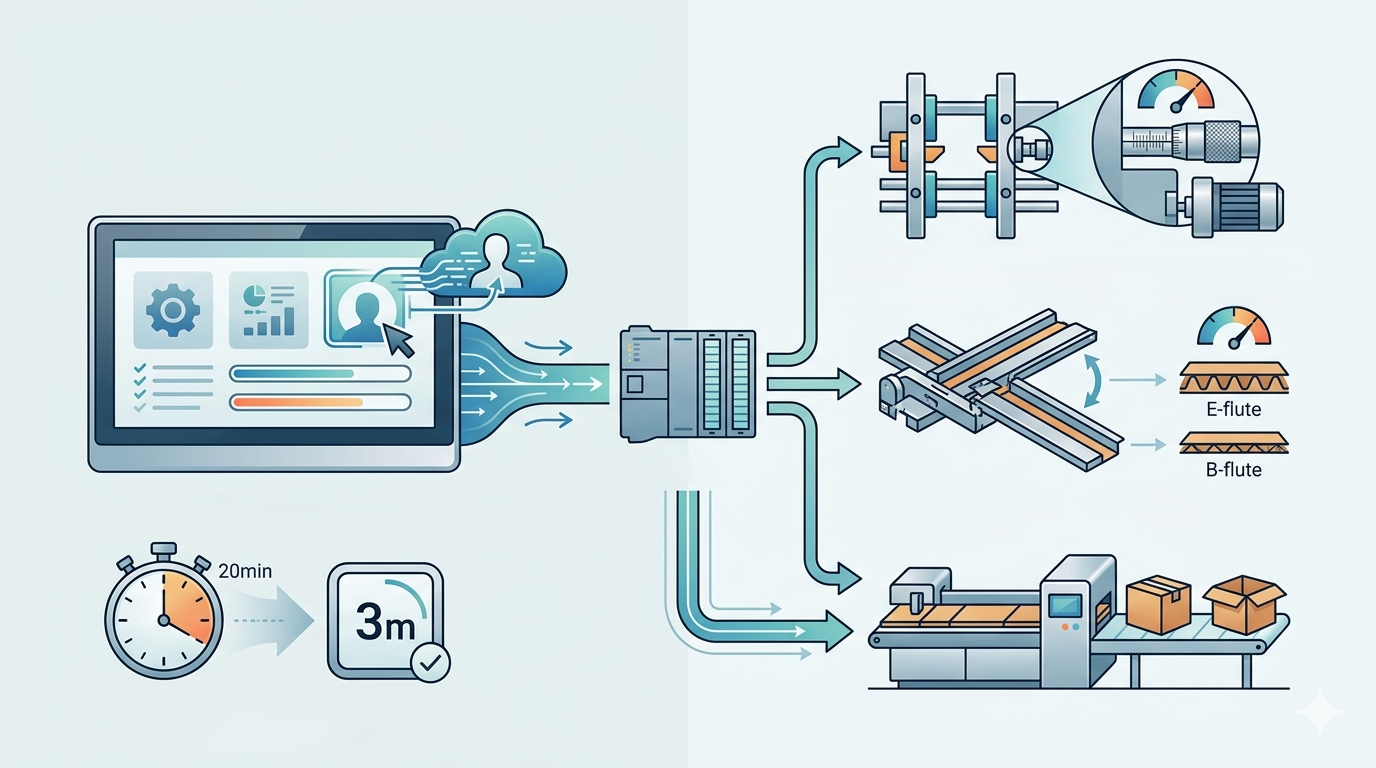


Corrugated box demand rarely stays level. Seasonal peaks, promotional campaigns, and shifting customer inventory plans all push order volumes up and down within a single year. A production line sized for the busiest weeks sits underused for the rest, while a line sized for average demand struggles when orders surge.
Why Fluctuating Orders Strain Conventional Folder Gluers
Order volume is only half of the challenge. Fluctuating demand usually arrives together with shorter runs and a wider mix of box sizes, so the machine is reset far more often than its nameplate output suggests. On conventional equipment, each reset means repositioning guides, readjusting the feed, and test-running sheets until the fold and glue line look right. When batches are small, this adjustment time can consume a large share of the working shift.
Feeding is the next weak point. Many older machines rely on a single stacking position, so the operator must slow the line or stop it to replenish cardboard. In long runs this pause is a minor annoyance. In short, frequent runs, the interruptions accumulate and quietly lower effective output. Uneven feeding also lets sheets drift, and a drifting sheet leads to a skewed fold or an uneven glue flap.
Quality consistency completes the picture. Worn belts, manual guide settings, and limited glue options make it hard to hold the same standard at both low and high operating speeds. A factory that runs slowly in a quiet month and flat out in a peak month needs a machine that behaves predictably in both conditions. Rework, rejected cartons, and customer complaints tend to rise when the machine does not.
How Feeding and Splicing Design Affects Machine Performance
Our approach to these problems starts at the two sections that most influence changeover speed and gluing accuracy: the feeder and the splicing unit. Other sections matter, but these two determine how well a machine copes with variable workloads.
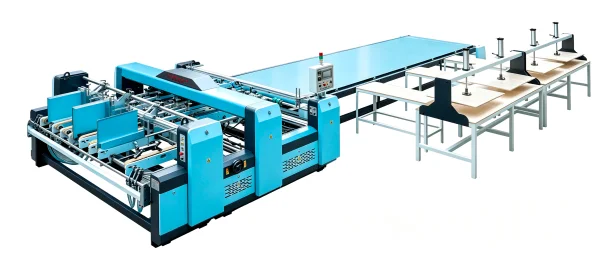
The feeder uses a set of wide rubber belts driven by independent dual servo motors, which keeps the sheet moving squarely instead of drifting to one side. Two cardboard stacking positions are provided, and their placement can be adjusted to the size of the board. While one stack feeds the machine, the operator can prepare the other, so replenishment does not force a stop. The feeder also applies a downward suction structure with a vortex suction pump, which holds the sheet firmly against the belts and supports smooth, uniform conveying. Adjustable feeder knives let the operator set the asymmetric length to suit the actual sample, and the layout is designed to avoid producing waste sheets during setup.
The splicing section addresses the changeover and glue quality issues together. Its guide plate structure is adjusted by a leading screw with electric control, which replaces repeated manual repositioning with a faster and more repeatable operation. Dual servo motors drive the conveying belts, so the box blank travels with higher precision through the stitching zone. Steel balls press the cardboard, and a plastic cover reduces noise while helping the adhesive bond firmly. At the glued interface, hot and cold double coating strengthens the joint, and a photoelectric device guides the cylinders so the splice lands in the intended position.
The gluing section supports this work with mechanical roller application. Operators can choose between hot and cold bonding methods depending on the board and the adhesive requirements, and a spray glue system is available as an option. Installing the double glue system on the side improves secondary positioning of the sheet, which matters when box styles change from one order to the next.
How Our Semi-Automatic Machine Handles Uneven Workloads
The value of these components becomes clearer when they are matched to real production situations. During a seasonal peak, such as the weeks before a major shopping event, a plant needs continuous output from a single operator team. The dual stacking positions allow cardboard to be replenished without interrupting the flow, and the servo-driven feeding keeps sheet positioning steady as the shift runs on.
When a plant takes on many small orders with different box dimensions, setup time matters more than top speed. Electric adjustment of the guide plates shortens the effort needed to move from one specification to the next, and the adjustable stacking positions follow the new board size without major reconfiguration. A plant serving local packaging buyers, where a single day may include several short runs, benefits most from this kind of flexibility.
In slower months, the semi-automatic configuration remains practical. Operators stay involved in loading and monitoring, which keeps the machine economical when orders thin out, while the same equipment still has the capacity to run at a higher pace when demand returns. Because the machine produces double-sheet folder gluing work in a multi-station format, it also gives plants a way to handle larger boards that smaller equipment cannot accommodate. We build this machine in both multi-station and single-station layouts so the choice can follow the available floor space and the expected board sizes.
Weighing Semi-Automatic Against Fully Automatic Lines
A semi-automatic machine is not the right choice for every plant. A fully automatic line is generally better suited to factories producing the same carton style in large volumes over long runs, where automation can reduce labor costs per carton. Semi-automatic equipment is often a better fit for plants handling fluctuating order volumes, varied carton designs, and shorter production runs, where flexibility and investment control matter as much as output.
The decision largely depends on batch size, product range, and available labor. Plants with frequent job changes and varying board dimensions often benefit more from quick setup and reliable feeding than from maximum production speed. A semi-automatic corrugated box folder gluer machine can provide a practical balance between operating efficiency and the ability to switch between orders.
The factory layout also matters. A multi-station configuration requires space for stacking tables and material transfer, while a single-station setup generally has a smaller footprint. Choosing a layout that fits the available floor space and material flow helps prevent handling bottlenecks and keeps production moving smoothly.
Building Flexible Capacity Around the Right Machine
Fluctuating demand is a permanent feature of the corrugated packaging market, so equipment choices should be judged by how well they absorb change, not only by how fast they run at their best. Continuous feeding, quick adjustment, and stable splicing are practical answers to the three problems that uneven orders create: lost time at changeover, interrupted flow, and inconsistent glue quality.
We design and manufacture our folder gluer machines with these working conditions in mind. Our equipment carries CE certification and is backed by Chinese patent certificates, and our machines serve customers in many regions around the world. If you are evaluating a semi-automatic corrugated box folder gluer for a production plan with uneven order volumes, our team can discuss the board sizes, batch patterns, and plant layout you work with, and help you assess which configuration of our machine fits them.
 Application Scenarios