


Roll changes are a routine part of double-sided tape application, whether a roll runs out during production or a new order requires a different tape specification. The time needed to replace the roll, restore the settings and verify the first sheets can affect both changeover efficiency and the consistency of the next run. On an automatic multi-head double-sided tape pasting machine, an accessible tape-head design helps make this process more manageable.
Why Tape Changes Take Longer Than Expected
A roll running out is only one reason to change tape. A new product may require a different tape width, while a revised closure design may call for a different tape type or strip position. On a multi-head double-sided tape pasting machine, these changes can involve several heads, making the process more time-consuming if each head needs to be adjusted separately. An efficient changeover starts with checking the replacement tape against the product drawing, then ensuring that it runs smoothly through the tape path without twisting or catching. Once the tape is installed, operators should inspect the first sheets for strip position, distance from the sheet edge, and clean starting and ending points before resuming full production. Recording the settings used for each product also makes repeat orders easier to prepare and reduces repeated adjustments.
Although these checks are essential for consistent application, the time spent replacing tape and preparing the heads can accumulate across multiple production runs. A machine designed for convenient tape changes helps reduce this downtime while leaving operators enough time to verify the first sheets and maintain application quality.
What One-Key 45° Rotation Brings to Daily Production
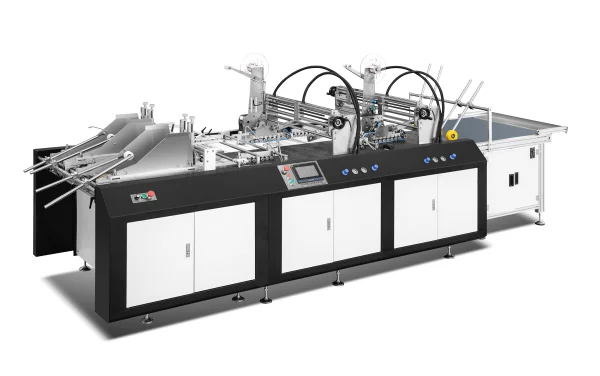
On our multi-head machines, the adhesive head rotates through 45° at the press of a key, allowing tape replacement to be completed in about 30 seconds under the specified operating procedure. This feature is available on multi-head models in our double-sided tape pasting range and on our triangle tape machine, making routine tape changes more convenient. Its practical value becomes clear in production environments where tape specifications, product formats and order quantities vary throughout the day.
Plants producing card boxes and gift boxes in multiple formats often need to change tape widths or adjust strip positions between jobs. Shorter changeovers help keep the transition between orders manageable, particularly when production runs are too short to absorb lengthy setup periods. The time saved can also be used to inspect the first sheets after a change, allowing operators to confirm tape alignment before the next batch moves into full production. The same benefit applies to small card products, where frequent format changes can account for a significant share of non-productive time.
Envelope bags and document bags present a different challenge. These products may be processed in larger batches, but the tape strip near the closing flap still needs to follow a defined position. A straightforward replacement procedure makes it easier to maintain a consistent routine after each roll change. By checking the first few sheets for strip position, edge distance and clean tape ends, operators can identify deviations early and reduce the risk of carrying a setup problem through a long production run.
The benefit becomes more significant on a multi-head machine because several tape strips may need to be replaced before production can resume. Each additional head adds another step to the changeover, so a convenient rotation mechanism helps prevent the replacement process from becoming unnecessarily complicated as the number of strips increases. Once the new tape rolls are installed and the heads are correctly positioned, multiple strips can be applied in one pass. Stable sheet feeding and consistent head positioning help maintain parallel alignment and even spacing across the finished product.
Other machine features support repeatable setup after the tape has been changed. On our triangle tape machine, operators can move the adhesive head laterally with a handwheel and use a steel ruler as a visible reference when restoring a recorded position. The touchscreen allows product settings to be entered, saved and recalled for repeat orders, reducing the need to rebuild a setup from scratch. PLC control coordinates feeding, pasting and collection, while the high-friction feeding belt moves sheets toward the application heads in a controlled sequence. At the discharge end, a straight-out fish-scale collection belt arranges finished sheets for easier handling and inspection. An optional counting function is also available for orders that require fixed quantities.
Together, these features help make tape replacement a more controlled part of the production process rather than an extended interruption. Operators can restore the setup, verify the first sheets and return to normal production with less time spent on changeover, while maintaining the checks needed for consistent tape placement across different products and order sizes.
Matching Changeover Convenience to Your Order Pattern
The value of faster tape changes depends largely on how production orders are organized. A plant running a few long orders each week may replace tape only occasionally, making quick changeover a useful convenience. By contrast, a plant handling multiple product formats, tape widths and short production runs may need to change tape several times a day. In this environment, changeover time becomes an important part of production planning. Products requiring several tape strips or a separate tape type for easy-tear closures can add further steps to the process.
When evaluating a double-sided tape pasting machine, it helps to consider the actual order pattern rather than focusing on changeover speed alone. The number of product formats processed each week, the frequency of tape changes, the number of strips per product and the average length of each production run all affect how much time can be saved. These details also help determine how changeover convenience should be balanced against feeding stability, application accuracy and production output.
Our double-sided tape pasting machines combine convenient tape-head rotation with multi-head application, saved product settings, PLC-coordinated operation and orderly sheet collection, with an optional counting function for batch control. Different series and working widths are available for cardboard, card boxes, corrugated cartons, envelope bags and document bags. Our team can help match the right machine configuration to your product range, tape layouts and production volume, combining efficient changeovers with stable feeding and consistent tape application to support smoother, more productive operations.
 Application Scenarios