


A stable feeding process is essential for accurate tape placement on a double-sided tape applicator. The high-friction belt grips each sheet and moves it toward the pasting position at a consistent speed, helping reduce slipping, skewing, and uneven spacing between sheets. Regular inspection of the belt helps maintain smooth feeding and consistent application quality.
How Belt Grip Moves a Sheet and What Happens When It Weakens
A feeding belt drives a sheet through friction, and the sheet advances without slipping only when the grip between belt and paper exceeds the resistance it meets on its way. That margin depends on the belt surface, the paper surface, the weight of the sheet and the contact area. Coated stock and dust on the belt reduce grip, small sheets have little contact area to spare, and heavy board needs a firmer hold. When grip weakens, the first sign is slippage: the sheet lags behind the belt, gaps between sheets become uneven and the strip starts at a varying distance from the leading edge. When grip is uneven from one side of the sheet to the other, the sheet turns slightly and arrives skewed, and because a long strip carries any angle along its whole length, its distance from the edge changes from one end to the other. Small sheets slip first, heavy board shows skew sooner, and since both effects build up slowly as belts wear or collect dirt, they often go unnoticed until rejected cartons appear at forming or packing.
Daily Checks That Keep Grip Consistent
Before production starts, inspect the belt surface for paper dust, adhesive residue, oil, glazing or cracking, and confirm that the belt runs in its normal position. After start-up, use the first sheets as evidence: they should enter the pasting position straight, with even gaps, and the strip should sit at the same distance from the edge at both ends. A strip that is correct at one end and off at the other points to skew, and a variable start position points to slippage. Repeat the check whenever the paper type changes, and keep brief notes for each product so that a gradual change shows early. If skew or slippage grows over days with the same material, examine the belt condition and cleanliness first.
How Our Machines Feed Sheets to the Tape Heads
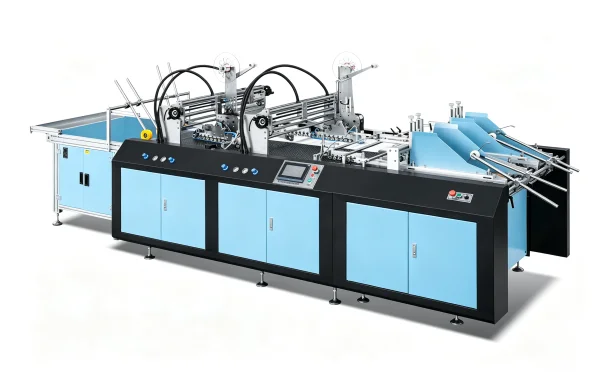
Our automatic multi-head double-sided tape pasting machines use a high-friction belt feeding system to move sheets smoothly toward the tape heads. The belt maintains contact with the material as it travels forward, helping each sheet follow a consistent path and reach the correct pasting position. Stable feeding is essential to the overall process because even a small shift before tape application can affect strip alignment and the distance between the tape and the sheet edge.
Different materials place different demands on the feeding system. Rigid cardboard and E, B and C flute corrugated board require sufficient friction to move forward without slipping or drifting out of alignment. Stable feeding helps keep long tape strips parallel to the panel edge on card boxes, gift boxes and corrugated cartons. Smaller card products also benefit from consistent belt contact, particularly when tape must be positioned close to a narrow edge. For envelope bags and document bags, repeatable feeding helps maintain tape placement near the closing flap across large production batches.
Feeding stability becomes even more important when several tape strips are applied in one pass. The adjustable heads work along the same feeding path, so any movement of the sheet can affect strip alignment and spacing. When the sheet advances at a steady speed and remains properly aligned, the tape heads can maintain more consistent positions across successive sheets, reducing the need for repeated adjustments during production.
PLC control coordinates feeding, tape application and collection, while the touchscreen allows operators to save and recall product settings for repeat orders. The one-key rotating adhesive head supports tape-position changes in about 30 seconds, helping shorten changeover time. After each adjustment, operators can run a few sheets to check feeding stability, tape alignment and spacing before resuming full production. Saved settings provide a useful starting point, while final checks help account for differences in material and sheet size.
At the discharge end, the fish-scale collection belt arranges finished sheets in sequence, making it easier to check the results of the feeding and pasting stages. An optional counting function supports batch collection and handling. For daily maintenance, operators should check the belt surface for paper dust, adhesive residue and visible wear, while watching for slipping, skewing or irregular sheet spacing during operation. Keeping the feeding system clean and in good condition helps the tape heads maintain accurate placement and consistent results across different materials and sheet sizes.
Reading Feeding Performance When Choosing a Machine
A data sheet seldom describes feeding behavior in detail, so it helps to ask about the points that matter for your products. The range of paper types and weights the machine is designed for should match your own, including any coated or laminated surfaces. Products with long strips or with easy-tear tape near an edge will be more sensitive to skew and deserve closer attention to feeding. Small blanks call for particular care about grip and exit handling.
It is also worth considering how the belt can be inspected and kept clean in daily work, since a feeding system that is simple to observe is easier to keep consistent. Describing your materials, sheet sizes and typical order pattern to the manufacturer gives the clearest basis for judging how a machine will feed them.
As a manufacturer, we design our double-sided tape applicators around steady feeding, with high-friction belts at the start of the line, several strips in one pass, PLC coordination, saved product settings, quick tape changes and orderly collection with an optional count. Our range covers several series and working widths for cardboard, card boxes, corrugated cartons, envelope bags and document bags. Send us your products, sheet sizes, tape specifications and typical batch quantities, and our team will suggest a configuration that fits your production.
 Application Scenarios