


A programmable logic controller, or PLC, executes a stored program that manages the order and timing of a machine's actions. On a multi-head double-sided tape applicator, several pasting heads work on the same sheet during a single pass, while the feeding and collection sections work on either side of them. Whether these sections run as one process or as separate stations depends largely on the control system that connects them.
Why Several Heads Need One Rhythm
A sheet that receives more than one strip is taped by more than one head, and the strips must end up parallel, evenly spaced and consistent from sheet to sheet. That outcome requires all heads to act under the same conditions. The sheet's motion, the timing of each head and the pace of the sections around them have to agree with one another, since a mismatch in any of them appears directly in the finished product.
The sections upstream and downstream matter as well. Feeding decides how and when a sheet arrives at the heads, and collection decides how it leaves. If each section is set independently, small differences in setting accumulate, and the operator ends up compensating one section for the behavior of another. The compensation hides the cause and makes results depend on whoever made the last adjustment.
What a PLC Contributes to a Tape Applicator
A PLC brings three qualities to this task. The first is sequence control: the program defines what starts, what runs and what stops, in what order, so the machine behaves the same way at the beginning of a shift as at the end. The second is repeatability. A stored program does not rely on feel or memory, so identical settings produce identical behavior from one run to the next. The third is manageability. Parameters are entered through an operator interface, and changing a product means changing values instead of re-balancing independent sections by hand.
The cost of lacking such control is familiar to plants that run many orders. Each changeover requires several separate adjustments, any of which can be missed. A repeat order depends on recorded notes or on an operator's recollection of what worked last time. When results differ between shifts, it is hard to say whether the cause lies in the materials or in the settings. A controlled, stored and recallable process reduces the number of variables the team has to account for.
What Our Machines Offer Through PLC Control
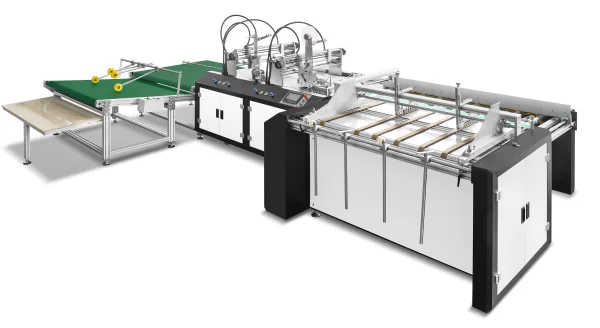
PLC control coordinates the main stages of our automatic multi-head double-sided tape pasting machines, linking sheet feeding, tape application and finished-sheet collection into a continuous production sequence. Rather than treating each stage as a separate operation, the control system helps the machine follow a coordinated workflow, supporting consistent operation across repeated production runs.
The PLC manages the sequence of feeding and tape application, allowing multiple adhesive heads to work within the same production cycle. For high-volume orders of envelope bags, document bags and other paper products, this coordination helps maintain a consistent operating rhythm from one sheet to the next. Operators can focus on checking tape placement and finished-product quality instead of manually coordinating separate stages of the process.
A touchscreen interface gives operators centralized access to job settings. When production switches to a different product format, the relevant parameters can be adjusted through the interface rather than managed across multiple separate controls. This simplifies routine changeovers, particularly in plants that process several product formats within a short production schedule. Operators still need to verify the settings against the product drawing and material requirements before starting a new run.
The ability to store and recall product settings is another practical advantage. Our machines can save parameters for different products and retrieve them when repeat orders return. Instead of entering every setting from the beginning, operators can load the corresponding saved values, check the first sheets and make any necessary corrections before continuing production. Stored settings provide a repeatable starting point, reducing reliance on manual recollection while keeping first-sheet verification part of the setup process.
These control functions are particularly useful in a multi-head configuration. When a product requires several strips of double-sided tape, multiple heads can apply the strips during the same pass. Their positions and spacing must be set according to the product drawing, while stable feeding and correct head adjustment help maintain the intended layout. Once a suitable setup has been verified, the corresponding settings can be saved for subsequent runs, making repeat production easier to prepare and manage.
Mechanical design also contributes to stable operation. A high-friction belt feeding system helps move sheets forward in an orderly manner, providing a steady input for the coordinated application sequence. The adhesive head can be rotated at the press of a key, and the head-change operation takes approximately 30 seconds under the specified changeover procedure. On our triangle tape machine, operators can also adjust the adhesive head laterally using a handwheel and a steel ruler as a visible positioning reference.
At the discharge end, a fish-scale collection belt arranges finished sheets in an overlapping sequence for easier collection and inspection. An optional counting function helps operators check batch quantities against order requirements. Together, PLC-based sequence control, stored job settings and practical mechanical adjustments support a more organized production process, particularly for products that require multiple tape strips and recurring setup configurations.
Coordinating Multiple Heads for Repeatable Production
Our automatic multi-head double-sided tape pasting machines combine PLC control, adjustable adhesive heads and stored job settings to coordinate tape application across different product formats. The PLC manages the operating sequence, while stable sheet feeding and accurate head positioning help each tape strip follow the intended layout. Multiple strips can be applied in a single pass, reducing repeated handling and supporting consistent placement across production runs.
For repeat orders, stored parameters allow operators to recall previous settings instead of configuring every position from scratch. The first sheets still need to be checked against the product drawing, particularly for tape position, spacing and edge clearance, before full production begins. This combination of coordinated control and repeatable setup helps simplify changeovers and maintain an organized workflow.
Machine configuration depends on sheet dimensions, material characteristics, tape specifications and production volume. Share your product drawings or samples and typical order requirements with our team so we can recommend a configuration suited to your application.
 Application Scenarios