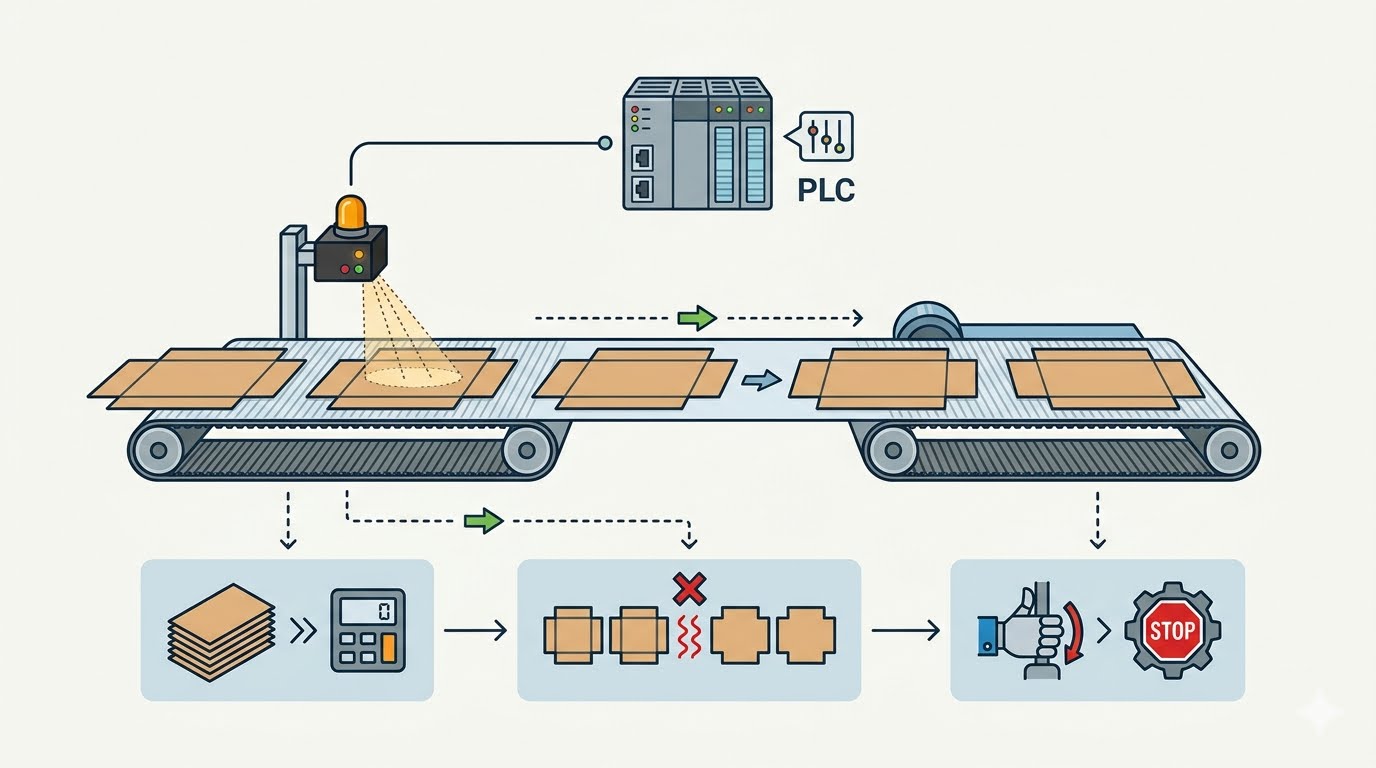
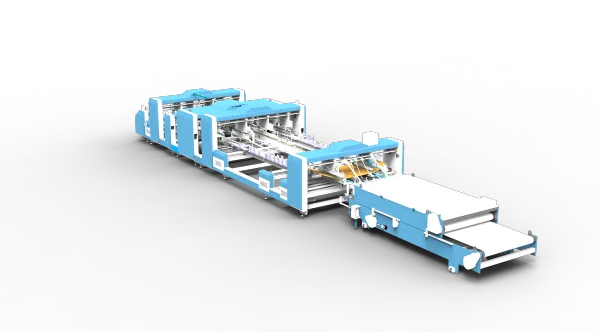
A two-piece folding and gluing machine consists of six functional sections: paper feeding, gluing, folding, patting, conveying and splicing. Each section performs a specific task in the carton-forming process, while its operation must remain coordinated with the other sections. Consistent carton squareness, accurate joint alignment and reliable seam strength depend not only on the performance of individual sections but also on how effectively the entire machine works as an integrated system.
Coordination Gaps in Conventional Folder Gluers
A two-piece machine forms a large carton from two corrugated pieces. Each piece is fed, glued and folded, and the two pieces are then spliced and pressed into a single carton. Every stage inherits the position of the board from the stage before it, so a small error early in the line rarely stays small. Many conventional machines drive several sections from shared transmissions, which means speed and timing can only be adjusted as a group. A slight drift at the feeder then carries through to the folding and splicing stages, where it appears as a skewed carton or a seam that sits off its line. Adjustment is a further weakness. On older designs, operators set guides, belts and pressure section by section, so a change of carton size depends heavily on individual experience and takes considerable time. Light frames and lower-grade bearings add a slower problem. After long periods of running, the positional relationships between sections loosen, and settings that were accurate in the morning no longer hold by the end of a shift.
Core Components That Keep Six Sections in Step
Our two-piece folding and gluing machine addresses coordination at the level of its drives and structure. Each functional section has its own motor, with servo motors and PLC control matching speeds across the line. Any section can be adjusted without disturbing the others, yet the line still runs as one synchronised process. The wall panels are thick, cold and heat treated steel, which limits vibration and flex under continuous running. Linear guides and branded bearings help adjustable parts return to their set positions after repeated size changes. Photoelectric switches and a central touch screen complete the arrangement, because they place position detection and parameter settings in one location. None of these components is remarkable alone. Together they give six separate sections a stable shared foundation.
Feeding, Gluing and Folding Sections
The feeding section sets the starting position for everything that follows. Ours is a friction feeder with an independent servo drive, and its side flaps adjust across the board width. A retractable rear support steadies the paper stack for longer carton formats, and an air suction function assists the feeding of double pieces. This matters most with long or narrow blanks, which tend to wander if the stack is unsupported. A blank that enters straight is far easier to fold and splice accurately later. The gluing section applies adhesive with mechanical rollers. Operators can choose between hot and cold dipping to suit the board and the adhesive system in use, and a spray glue system is available as an option. Because the glue is applied while the board is still in its original position, its placement stays consistent with the feeder's alignment.
The folding section completes the second fold and the fourth fold, which closes through 180 degrees. An independent motor drives the section, and the left and right belts run with stepless speed adjustment. A servo configuration is available for customers who want finer control. For thick or double-wall board, this allows the fold to develop gradually and in time with the feeding speed, rather than being forced at one fixed rate. The result is a cleaner crease, with less cracking along the score line. The section is also designed for easy disassembly, so routine maintenance does not require removing large parts of the machine.
Splicing, Conveying and Patting Sections
The splicing section is where two folded pieces become one carton, and where squareness is largely decided. Its guide plates are arranged in a multi-plate structure with screw rod adjustment. Electric adjustment and a memory function let operators recall stored settings for a repeat carton, instead of measuring and aligning from scratch. Flat belt conveyors, each driven by its own servo motor, advance the pieces, while pressing wheels hold the board flat and keep running noise low. A photoelectric device checks the position of the board before the pieces are joined. At the splicing mouth, a hot and cold double coating produces a firmer joint. For large cartons, or cartons that carry heavy contents, this combination of accurate positioning and secure bonding protects the strength of the seam.
The conveying section keeps the carton under controlled pressure as the adhesive sets. It is motor driven and can run in manual mode or in an automatic follow-up mode that tracks the carton length. The upper conveying pressure section has its own motor and can move back and forth to suit the carton, and optional pneumatic regulation allows the pressure to be adjusted. A lighter carton and a heavier one therefore do not need to share the same setting. The patting section completes the sequence. Its upper and lower pallets, also called guide plates, are driven separately by motors, which allows the length to be adjusted quickly. Stacking is orderly, and an automatic belt tensioning system keeps the belts consistent over time. Finished cartons leave the machine in tidy stacks that are easier to handle in later packing and loading.
Synchronised Six-Section Operation
The six sections of our machine are designed to operate as one coordinated production line. Independent drives allow each section to be adjusted separately, while central control keeps the entire process synchronised. In daily production, this helps shorten changeover time between carton sizes, maintain consistent quality across long runs and simplify maintenance by making it easier to identify the source of a problem. As the manufacturer, we handle machine design and assembly in-house, giving us the flexibility to configure the equipment around different carton formats, board grades and production requirements.
From long corrugated blanks to demanding two-piece carton structures, our machine can be configured to match the way your factory works, helping turn complex folding and gluing requirements into a more controlled and dependable production process.
 Application Scenarios