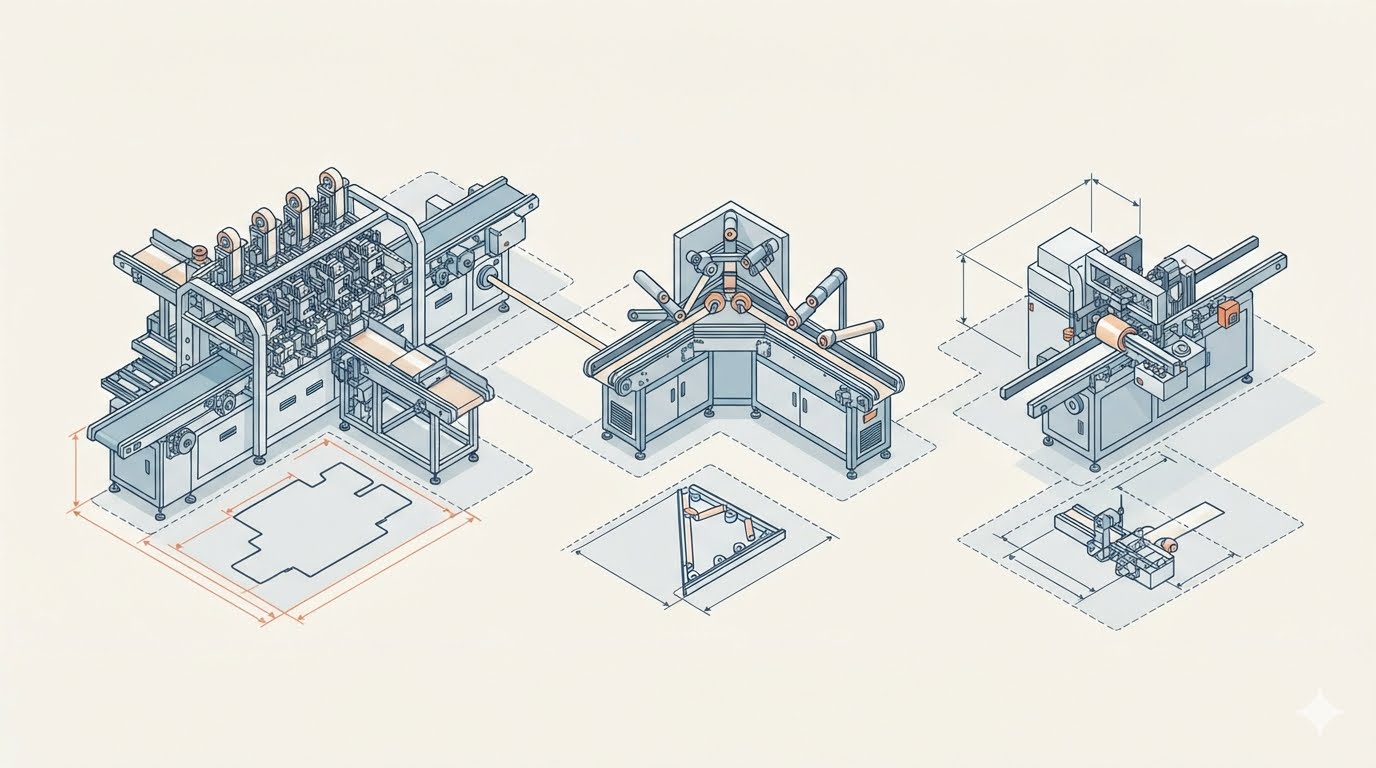


When double-sided tape is applied to a carton or paper sheet, even a small shift can affect how well the finished product fits together. On a double-sided tape pasting machine, placement accuracy refers to how closely the tape follows its intended position. It is often expressed as a tolerance in millimeters, showing the permitted difference between the target position and the actual tape placement. However, this figure alone does not tell the whole story, as feeding stability, material properties and machine settings also affect the final result.
What Placement Accuracy Actually Describes
A tolerance value covers more than the distance from the tape to the sheet edge. It also reflects how straight the strip runs, because a tape that starts at the correct distance but drifts along its length is still misplaced. For long strips on large cartons, angular error often matters more than a simple offset, since a small tilt grows with the length of the tape.
The stated value should also be understood as a specification under defined conditions. A machine rated for a given tolerance achieves it with suitable board, a matching tape and correct settings. Real production introduces variation in all three, so the tolerance describes what the machine is designed to deliver and not a guarantee for every sheet under every circumstance. Treating it this way avoids two common mistakes: expecting the figure to hold when materials change without a recheck, and blaming the machine for deviations whose source lies elsewhere in the process.
Tape placed close to a fold line, a sheet edge or a flap boundary leaves little margin. A strip that sits slightly outside its zone may protrude from the edge, press into a crease or fail to close a flap evenly. The tolerance therefore decides how much design margin a carton or envelope needs, and a tighter, more repeatable placement lets packaging designers work with narrower margins.
Where Placement Drift Usually Begins
Most deviations arise before the tape reaches the sheet. If a sheet arrives at the pasting head at a slight angle, or with an uneven gap from the sheet ahead of it, the tape is applied correctly to the machine's reference and incorrectly to the sheet. The machine did what it was set to do, but the sheet was not where the setting assumed. This is why feeding stability appears at the top of almost every list of accuracy factors.
Settings are the second common source. When the pasting head position is judged by eye and not set against a reference, two operators can arrive at positions that differ by more than the machine's tolerance. The difference stays hidden until the carton is folded and the tape no longer sits where it should. A third source is the changeover itself. After a change of board, tape width or sheet size, an old setting is often carried over, and the shift only appears further down the line, once a section of the batch has already been produced.

The Main Factors That Influence Accuracy
The factors fall into three groups: the sheet, the machine and the operation. On the sheet side, size, thickness, surface condition and cut quality all play a part. Small and thin sheets are more sensitive to variations in grip, coated or dusty surfaces change the friction at the feeding belt, and edges that are not cleanly cut make the sheet harder to hold in line. A batch with consistent dimensions is easier to position than one with variations between sheets.
On the machine side, the condition of the feeding belts, the repeatability of the pasting head position and the state of the drive components decide how consistently the sheet and the tape meet. Belt wear reduces grip gradually, so the effect on placement is often noticed late. Head position repeatability matters most for frequent changeovers, since the head must return to the same reference after each adjustment.
On the operating side, the most influential habits are checking the first sheets after every change, matching running speed to the sheet format, and keeping belts and rollers clean. A short record of the settings used for each product turns a one-off adjustment into a reference that later operators can follow. None of these steps is complicated, but they are easy to skip when a schedule is tight, and skipping them is a frequent reason why a machine's stated tolerance is not reflected in the finished product.
How Our Machines Support Repeatable Placement
Our automatic multi-head double-sided tape pasting machines address the first source of drift at the feeding stage. A high-friction belt system carries sheets forward smoothly and delivers them in an orderly way, so the sheet reaches the pasting position in a stable condition. The machine's technical data lists placement accuracy as a specification, and the feeding design is what allows that specification to be approached in daily production.
Changeovers are handled by the adhesive head design. On our multi-head machines, the adhesive head rotates at the press of a key, which shortens the time needed to replace the tape. On our triangle tape machine, the adhesive head can also be moved left and right with a handwheel against a steel ruler, giving operators a visible reference for repositioning. A short changeover with a clear reference encourages the recheck that keeps placement consistent after every material change.
The machine runs under PLC control, which coordinates feeding, pasting and collection as one sequence. At the exit, the straight-out fish-scale collection belt delivers sheets in an overlapping order, so tape position can be checked as the sheets arrive and a drift can be caught early. These features suit the products our customers make. Envelope bags and document bags often carry easy-tear tape close to an edge, where deviation is easy to see. Card boxes and gift boxes use long strips at bonding positions, where the tape must sit in the intended zone to hold the carton shape. Orders with many sizes and frequent batch changes depend on quick, repeatable resetting more than anything else.
Matching Machine Configuration to Placement Requirements
As a manufacturer, we offer double-sided tape pasting machines in different series and working widths for cardboard, card boxes, corrugated cartons, envelope bags and document bags. The right configuration depends on the sheet dimensions, tape specifications and required placement positions. By reviewing these requirements alongside the intended application, we can help identify a suitable model and assess whether sample testing is needed to confirm placement performance before production.
 Application Scenarios