Some corrugated cartons are too large or have dimensions that make production from a single sheet impractical. Manufacturers can divide these designs into two board pieces, process them separately and join them through a splicing section. In a two-piece folding and gluing machine, this section controls the positioning, bonding and pressing of both pieces. Its accuracy affects carton squareness, seam quality and the finished package's ability to withstand handling and stacking.
Common Splicing Defects and Their Causes
In a two-piece folding and gluing machine, both board pieces pass through feeding, gluing and folding before reaching the splicing section. Their edges and crease lines must align when they meet. Even a small positioning deviation can produce visible defects along the joint.
Fishtailing is a common example. The gap between the two pieces gradually widens or narrows along the seam, making the joint uneven. Misaligned crease lines and inconsistent gaps can also affect carton squareness and panel positioning.
These problems often originate earlier in the process. Crooked feeding can cause a blank to reach the splicing section at an incorrect angle. Inconsistent conveying speeds may create relative movement between the two pieces. Machines relying mainly on mechanical stops and manual positioning also require more operator intervention when changing carton sizes. Even correctly aligned pieces can produce a weak joint if adhesive coverage or pressing pressure is insufficient.
Servo Positioning and Independent Belt Conveying
Our two-piece folding and gluing machine uses four servo-controlled stops to position the board pieces before joining. This arrangement provides controlled positioning rather than relying entirely on manual alignment. A memory function is also available, allowing operators to save and recall stop positions for repeat carton specifications.
The guide plates use an electrically driven screw-rod adjustment system. Their positions can be adjusted to match different board dimensions, helping guide the edges into the intended joining position.
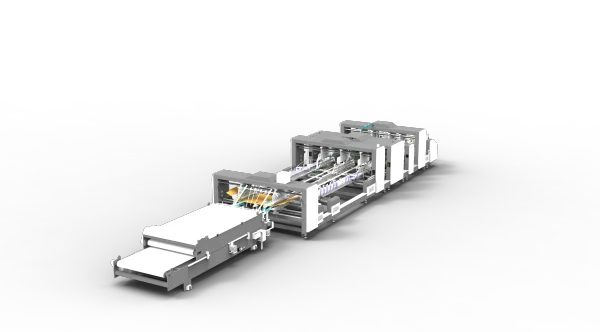
The flat conveying belts in the splicing section are driven by independent servo motors. Separate drives allow the conveying movement to be controlled independently, helping coordinate the two board pieces and reduce relative displacement during transfer.
A photoelectric detection device checks the board position before splicing. The servo-driven mechanism then completes the joining movement according to the positioning settings. Pressing wheels hold the board against the belts during conveying, helping prevent unwanted movement while maintaining relatively low operating noise.
These features become particularly useful when processing large blanks. A small feeding deviation on a compact carton may have a limited effect, but the same deviation can become more noticeable across a long appliance or furniture carton.
Hot Melt and Cold Glue Bonding at the Joint
Positioning accuracy is only one part of splicing quality. Adhesive application and pressing determine whether the two pieces remain securely connected.
Our splicing section applies hot melt and cold glue together. Hot melt provides rapid initial adhesion, helping hold the joint as the carton continues through the machine. Cold glue develops bonding strength as it dries, contributing to the longer-term integrity of the seam.
After coating, the carton passes through a conveying and pressing section. Adjustable upper pressure maintains contact between the joined surfaces while the adhesives develop their bond. Optional pneumatic pressure regulation provides another way to adjust pressing force for different production requirements.
The pressure must suit the board thickness and carton structure. Insufficient pressure may leave parts of the joint poorly bonded, while uneven pressure can affect contact along the seam. Positioning, adhesive coverage and pressing therefore need to work as one coordinated process.
Applications in Appliance, Furniture and Industrial Packaging
Large appliance cartons are a typical application for two-piece production. Refrigerators, washing machines and similar products require wide and tall packaging formats. Their cartons often use double-wall or heavier corrugated board to support handling and stacking. The splicing section must maintain alignment across large panels, while the bonded seam must remain consistent throughout the carton.
Furniture packaging presents a different challenge. Flat-pack furniture often uses long, narrow cartons, while assembled furniture may require much larger dimensions. These orders can involve frequent changes in carton length and width. Saved servo positioning settings help reduce repeated setup work when previously processed specifications return to production.
Industrial equipment packaging places greater emphasis on load distribution and carton strength. Machine parts, motors and other heavy components can create concentrated loads inside the package. Uneven corners or poorly bonded seams may weaken the carton under stacking pressure. Accurate splicing helps maintain the intended carton geometry and supports consistent seam formation.
Special-shaped cartons provide another application. When a design contains unusual dimensions or panel arrangements, dividing it into separate pieces can offer greater flexibility in board layout and printing. Depending on the design, this approach may also reduce material waste compared with producing the entire carton from one oversized blank.
Joint Quality Checks During Production
The first carton after a size change or machine setup should be inspected before continuous production begins. The gap along the joint should remain consistent, the crease lines of both pieces should align, and the finished carton should maintain its intended square shape. Comparing the two diagonals provides a practical check of carton squareness.
The bonded seam should also be checked for incomplete adhesion, lifting edges and uneven pressing marks. Board flatness, moisture content and adhesive conditions can influence the final result, so regular inspection helps maintain consistent production quality.
Our two-piece folding and gluing machine is designed to make large-carton production more manageable. Its positioning memory reduces repeated setup work, while independent conveying and coordinated splicing help operators handle different carton sizes with greater convenience. From large appliance cartons to long furniture boxes and heavy industrial packaging, our machine offers flexible production support, consistent processing and a practical solution for manufacturers looking to expand their large-format carton capabilities.
 Application Scenarios