

Two-sheet corrugated box folder gluer machines are long, heavy production lines. Our larger configurations measure about thirteen and a half meters from the feeding end to the delivery end, with a working width of roughly three meters or more. Depending on the sheet size they handle, they weigh between about ten and thirteen tonnes. These figures influence where the machine can be installed, how the floor needs to be prepared and how well the machine holds its accuracy once production starts.
Where Floor Planning Usually Goes Wrong
The most common shortcut is to compare the machine's total weight with a floor rating and stop there. A corrugated box folder gluer machine does not spread its weight evenly. The load reaches the floor through the frame supports, so the pressure under each support point is much higher than the average across the machine's footprint. Slab thickness, reinforcement and the condition of the ground beneath it all decide whether those points are acceptable.
Flatness is the second issue, and it affects output more directly than most buyers expect. The machine is built as a sequence of connected sections: feeding, gluing, folding, patting, conveying and splicing. Each section depends on the one before it for sheet position. If the floor slopes or has settled unevenly, the sections drift out of alignment with each other. Operators then see sheets wandering sideways, fold lines moving away from the scores and glue flaps missing their target panel. Over a line more than thirteen meters long, small level differences add up.
Three Plant Situations That Raise the Stakes
A new or relocated carton plant has the most freedom, and also the most to gain from early planning. When the building is still being designed, the machine's weight, length and material flow can be built into the layout from the start. Slab thickness, floor leveling and the positions of power drops can be specified once, instead of corrected after the machine is on site. Pouring and leveling a floor to suit the line is far less disruptive than breaking it up later.
Plants adding a line to an existing workshop face a different problem. Older slabs are often uneven in thickness and flatness, and they may already carry other heavy equipment nearby. A new folder gluer must also fit around existing forklift routes, pallet storage and the paths operators use. The floor under the planned position should be checked on its own merits and should not be assumed to match the condition of the rest of the building.
Companies operating from upper floors or leased premises have the tightest limits. Floor capacity on elevated slabs is normally lower than on a ground-level industrial slab, and lifts, stairwells and doorways restrict what can be moved in at all. For a machine in the ten-tonne class, ground-level installation is usually the practical choice. Leased buildings may also need the owner's agreement before floor work or modifications can proceed.

What a Heavy Frame Contributes to Daily Production
Weight in a folder gluer comes mainly from structure. The machine walls on our units are built from 16 mm cold-heat-treated plate, which gives the frame the stiffness to keep its geometry while the machine runs at production speed. A rigid frame vibrates less, and low vibration helps the fold lines and splicing position stay consistent across a shift. This matters most for large, heavy outer cartons such as those used in household appliance packaging, and for high-volume consumer goods cartons where the machine runs for long periods without stopping.
The machine's layout also helps with planning. The six sections follow one another in a fixed order, so a plant can map out the footprint, the stacking area at the feeder, the delivery path and the maintenance access in advance. The splicing section needs room on both sides for adjustment, and the feeding end needs space to load blanks without blocking traffic. A clear sequence makes it easier to draw these requirements onto a floor plan before the machine is positioned.
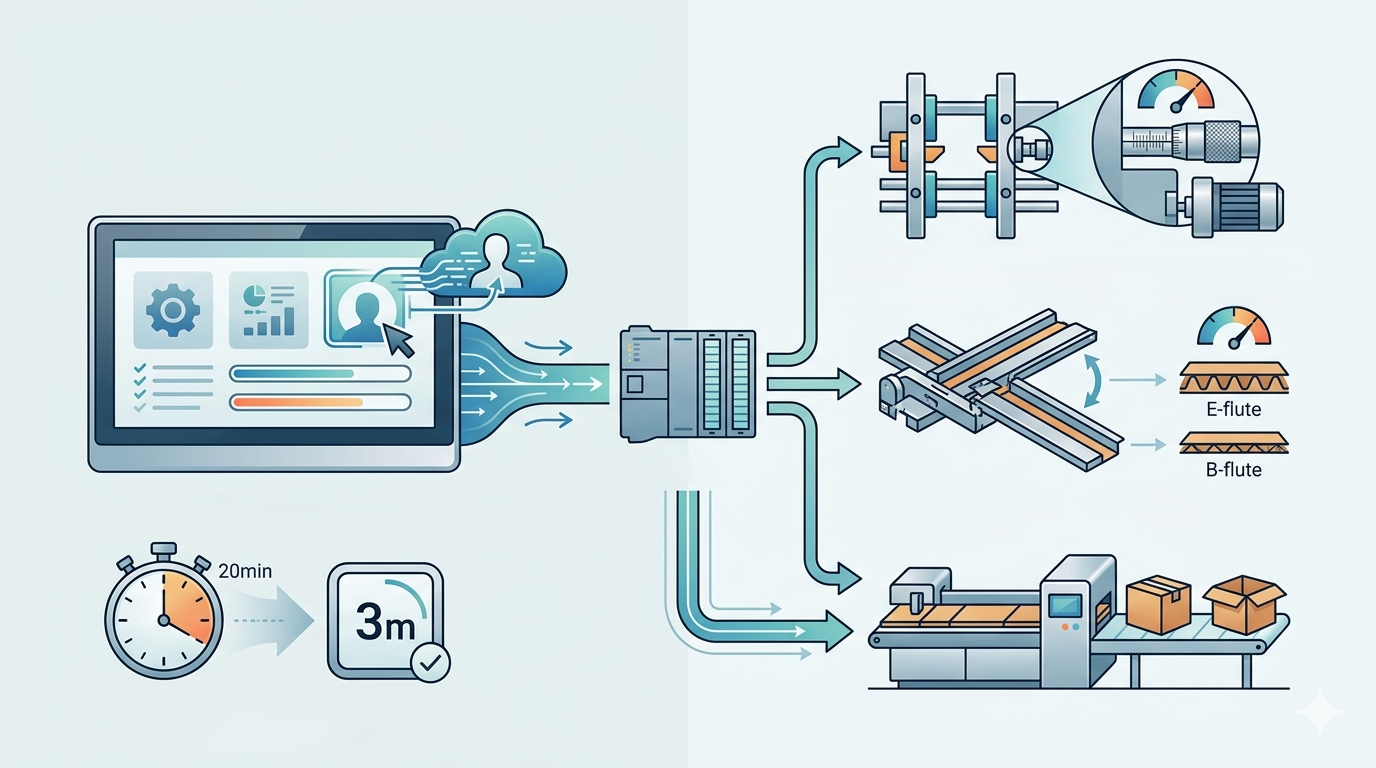
Stable ground pays off most when plants change carton sizes often. The splicing guide plates are adjusted electrically and can store their positions in memory, and the belt conveyors in that section are driven by separate servo motors. Recalling a stored setting only returns the machine to the same position if it sits on a level, steady floor. When the floor is right, a plant running many carton formats can return to a known setup with less trial adjustment between orders.
Preparing the Workshop Before the Machine Arrives
A practical approach starts with the machine documentation. The weight, overall dimensions, power and current figures for the chosen configuration should be compared with the building drawings before any order is finalized. Where the drawings are incomplete, as is common in older premises, the floor should be surveyed. A structural engineer can assess slab thickness, reinforcement and subgrade, and a flatness survey will show whether leveling work is needed under the planned footprint.
The route into the building deserves the same attention as the final position. Plants should check door heights and widths, turning space for the delivery vehicle, ground conditions along the path and the lifting equipment available on site. The working zones around the line need to be planned at the same time, covering blank storage at the feeding end, finished carton handling at the delivery end and walkways for operators and maintenance staff. After the machine is positioned, leveling it on its supports and checking the alignment of the sections is part of getting it ready for production. Skipping this step brings back the very problems that floor preparation was meant to avoid.
Machine weight is a consequence of design choices. We build the frame, the feeding section and the splicing section as one system, so that mass and rigidity support the accuracy needed in real carton production. If you are planning a new line, a relocation or a floor upgrade, send us your workshop layout details, board grades, carton styles and daily output targets. We will review them against the configurations we build and discuss which corrugated box folder gluer machine suits both your production needs and the space you have prepared for it.
 Application Scenarios