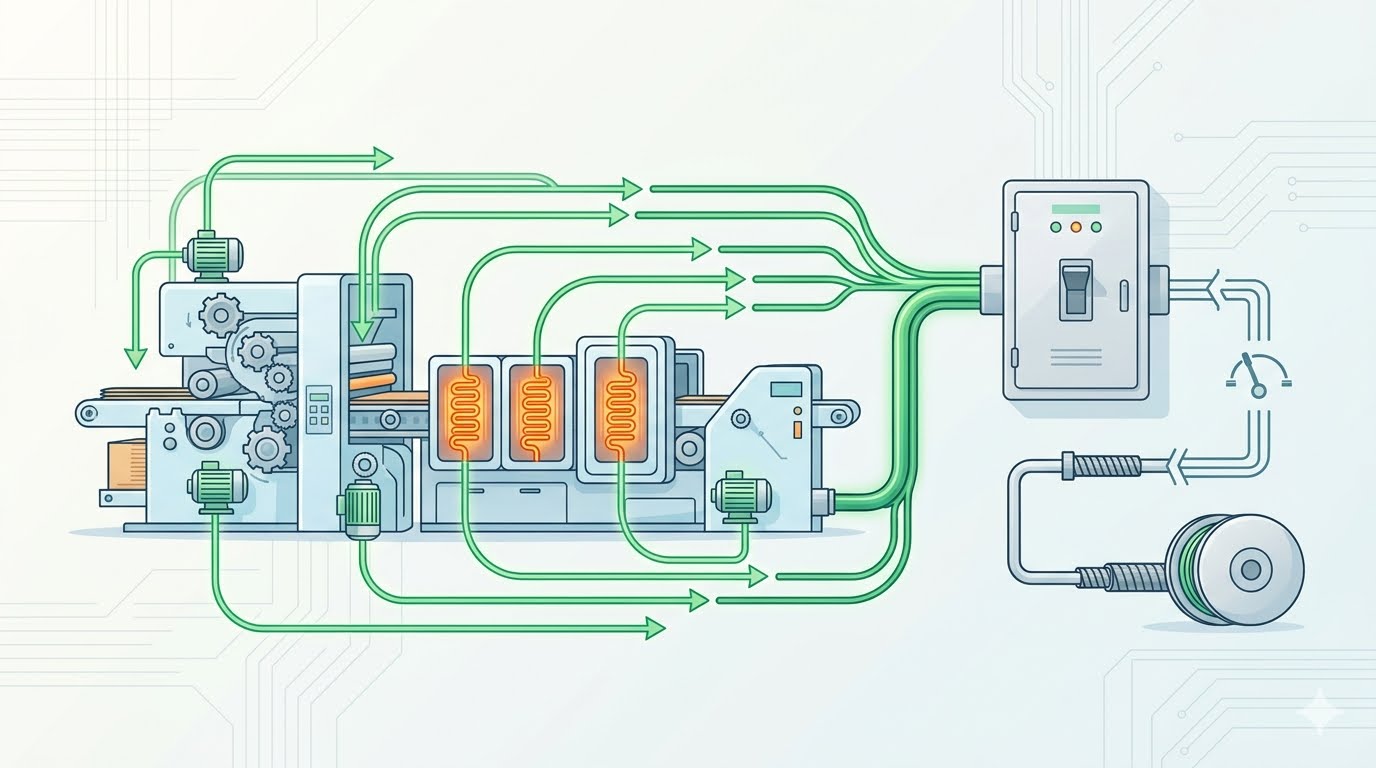


Feeding, belt conveying, folding and servo starts and stops each send a small impulse through the frame of a folder gluer on every cycle. Over thousands of cycles those impulses accumulate, and the frame decides whether the machine keeps its settings or slowly loses them. In a two-piece folding and gluing machine, the thickness of the wall panels and the way the steel has been treated both shape that outcome strongly.
Vibration Problems on Lightweight Frames
A two-piece folding and gluing machine moves two corrugated pieces through feeding, folding and splicing before pressing them into one carton, and every moving assembly passes some of its motion into the frame. On a lightweight frame, thinner wall panels flex slightly under that load. Guide plates and belts then drift by small amounts during a run, and the drift appears in the carton as skewed blanks, uneven folds and seams that sit slightly off their line. Noise rises as well, and bearings, rails and belts wear faster under repeated shock. The effect grows with thick or oversized board, because stiff double-wall sheets resist folding and return more force to the machine. A second problem is less visible. Welded steel structures contain residual stresses left by the welding process, and published research on welded machine frames shows that these stresses release slowly over time and can change the geometry of the frame. A machine adjusted accurately at installation may therefore lose some of that accuracy months later, even though no part has been touched.
Thick Board and Heavy-Load Cartons
Our two-piece folding and gluing machine is built on 16 mm wall panels that are cold and heat treated to an international standard. Thickness gives the panels stiffness against the flexing described above, and heat treatment of steel structures is generally used to improve dimensional stability. The machine's substantial self-weight adds mass that helps absorb the impulses created by feeding and folding. Together, these features give the guide plates, belts and splicing mechanisms a steadier base to work from, and they allow adjustments made at setup to stay where they were put.
Thick board is where this base proves its worth. Double-wall and heavier corrugated springs back at the crease and pushes against the folding belts, so the folding position must stay constant while the board resists it. On a rigid frame, the crease line is folded where it was set, which reduces the chance of cracked scores and half-closed corners. The splicing stage benefits in the same way. Its guide plates and belts keep their position relative to one another, so the two folded pieces meet accurately and the glued seam sits where it should. In a heavy carton the seam carries part of the load, so its position and bonding matter more than they do in a light one
| Structural Feature | Main Function | Production Benefit |
|---|---|---|
| 16 mm wall panels | Resist frame flexing | Maintain alignment during operation |
| Heat-treated steel | Improve dimensional stability | Reduce the risk of frame deformation |
| Heavy machine frame | Absorb operating impulses | Reduce vibration and support stable folding |
| Stable guide plate support | Maintain component positioning | Improve feeding and splicing accuracy |
| Suitable floor foundation | Support machine weight | Maintain installation stability |
Applications in Appliance, Furniture and Equipment Packaging
Heavy-duty double-wall and triple-wall corrugated board is widely used for packaging household appliances, furniture and industrial equipment, where carton dimensions, board weight and load requirements place greater demands on folding equipment.
Large appliance cartons highlight the importance of frame stability. Their wide blanks leave less room for positional deviation during feeding and folding. Even a small shift can affect panel alignment and carton squareness, making subsequent stacking and internal packaging more difficult. A rigid machine frame helps limit vibration during operation, supporting more consistent sheet transport and folding. This provides a more stable foundation for processing large-format cartons.
Furniture packaging brings different production demands. Flat-pack furniture cartons are often long and heavy, while assembled furniture may require larger carton formats. Manufacturers may also switch between several sizes within a short production cycle. A stable frame helps maintain consistent machine operation during these changes, reducing the need for repeated corrections. Reliable support throughout feeding and folding is particularly important when handling long blanks that are more susceptible to misalignment.
Cartons for machine parts and industrial equipment must also withstand concentrated loads during storage and transportation. Poorly formed corners, uneven folds or weak glued seams can compromise carton strength under stacking pressure. Consistent folding and bonding help maintain the structural integrity of the finished carton, while a vibration-resistant frame supports the mechanical stability needed for repeatable processing.
Across all three applications, frame rigidity is not an isolated structural feature. It contributes to stable feeding, accurate folding and consistent seam formation, particularly when processing large-format blanks and heavy corrugated board.
Foundation and Maintenance for Lasting Accuracy
A frame performs best when it stands on a suitable base. The machine is long and heavy, so floor flatness and load-bearing capacity deserve review when a workshop layout is planned. In daily operation, routine checks of fasteners, rails and belt tension keep the benefit of the frame in place. A rigid structure improves stability, and it works alongside board quality and correct adjustment rather than replacing them.
A folder gluer's accuracy begins with the steel beneath it. We build the frame, drives and mechanisms of our two-piece folding and gluing machine as one system, and the heat-treated wall panels are where that system starts, giving appliance, furniture and equipment cartons a steady machine behind every fold.
 Application Scenarios