


Modern packaging factories are increasingly focused on production efficiency, equipment stability, and reasonable factory power planning. As a key converting machine in corrugated box production, a corrugated folder gluer machine integrates multiple working sections, including paper feeding, gluing, folding, pressing, and conveying. Each section requires coordinated mechanical movement and electrical control, which makes total rated current and power requirements important considerations during equipment selection and factory installation.
Why Total Rated Current Matters for Corrugated Folder Gluer Machine Installation
The total rated current of a corrugated folder gluer machine represents the overall electrical demand when different functional systems operate together under designed working conditions. Unlike a simple machine driven by a single motor, modern folder gluer equipment combines multiple drive units, control components, sensors, and auxiliary systems.
During actual production, the power demand is influenced by many factors, including machine size, working speed, automation level, carton structure, and the number of functional sections involved. For example, a high-speed two-sheet folder gluer machine designed for larger corrugated boxes usually requires more coordinated movement between the splicing section, gluing section, folding section, and delivery system compared with a basic folding and gluing unit.
The total rated current design of our corrugated folder gluer machine provides customers with clearer electrical planning information during installation. By considering the requirements of different drive units, control systems, and functional sections, our machines are designed to achieve stable power distribution and reliable operation in modern packaging production environments.
Common Power Challenges in Traditional Folder Gluer Machines
Traditional mechanical equipment may use centralized transmission structures with induction motors and mechanical connections to drive multiple sections. While this type of design can provide reliable operation in certain applications, it may create challenges when production requirements become more demanding.
One common issue is the starting current peak caused by direct motor starting methods. When a large induction motor starts directly, the temporary current demand can be significantly higher than its normal operating current. If multiple motors start at the same time, the electrical load impact on the factory power system may become more noticeable.
Another challenge is the limited flexibility of traditional mechanical adjustment systems. Corrugated box manufacturers often need to process different box sizes, materials, and designs. Frequent manual adjustments can increase setup time and require operators to spend more effort maintaining production consistency.
In addition, when a factory expands its production capacity and installs multiple machines, unclear power distribution planning may create difficulties in balancing electrical loads. Therefore, modern corrugated folder gluer machine designs increasingly focus on efficient drive control, modular electrical structures, and optimized power management.
Factors Affecting Corrugated Folder Gluer Machine Power Requirements
The power requirements of a folder gluer machine are determined by several technical factors rather than a single motor rating.
Machine size is one important factor. Larger working widths usually require stronger feeding, conveying, and pressing systems to maintain stable movement of corrugated sheets. For example, equipment designed for large-format cartons needs sufficient mechanical power to handle heavier boards while maintaining accurate folding performance.
Production speed also influences electrical demand. A high-speed corrugated folder gluer machine requires precise synchronization between different sections. The feeding unit, gluing system, folding mechanism, and conveyor must work together continuously, which requires reliable drive and control systems.
The level of automation is another consideration. Machines equipped with more automatic adjustment functions may include additional servo motors, sensors, and control modules. These components improve operational convenience and repeatability but also become part of the overall electrical design.
The carton structure being produced can also affect power consumption. Double-piece corrugated boxes or larger industrial packaging often require additional processes, such as sheet alignment and splicing. Therefore, the machine configuration should be selected according to actual production requirements rather than only focusing on rated speed.
Intelligent Servo and Variable Frequency Control for Stable Power Management
Advanced corrugated folder gluer machine designs commonly adopt servo technology and variable frequency control to improve motion accuracy and optimize power usage. Compared with traditional direct-start motor systems, modern drive solutions provide smoother acceleration and deceleration, reducing unnecessary mechanical impact during machine operation.
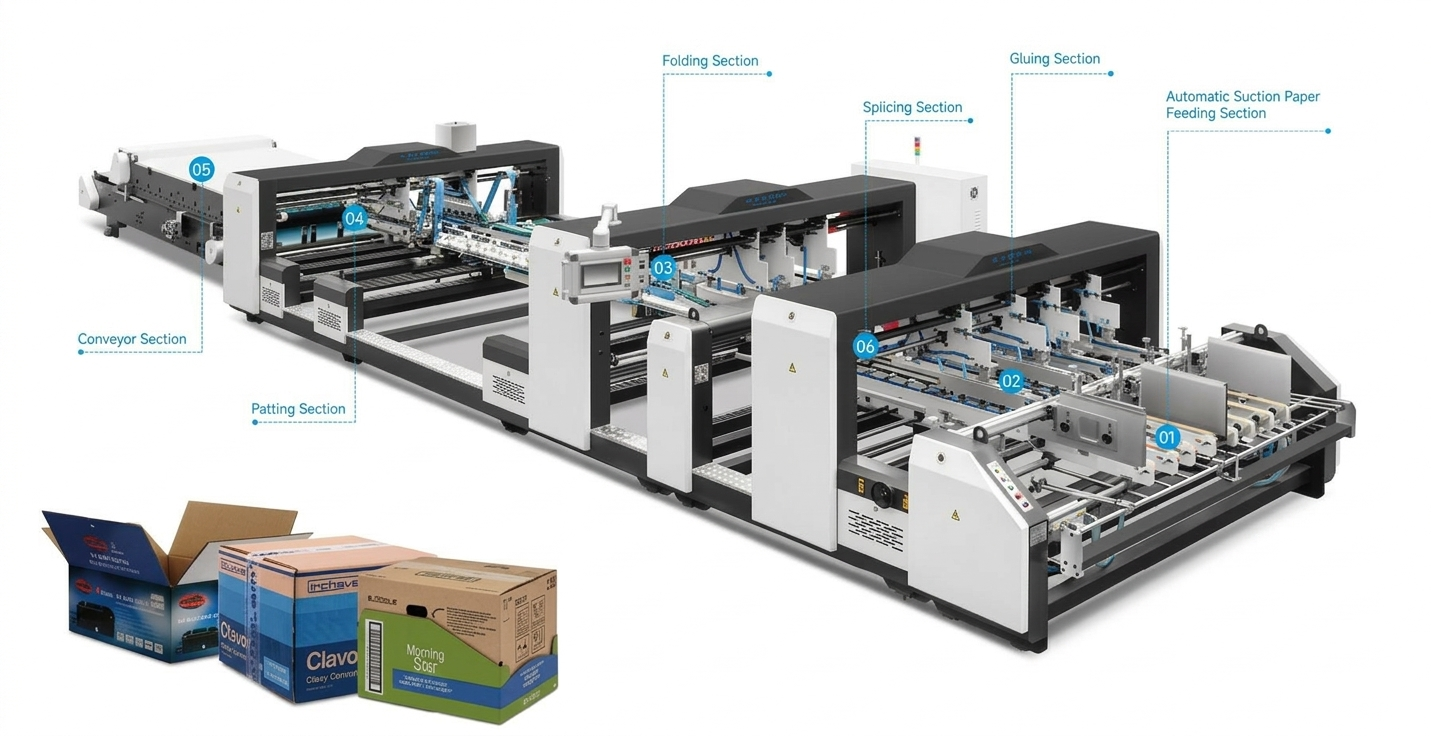
In a high-speed folder gluer system, different sections need to operate according to a coordinated sequence. The automatic paper feeding section, gluing section, splicing section, folding section, and conveyor section each have their own operating requirements. Intelligent control systems allow these sections to start, adjust, and stop according to programmed production conditions.
This type of distributed drive structure helps reduce sudden load changes during operation. For factory electrical planning, smoother power demand makes it easier to configure appropriate protection devices and power capacity based on real production requirements.
For the LYA-2300/2600 high-speed two-sheet folder gluer machine, the integrated design of feeding, gluing, splicing, folding, and conveying sections supports stable coordination between mechanical movements and electrical control systems. This structure is suitable for manufacturers producing larger corrugated cartons that require consistent processing performance.
Efficient Electrical System Design for Optimized Power Utilization
A well-designed electrical system is not only about providing enough power but also about improving the overall efficiency and reliability of machine operation.
Modern folder gluer machines use industrial electrical components such as PLC control systems, sensors, relays, contactors, and motor control devices to manage production processes. These components work together to monitor machine status, control movement accuracy, and support safe operation.
Efficient drive systems can also help improve energy utilization by adjusting motor operation according to production conditions. Instead of operating all components at unnecessary power levels, intelligent control allows different sections to work according to actual production requirements.
For packaging manufacturers, optimized electrical design provides several practical benefits. It supports stable machine operation, simplifies maintenance procedures, and helps factories develop more reasonable power management strategies when integrating multiple production lines.
Modular Power Distribution Improves Factory Integration
One important development trend in modern corrugated folder gluer machine manufacturing is modular electrical design. Instead of treating the entire machine as one complex system, different functional areas are designed with clearer control structures.
A typical high-speed folder gluer machine may include:
- Automatic suction paper feeding section
- Gluing section
- Splicing section
- Folding section
- Pressing and conveyor section
Each section performs a specific function and requires coordinated control. Modular design makes it easier for engineers to understand electrical loads, maintain equipment, and organize factory installation.
For factories operating multiple packaging machines, clear power distribution information is especially valuable. Engineers can evaluate load balance between different production lines and arrange electrical connections more efficiently.
This approach also supports future upgrades. When manufacturers add additional automation features or adjust production requirements, a modular system provides a more flexible foundation.
Advanced Electrical Design of Our Corrugated Folder Gluer Machine Solutions
Modern corrugated folder gluer machines are developed with a combination of mechanical precision and intelligent electrical control to meet the requirements of different carton production applications. Depending on the production capacity, carton structure, and automation level, different models can be configured with suitable drive systems, control units, and power management solutions.
Our corrugated folder gluer machine series integrates multiple functional sections, including automatic paper feeding, gluing, folding, pressing, and conveying systems. For applications requiring more complex carton structures, additional functions such as sheet splicing and advanced positioning systems can also be integrated according to production requirements.
The electrical system is designed based on the actual operating conditions of each machine configuration. By coordinating motors, servo drives, PLC control systems, sensors, and other electrical components, the equipment achieves balanced power distribution between different working sections.
This design approach helps maintain stable machine operation during continuous production while providing customers with clearer power requirement information for factory installation and production planning.
Different models within our corrugated folder gluer machine range are developed for various packaging applications, including standard corrugated boxes, large-size industrial cartons, double-piece cartons, and customized packaging solutions. Through flexible configuration options, customers can select suitable equipment according to carton dimensions, production speed, and manufacturing requirements.
Through continuous improvement in machine structure, control systems, and manufacturing processes, we aim to provide customers with equipment that supports stable operation, efficient production, and long-term value. By understanding each customer's factory conditions and packaging needs, we provide suitable corrugated folder gluer machine solutions designed for modern manufacturing environments.
'/%3e%3cpath%20id='Rectangle%20455'%20d='M0%2011.1428H5.57143L22.2857%2052H0V11.1428Z'%20fill='%23CE221D'/%3e%3c/g%3e%3cdefs%3e%3clinearGradient%20id='paint0_linear_888_3811'%20x1='0'%20y1='26'%20x2='401.607'%20y2='26'%20gradientUnits='userSpaceOnUse'%3e%3cstop%20stop-color='%23153B8A'/%3e%3cstop%20offset='1'%20stop-color='%23153B8A'%20stop-opacity='0'/%3e%3c/linearGradient%3e%3c/defs%3e%3c/svg%3e) Products
Products
'/%3e%3cpath%20id='Rectangle%20455'%20d='M0%2012H6L24%2056H0V12Z'%20fill='%23CE221D'/%3e%3c/g%3e%3cdefs%3e%3clinearGradient%20id='paint0_linear_769_2773'%20x1='0'%20y1='28'%20x2='432.5'%20y2='28'%20gradientUnits='userSpaceOnUse'%3e%3cstop%20stop-color='%23153B8A'/%3e%3cstop%20offset='1'%20stop-color='%23153B8A'%20stop-opacity='0'/%3e%3c/linearGradient%3e%3c/defs%3e%3c/svg%3e)


