

Manual box gluing requires operators to apply adhesive, fold carton blanks and press the glued joints into place. A single-piece folder gluer machine combines these steps into a more continuous process, changing how carton plants manage production volume, labor and finished-box consistency. The difference becomes more noticeable as order quantities increase and delivery schedules become tighter. Comparing both methods across these factors helps manufacturers assess which approach fits their carton sizes, order volumes and production requirements.
Manual Box Gluing and the Limits of Hand Production
Manual box gluing involves several operations, including applying adhesive to the flap, folding the carton panels, pressing the joint and arranging the finished boxes. Each carton requires direct operator involvement, so production speed depends on individual working pace and the number of people available. As order volumes increase, maintaining the required output becomes more difficult, particularly when delivery deadlines leave little room for delays.
The amount of labor required also affects daily production. Workers must handle gluing, folding, pressing, counting and stacking, while supervisors monitor the finished cartons for defects. Repetitive work can increase fatigue over a long shift, and staff shortages may reduce output. Additional time is also needed to identify cartons with poor bonding or inaccurate folds and separate them from acceptable products.
Maintaining consistent carton quality presents another challenge. Differences in adhesive application can leave some flaps with excess glue and others with insufficient coverage. Uneven folding or inaccurate flap positioning may cause cartons to appear skewed or prevent the glued joints from holding securely. These defects can become more apparent during stacking, transport or downstream packing. For carton plants supplying automatic filling and sealing lines, variations in box dimensions and shape can also interrupt smooth handling.
Automating the Sequence with a Single-Piece Folder Gluer Machine
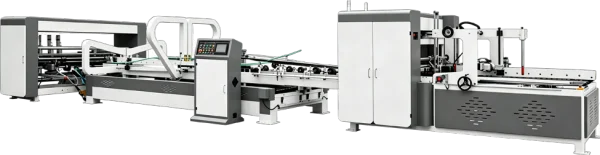
A single-piece folder gluer machine replaces that chain of manual tasks with one continuous line. Blanks are lifted from the stack by an automatic belt suction feeder and passed forward individually. The machine then applies glue, folds the panels, corrects the carton position and bonds the flap before counting and delivering the finished boxes in order. An optional box-flipping function and a packing arrangement can be added, depending on how the plant organizes its output.
What changes is where control resides. Glue position, folding movement and carton alignment are governed by the mechanical structure and settings of the machine rather than by individual technique. Counting and stacking happen at the output end, which removes manual tallying and carrying. Operators remain essential, but their work shifts toward loading blanks, monitoring the line and collecting stacks, tasks that rely on supervision rather than repeated manipulation of each carton.
Output, Labor and Consistency Measured Side by Side
On output, the contrast lies in predictability more than in any single figure. Manual production slows and speeds with fatigue, breaks and staffing, while a machine running at its set condition delivers a steadier flow of cartons. That steadiness helps planners estimate how long an order will take, and it supports commitments to customers who expect scheduled shipments. Actual throughput still depends on carton style, board quality and glue type, so each plant should assess it against its own products.
Labor and consistency follow the same pattern. A manual line needs several people working in coordination, whereas a folder gluer machine is typically supervised by a small team handling loading, monitoring and collection. The saved effort can be redirected to inspection, preparation and handling of other orders. Because the machine repeats one defined sequence, cartons tend to share closer dimensions, glue-line placement and joint appearance. That regularity reduces rework, supports smoother passage through automatic packing equipment and gives buyers of the cartons fewer surprises at their own filling stations.
Carton Orders Where the Gap Becomes Visible
E-commerce and express packaging show the difference most clearly. Orders are large, box styles are fairly uniform and delivery windows are short. Our machine suits this pattern because continuous feeding, folding and bonding keep a long batch moving at a regular pace, and the counted, stacked output moves straight to bundling or packing. The same steadiness benefits plants that supply parcel carriers, where late cartons can interrupt a customer's own dispatch.
Food, beverage and household product cartons raise a different concern. Outer boxes are stacked high in warehouses and travel through long distribution chains, so the strength and neatness of each glued joint influence transport losses and how the brand looks on arrival. The calibration step on our machine corrects carton position before bonding, which supports square boxes and firm seams in these sectors. Appliance, electronics and industrial packaging introduce wide size variation across many specifications, and the broad board size range of our machine allows a single line to cover more of these orders, reducing the need to outsource smaller or less common carton types.
Manual gluing keeps a place in a few situations. Very small batches, prototype cartons and unusual shapes may be handled more flexibly by hand, and some plants keep a manual station for exactly these jobs. The practical decision is therefore less a question of replacing one method than of assigning each order type to the process that suits it.
Finding the Right Fit for Your Carton Production
The right production method depends on your typical order volume, carton specifications, staffing capacity and required output. Manual gluing may suit occasional orders and small batches, while a single-piece folder gluer machine offers a more structured process for regular production. Comparing these factors helps carton manufacturers choose equipment that matches their actual workload and budget.
We manufacture single-piece folder gluer machines with integrated feeding, gluing, folding and output functions for corrugated carton production. Share your carton dimensions, board specifications and expected production volume with our team. We can assess your requirements and recommend a suitable machine configuration for your factory.
 Application Scenarios