

Changing a folder gluer from one carton size to the next means repositioning guides, belts and pressure settings across the whole line. The time this takes, and the consistency of the result, depend largely on how those adjustments are made. In a modern two-piece folding and gluing machine, a PLC, a touchscreen and servo-driven adjustment bring them together into one repeatable routine.
Costs of Manual Adjustment on Conventional Machines
A two-piece folding and gluing machine feeds, glues and folds two separate pieces, then splices them into a single carton, so every section must be set to the dimensions of the carton being produced. On conventional machines, much of this setting is done by hand. Operators turn hand wheels to position guide plates, side flaps and belts, and they confirm each position against a printed scale or their own judgement. The method works, but it carries clear costs. Changeovers take longer because each adjustment is made and checked individually. Two operators setting the same carton may reach slightly different positions, which shows up as variation in squareness from shift to shift. A repeat order is often set up again from the beginning, with trial sheets consumed until the carton runs correctly. Control is a further weakness. When several sections share a drive or lack central coordination, speed and position cannot be tuned separately, and tracing a defect to the section that caused it becomes a matter of experience rather than observation.
PLC, Touchscreen and Servo Drives at the Core
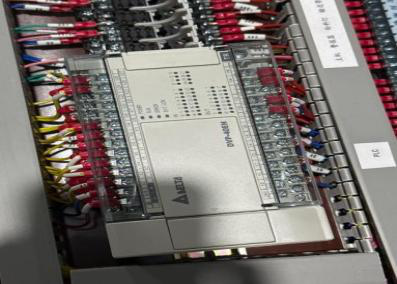
Our two-piece folding and gluing machine moves much of this work from the operator's hands to its control system. A Delta PLC coordinates the movements and speeds of the individual sections. A WECON touchscreen serves as the operator interface, so settings are entered and reviewed in one place instead of at several points along the line. Delta servo motors carry out the precise positioning, and photoelectric switches detect the position of the board as it travels. Relays, contactors and a frequency converter from recognised suppliers handle electrical switching and motor speed. The combination matters more than any single part. The PLC decides, the touchscreen communicates, and the drives execute, which gives the operator one clear path from a carton specification to a correctly adjusted machine.
Stored Settings and Electric Adjustment
The practical benefit of this control arrangement is most visible during changeover. The touchscreen stores settings for specific carton formats, allowing operators to recall verified parameters when repeat orders return. This reduces repeated measurements and trial adjustments, making size changes more efficient.
The splicing section offers a similar function through electrically adjusted guide plates with screw-rod positioning and memory settings. Since splicing accuracy directly affects carton squareness, recalling guide plate positions helps maintain consistent alignment across production runs.
Independent drives provide further flexibility. The feeding, folding, conveying and patting sections each have their own motor, coordinated by the PLC. Operators can adjust one section without resetting the others. For example, folding belt speed can be reduced for stiff double-wall board while feeding and conveying settings remain unchanged. The conveying section also supports manual or automatic length-following operation, with adjustable upper pressure and optional pneumatic regulation. Photoelectric detection and servo positioning at the splicing mouth provide additional control over board alignment.
For plants handling frequent size changes and small or medium batches, these functions make setup more repeatable. Operators can work from stored parameters and defined adjustment points rather than relying entirely on experience, helping maintain consistent production quality across different carton formats.
Consistent Setup Across Shifts
Control hardware delivers its full value only when it is used consistently. Plants that record the stored settings for their common carton formats, and apply them in the same order each time, tend to see more uniform results between operators and between shifts. Centralised control also makes maintenance more direct. Since each section is driven and adjusted separately, a deviation in the finished carton can be traced to the stage where it began, whether that is feeding, folding or splicing, instead of being sought across the whole machine. It is worth stating plainly that a control system improves the consistency of setup and cannot replace the other conditions for good cartons. Board quality, adhesive selection and workshop conditions still need attention, and the best settings are those developed on the plant's own materials.
For plants that run a wide range of carton sizes, the control layer of a folder gluer deserves as much attention as its mechanical structure. We design and build our two-piece folding and gluing machine as one system, with the PLC, touchscreen, servo drives and electric adjustment developed to work with its mechanics. Each machine can be configured to the carton formats and board grades our customers produce, and the same control platform carries through the whole line. For manufacturers who want setup to depend on stored settings rather than on individual habit, that is the design principle behind our machine.
 Application Scenarios