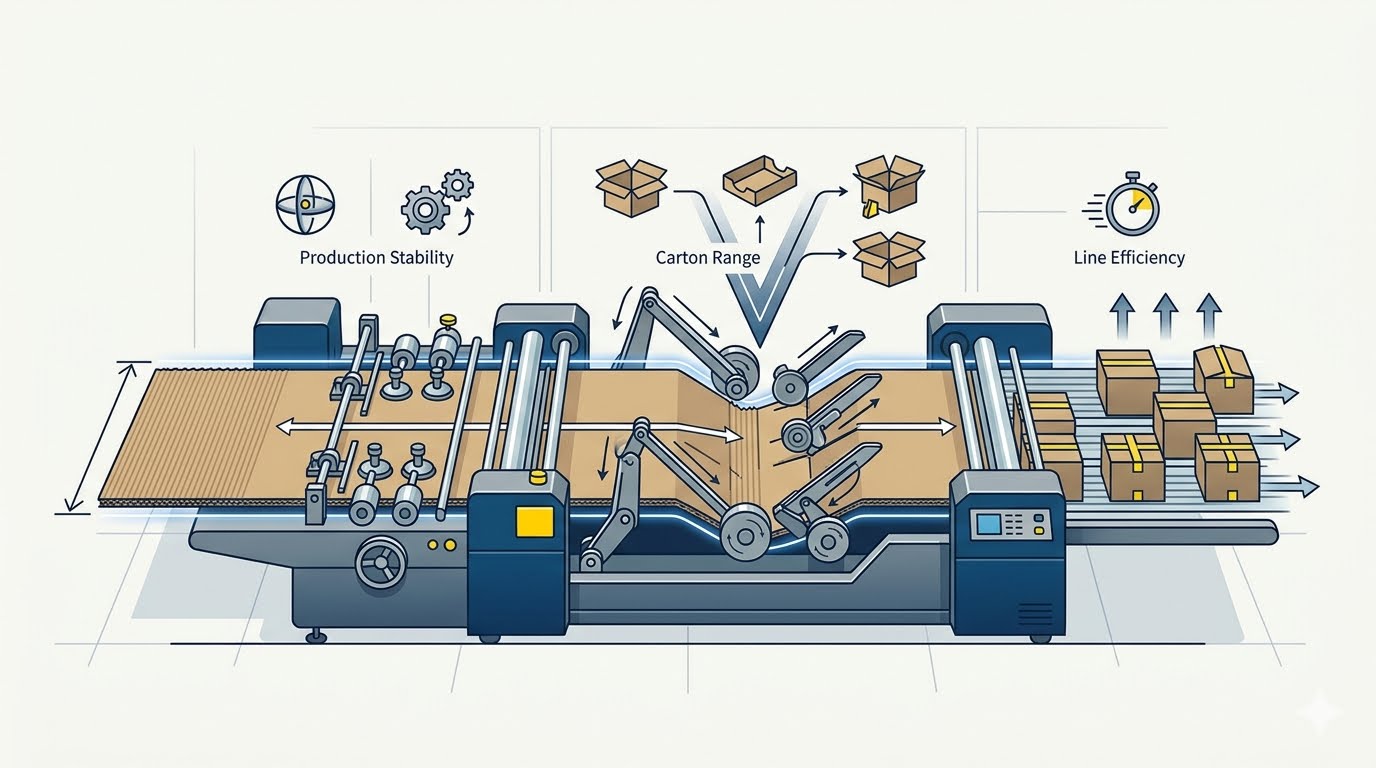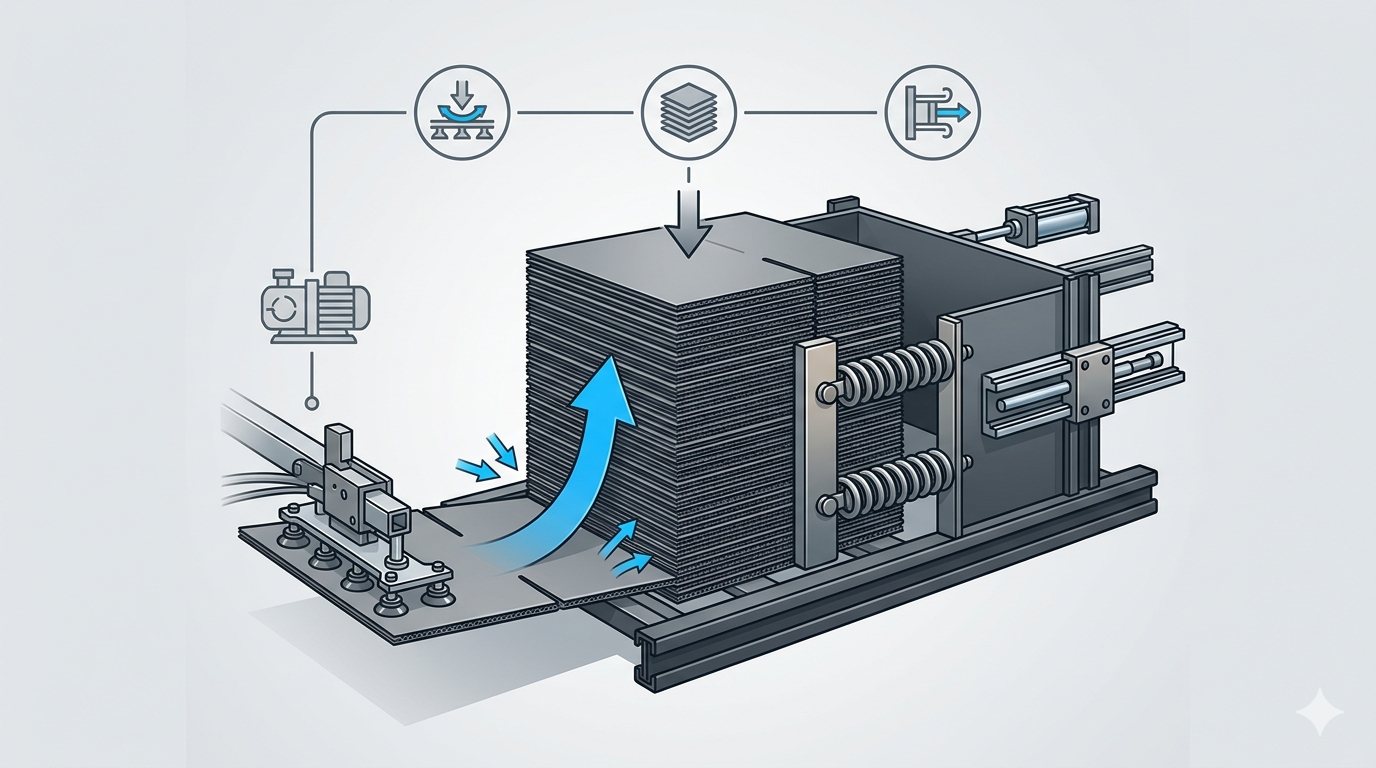


A folder gluer can only fold and glue a carton as accurately as it receives the board. The feeder fixes the position of every sheet before it enters the folding, gluing, and stitching sections, so a small sideways shift at the start carries through to the finished box. Sheet drift is therefore a common source of skewed folds and uneven glue flaps. In our semi-automatic folder gluer, a downward vortex suction feeding system holds the board against the belts and helps it travel in a straight line.
Why Sheets Drift and What Drift Costs the Finished Carton
Drift rarely has a single cause. In most plants, several small factors act together. Friction between the board and the feeding belts is seldom perfectly even, and belts lose grip as they wear. Dust from corrugated board gathers on belt surfaces and reduces traction. Boards that have absorbed moisture or been stored under load often arrive slightly warped, and a warped sheet lifts away from the belt at the edges. Conventional feeders that rely mainly on the weight of the sheet itself have limited means of resisting these effects, particularly with large or thin boards.
The consequences appear quickly in the finished product. A sheet that enters the machine at a slight angle produces a fold line that is not parallel to the board edge. The glue flap then varies in width along its length, and the assembled box fails to sit square. In more severe cases, the sheet catches on a guide and causes a jam that stops the line.
The indirect costs matter as much as the visible defects. Cartons that do not meet the specification must be reworked or discarded, and operators spend time stopping the machine to realign sheets. Each interruption lowers effective output, and the effect is more pronounced on longer runs, where small corrections accumulate over a shift. Treating drift as a feeding problem, rather than a downstream adjustment problem, addresses it at its origin.
Packaging Sectors Where Sheet Alignment Matters Most
Folder gluers serve nearly every segment of corrugated packaging, but the tolerance for misalignment differs between them. E-commerce and parcel cartons are produced in large quantities and in many sizes. These boxes often pass through automatic case-erecting and sealing lines at the customer's warehouse, and a carton that is not square can hesitate or jam in that equipment. Consistent squareness at the folder gluer helps prevent those stoppages further along the supply chain.
Large cartons for household appliances and furniture present a different challenge. The boards are big, and a sheet of that size is more likely to swing or twist as it moves along the feeding path. The glue flap on such a box carries real load during stacking and transport, so a flap that is narrower than intended on one side weakens the joint exactly where strength is needed. Accurate positioning at the feeder supports a stronger and more uniform glued seam.
Outer cartons for food and household goods are judged on appearance as well as strength. Retail buyers and distributors notice misaligned folds and uneven glue lines, and such flaws can lead to rejected deliveries or quality complaints. Plants serving these customers need a machine whose feeding remains steady across long runs, since visual consistency depends on every sheet entering the machine in the same position.
How Downward Vortex Suction Holds the Board on the Belts
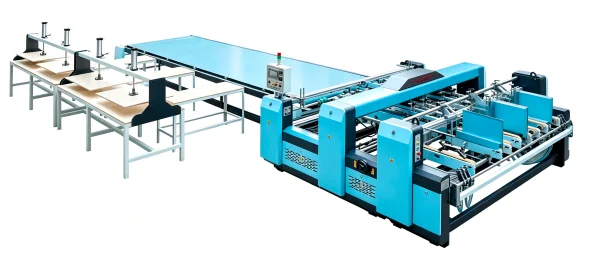
The feeding section of our semi-automatic folder gluer combines a downward suction structure with a vortex suction pump. Beneath the belts, the pump creates a steady holding force that draws the board toward the belt surface. The sheet stays in contact with the belts along its full width instead of resting on them under its own weight alone. Edge lift is reduced, and the board is less likely to slide sideways when the belts accelerate or when the sheet meets a guide.
The suction works together with the belt arrangement. Eight wide rubber feeding belts carry the board, and independent dual servo motors drive them. Because the drive is servo-controlled, belt speed remains consistent across the machine, and the sheet advances at an even pace. Suction provides the grip, while the servo drive provides the uniform motion. Neither alone would give the same stability, since a strong hold on belts that move unevenly would still distort the sheet's path.
This combination is designed to improve the accuracy and efficiency of paper output and to avoid generating waste sheets as the machine feeds. The feeding section also includes two cardboard stacking positions, which can be adjusted to board size, and four feeder knives whose asymmetric length can be set to match the actual sample. These features let the operator prepare the next stack while the current one is feeding, and they support accurate separation of each sheet from the pile.
Suction does have limits. It improves the grip on a board, but it cannot fully correct a badly warped sheet or a stack that has been stored poorly. Good board handling and sensible stacking remain part of reliable production. What the vortex suction system offers is a more stable starting point, so that the adjustments the operator makes are working with the sheet rather than against it. Downstream, the electrically adjusted guides and servo-driven belts in the splicing section continue the same logic of controlled, repeatable positioning, although the feeding stage remains where drift is most effectively addressed.
What Steadier Feeding Delivers in Daily Production
For e-commerce and parcel cartons, steadier feeding translates into boxes with more consistent squareness. This consistency supports smooth passage through downstream case-erecting and sealing equipment and reduces the likelihood of stoppages caused by irregular boxes. Plants that supply high-volume customers can run longer without pausing to realign sheets, which helps protect output during busy periods.
For large appliance and furniture cartons, the combination of suction and independent servo-driven belts helps big boards remain on a straight path. The glue flap lands in its intended position, and the glued joint is more even along its length. Such a joint is better able to carry the stacking and handling loads these cartons experience, and the box takes shape with fewer visible irregularities.
For food and household goods cartons, consistent entry of every sheet gives folds and glue lines a uniform appearance from the first carton to the last. Reduced rework and fewer rejected boxes also lower material waste, which matters in an industry where board is a major cost.
We design and manufacture our semi-automatic folder gluer in our own factory, and its development is supported by CE certification and Chinese patent certificates. Our machines operate for customers in many regions, handling a wide range of board sizes and carton styles. If sheet drift is affecting your production, our team can review your board specifications, carton types, and plant layout with you and discuss how the downward vortex suction feeding system in our machine could fit your requirements.
 Application Scenarios