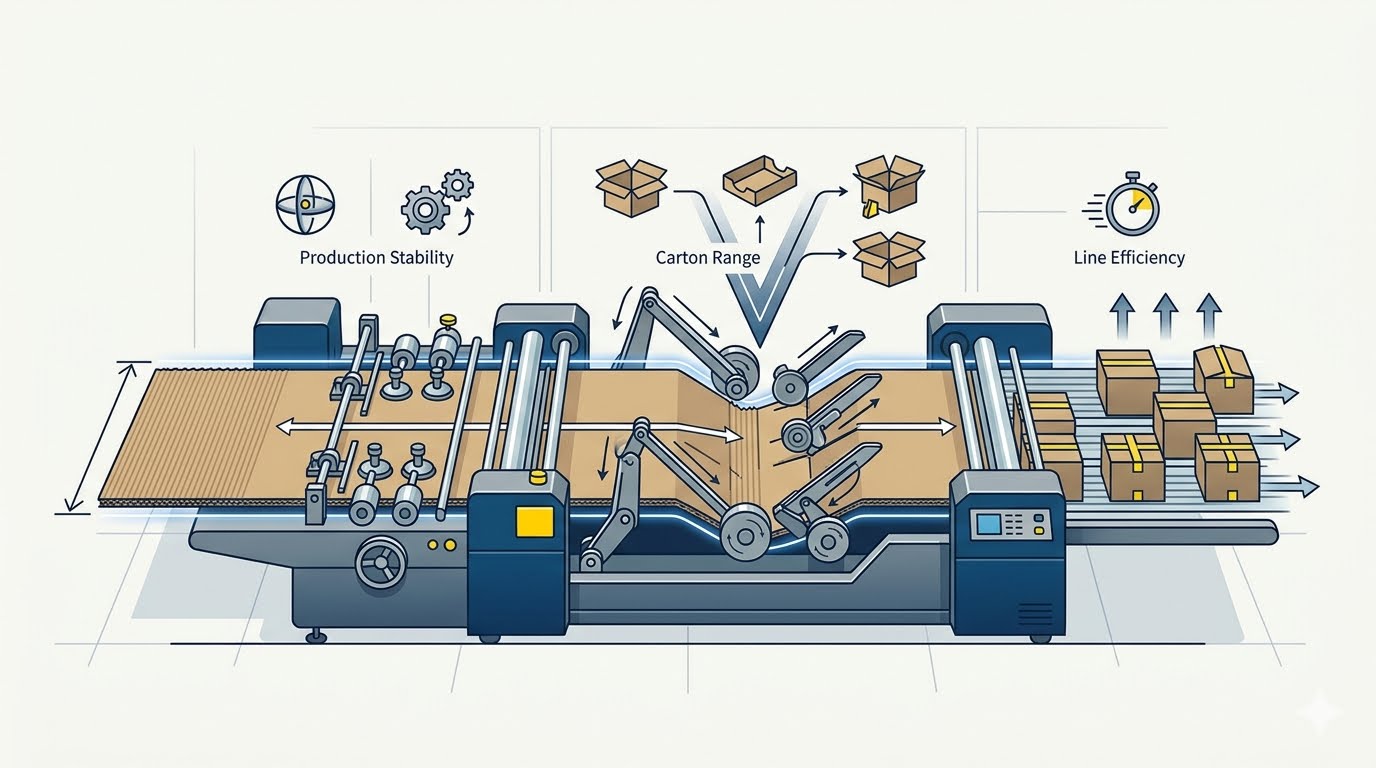


A carton takes its final dimensions in the splicing section. The printed and slotted board arrives with its panels already cut to size, but the position at which the glue flap meets the opposite panel decides the finished length, width, and squareness of the box. Once the seam is pressed, that position cannot be changed. In our semi-automatic folder gluer, the splicing section is designed around controlled guide plates, servo-driven belts, and photoelectric positioning, so that this final step holds the dimensions the board was cut to deliver.
How Small Splicing Deviations Become Dimensional Errors
The relationship between splicing and carton size is geometric. When the flap lands slightly too far in one direction, the panels it joins are pulled out of their intended relationship, and the box comes out longer or shorter than specified. When the flap lands correctly at one end but drifts at the other, the box twists. Its diagonals become unequal, and the carton no longer sits square on a flat surface. A deviation of only a few millimetres can be enough to cause trouble, because corrugated cartons are often packed with small clearances in mind.
Several features of conventional equipment make such deviations more likely. Guide plates that are adjusted by hand take time to set, and their final position depends heavily on the operator's judgement. After each change of order, the operator may need several trial sheets to find the correct setting, and the setting can shift again during a long run. Uneven pressure during pressing is another source of error. If the board is pushed unevenly as the seam closes, the panels can slip or spring back slightly before the adhesive takes hold.
The difficulty is that these errors often stay hidden until the carton is used. A box with the wrong dimensions looks acceptable on the pallet, and the problem appears only when the box meets a filling line, a product, or a stack. At that point the carton is finished goods, and the only options are rework or rejection.
Why Carton Size Consistency Matters Beyond the Folder Gluer
Dimensional accuracy has its greatest effect on the equipment and processes that handle the carton afterward. Automatic case erecting and sealing lines are set for a defined box size and a defined shape. A carton that is slightly out of square may open unevenly, catch on guides, or fail to close flat, and each hesitation can halt a line that is meant to run continuously. Plants that buy cartons in large volumes often specify tolerances for exactly this reason.
Fit matters as well. Many products are packed with inner supports such as pads, dividers, or trays that are made to match the interior of the box. If the carton is slightly smaller than intended, these inserts bind and are difficult to place. If it is slightly larger, the product has room to move during transport, and the protection the packaging was designed to give is reduced. Consistency from one carton to the next is therefore as valuable as the nominal size itself, since packing lines are tuned to a repeatable box.
Palletising and transport complete the chain. Cartons that are not square stack less neatly, and a pallet built from them can lean or lose usable space. During shipping, a leaning stack distributes load unevenly and puts extra stress on the boxes at the bottom. Good splicing is a small part of the process, but its results carry through each of these later stages.
Inside the Splicing Section: Where Dimensional Control Is Built In
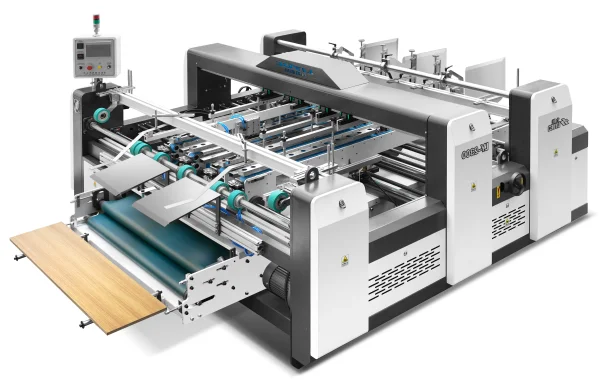
The guide plate arrangement is the starting point of our splicing section. The structure has five plates, four large and one small, and each large plate is moved by a leading screw under electric adjustment. Replacing manual repositioning with electric control makes each setting faster to reach and easier to repeat, which shortens the time spent on trial sheets after a change of order. The same repeatability helps the plates return to a known position, so that a size run earlier in the week can be set up again with less guesswork.
Conveying is handled by four narrow delivery belts, driven by dual servo motors. Servo drive keeps the speed of the belts even and responsive, and an even belt speed means the board advances through the stitching zone without being dragged or bunched. This matters for dimensions, because a board that is moving unevenly when it meets the flap is more likely to be joined out of position. The belts and guide plates work together, with the plates defining where the board should be and the belts carrying it there at a steady pace.
Pressing and positioning complete the section. Steel balls press the board, and a plastic cover over the pressing area reduces noise and helps the adhesive bond firmly. A photoelectric device guides the cylinders so that the splice is made at the intended point, which ties the physical position of the seam to a sensed reference instead of the operator's eye alone. At the stitching interface, a hot and cold double coating strengthens the joint, so that the position achieved during splicing is held once the carton leaves the machine.
What Dependable Splicing Means for Different Carton Orders
Cartons for e-commerce and parcel shipping need consistent dimensions to run smoothly on automatic packing lines. Poor splicing alignment can affect carton squareness and cause feeding or sealing problems. For custom-sized cartons used for appliances and industrial equipment, dimensional accuracy helps ensure that products and protective inserts fit as designed. In mixed-size production, repeatable guide plate settings also reduce adjustment time and help maintain consistent results across different specifications.
Splicing accuracy depends on the alignment of the board edges and the stability of the machine’s positioning system. Our semi-automatic folder gluer is manufactured in-house and available in single-station and multi-station configurations to suit different production spaces and carton sizes. We focus on practical machine design that helps operators maintain consistent carton dimensions and reliable gluing results. Share your carton specifications and dimensional tolerances with us to discuss the configuration best suited to your production needs.
 Application Scenarios