

A corrugated box folder gluer machine brings several carton-forming steps into one continuous production process. From suction feeding and precise positioning to glue application, folding and finished box delivery, each stage affects the accuracy and consistency of the final carton. For carton manufacturers, a well-coordinated workflow helps reduce manual handling, maintain stable production and prepare corrugated boxes for the next packaging stage.
Limitations of Manual and Semi-Automatic Carton Gluing
Manual and semi-automatic gluing rely heavily on operator skill, making consistent adhesive application difficult to maintain across large batches. Differences in glue quantity and placement can lead to excess adhesive on some cartons and weak bonding on others. If a glue flap does not bond securely, it may open during stacking or transport, creating problems when the cartons reach the packing line.
Keeping carton panels aligned is another challenge. Manual folding and equipment with limited positioning control can cause creases to shift or glue flaps to move out of place. The resulting cartons may be uneven or slightly skewed, affecting their performance on automatic case erectors, sealing machines and filling lines. Consistent carton dimensions and accurate folding help downstream equipment run with fewer interruptions.
Labor requirements also affect production efficiency. Operators must feed blanks, handle finished cartons, count output and arrange boxes into stacks. These tasks take time and make production capacity dependent on staffing levels. When order volumes increase, maintaining the same output may require additional workers and closer supervision. A corrugated box folder gluer machine integrates feeding, gluing, folding and delivery into a coordinated process, helping carton manufacturers maintain more consistent production while reducing repetitive manual handling.
Tracing the Workflow of a Corrugated Box Folder Gluer Machine, Step by Step
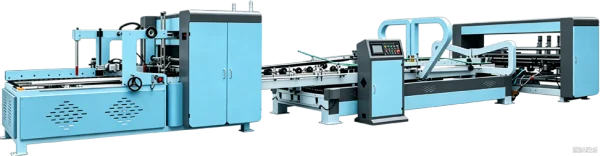
The machine is organized into paper feeding, gluing, folding, counting and stacking, and output sections. Each section addresses a specific weakness of manual production, and together they form one continuous line.
The process begins at the feeding section. An automatic belt suction system lifts the paperboard blanks and passes them forward one sheet at a time. Because the blanks are separated by controlled air suction rather than pushed or dragged, the risk of double feeding and surface scuffing is reduced. A steady, evenly spaced feed also determines how accurately every later stage can work, which is why this section matters as much as the gluing unit itself.
After feeding, the blank moves through automatic gluing and folding. The glue is applied to the flap area, the panels are folded along their creases, and an automatic calibration step corrects the position of the folded carton before bonding. Calibration is the stage that keeps the box square. Without it, small shifts that occur during folding would carry through to the finished product. The folded carton then passes through the bonding section, where the glued flap is pressed so that the joint sets evenly.
The final stage handles output. Finished cartons are counted and delivered in an orderly stack, which makes bundling and handover to the next process straightforward. Depending on production needs, the machine can also be equipped with an optional box-flipping function, followed by packing. This keeps the sequence from blank feeding to bundled cartons largely automatic and limits the number of points where an operator has to intervene.
How a Folder Gluer Supports Different Packaging Sectors
Electronic commerce and express packaging place heavy demands on carton plants. Orders are frequently large, box styles are relatively uniform, and delivery schedules are tight. A folder gluer suits this pattern because it keeps the same folding and bonding sequence running across long production batches, so the last carton in a run resembles the first.
Food, beverage and household product packaging introduces a different priority. Outer cartons in these sectors are stacked in warehouses and carried through long distribution chains, so the strength of the glued joint and the neatness of the box affect both transport losses and how the brand is presented at the point of delivery. Consistent glue application and accurate folding contribute directly to both concerns.
Appliance, electronics and general industrial packaging bring wide variation in carton size. Producers in these fields often handle many box dimensions within a single week, including short runs for specialized products. A machine that accepts a broad range of paperboard sizes lets a plant cover these varied orders without maintaining a separate line for each carton type.
What Our Machine Brings to Production Lines
As a manufacturer of corrugated box folder gluer machines, we design our equipment around the practical conditions of carton production. The belt suction feeding system supports steady sheet separation, which is useful for high-volume e-commerce and express cartons where a stable rhythm keeps the whole line productive. When the feed remains consistent, the later gluing and folding stages can operate with fewer interruptions.
The gluing, calibration and bonding sequence is built to help cartons leave the machine with a square shape and a firm joint. This matters most for food, beverage and household product cartons, where stacking pressure and transport vibration test the quality of every glued seam. Cartons that come off the line with accurate folds also fit more smoothly into downstream packing equipment, which supports efficiency beyond the folder gluer itself.
Our machine also accommodates a wide range of paperboard sizes, which benefits producers of appliance and industrial cartons who run many specifications. Counting and stacking at the output end give operators a tidy, countable stack, while the optional box-flipping function and packing arrangement allow the line to match different plant layouts. These features are intended to reduce manual handling and give production managers a more predictable process, without suggesting that any one machine fits every carton type.
Matching the Machine to Your Carton Line
The workflow of a folder gluer, from suction feeding to counted and stacked cartons, is a sequence in which each stage supports the next. Reliable feeding enables accurate gluing, accurate folding enables dependable bonding, and orderly output prepares the cartons for packing. When these stages work together, the plant gains a more controlled and repeatable production process.
We design and manufacture our corrugated box folder gluer machines with this entire sequence in mind. Our team can discuss your carton styles, board sizes and output requirements to help determine which configuration suits your production line. If you are evaluating equipment for a new or existing carton plant, send us your carton specifications and production targets, and we will be glad to review them with you.
 Application Scenarios