For overseas buyers, selecting a heavy-duty corrugated box folder gluer machine involves more than comparing prices and production capacities. When processing oversized cartons, the machine must maintain structural stability, accurate sheet positioning and consistent gluing performance. Component quality, certification and access to technical support also influence long-term operating reliability. Evaluating these factors helps manufacturers choose equipment suited to their carton specifications and production requirements.
The Questions Behind an Overseas Machine Purchase
Reliability over time is the first concern. A machine installed abroad cannot be inspected whenever a doubt arises, so buyers want evidence that the frame will stay rigid and the moving parts will hold their accuracy. A folder gluer that loses alignment after a year or two produces drifting fold lines and misplaced glue flaps. The plant then spends more time adjusting than producing.
Spare parts are the second concern. Every machine eventually needs replacement bearings, belts, sensors or electrical components. If these parts come from obscure or proprietary suppliers, a plant may wait weeks for a single item while the line stands idle. Buyers who have lived through this tend to ask about component brands early in the discussion.
The third concern is the carton itself. Plants that serve furniture, industrial and household goods markets handle large blanks as a matter of routine. They need to know whether a machine can feed, fold and splice oversized board without skew, and whether it can hold the same settings from one order to the next.
Large Cartons in Furniture, Industrial Parts and Household Goods
Furniture and flat-pack products are a clear example. Panels and frame members are long and heavy, so the cartons that carry them are large and must withstand stacking and repeated handling. The glued seam is a structural part of the box. If the overlap is misplaced or the bond is weak, the carton can open or deform under load in a warehouse or container.
Machinery components and automotive parts present a different profile. Their weight is concentrated, and carton sizes vary widely from one product to another. A plant serving this sector often runs many carton formats in modest quantities, which makes changeover speed and repeatability as important as raw capability. Each size change that requires repeated trial adjustment reduces the time left for production.
Large household goods and bulky consumer products follow another pattern. These cartons are usually palletized and loaded into containers, where dimensional consistency matters. A carton that is slightly out of square wastes pallet space and can destabilize a stack. Squareness at the folder gluer therefore affects freight efficiency further down the supply chain.
Conventional equipment struggles in all three cases for related reasons. Large sheets warp, so feeding becomes unstable. Frames that lack rigidity flex under heavy board. Splicing sections without positive control let the overlap wander. These are structural limitations, and they are difficult to correct through operator skill alone.

A Heavy Frame and Careful Sheet Control for Oversized Blanks
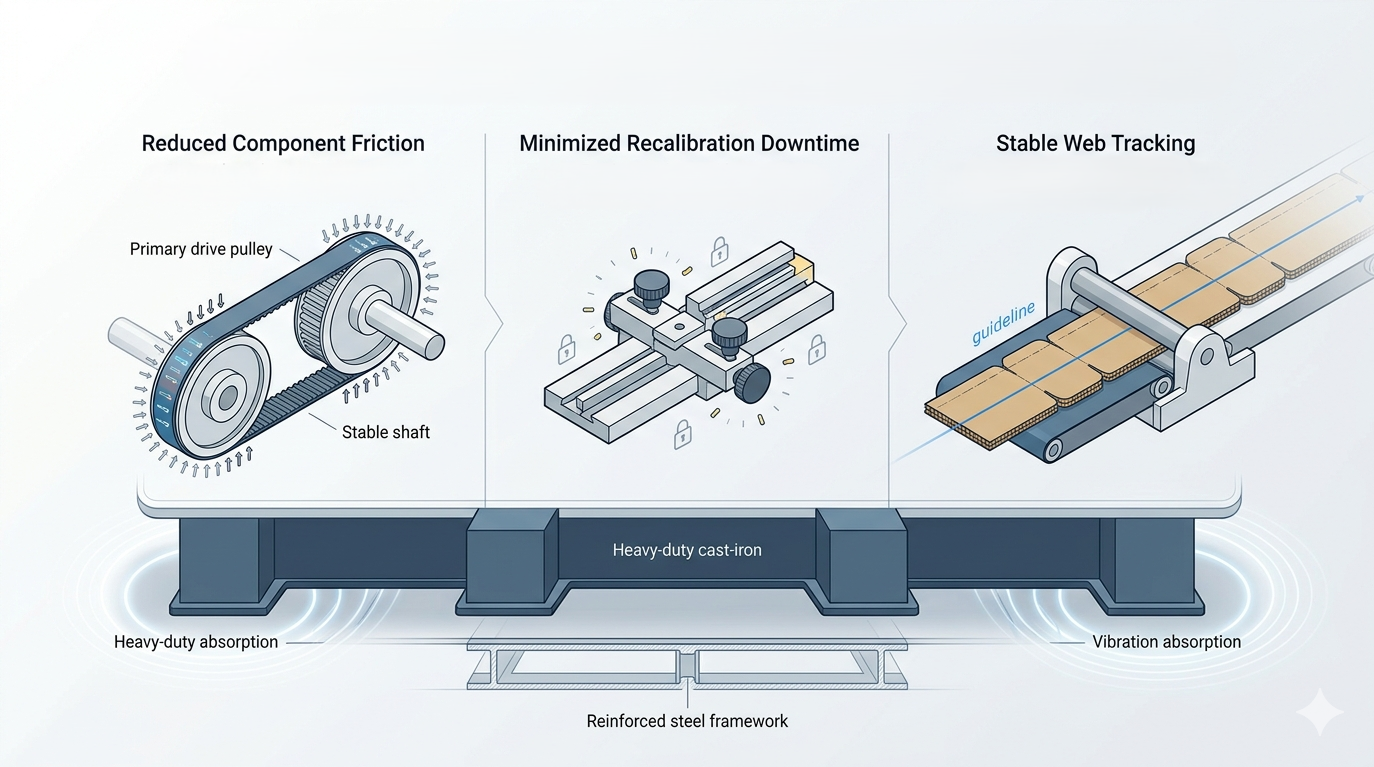
Our two-sheet folder gluer addresses these limitations through its structure. The machine walls are made from 16 mm cold-heat-treated plate, and the complete machine weighs in the ten-tonne range. This mass has a purpose. A rigid, heavy frame damps vibration and resists flexing under oversized board, which helps fold lines and seam positions remain consistent through long shifts. For plants producing large furniture and appliance-class cartons, that consistency is the foundation of repeatable quality.
Sheet control begins at the feeding section. A friction feeder with its own servo motor draws each blank forward, while adjustable side flaps and a retractable rear support keep long sheets seated correctly. An air suction function assists with separating sheets and reducing double feeding. Our larger configuration accepts sheets exceeding one meter in both directions, which covers the large carton formats common in export-oriented packaging.
The splicing section governs seam quality, and it is built for precision. Guide plates are adjusted electrically and can be stored in memory, so a plant that alternates between carton sizes can return to a proven setting without repeated trials. Two independent servo motors drive the belt conveyors, steel-ball pressing holds the board during bonding, and photoelectric detection guides the sheet into position. Hot and cold double coating at the splicing interface helps the glued area set firmly. For industrial parts cartons that carry concentrated loads, this combination produces an accurate overlap and an even, secure bond.
Replacement Parts From Recognized International Brands
A machine is only as maintainable as its components. We specify established international brands for the parts that matter most to long-term operation. Bearings come from NSK and linear guide rails from HIWIN. The PLC and servo motors are supplied by Delta, relays by Omron, contactors and optical switches by Schneider, and pneumatic components by AirTAC. These suppliers sell through distributors in a wide range of markets, which is exactly what an overseas plant needs when a part reaches the end of its service life.
The practical effect shows up on the maintenance schedule. When a bearing, sensor or contactor needs replacing, a plant can usually source an equivalent through its local industrial suppliers, without waiting for a shipment from the machine builder. Downtime shrinks, and maintenance staff work with components they already know. For a furniture or machinery carton plant running tight delivery schedules, shorter stoppages directly protect output.
Established components also support the machine's long-term accuracy. Parts from mature suppliers tend to show consistent performance, and consistent parts make it easier for a plant to keep the machine within its original tolerances. This complements the structural design described above. A rigid frame holds the geometry, and reliable components keep the motion and sensing within it dependable.
Certification forms part of the same picture. Our machine carries CE certification, which is a relevant credential for buyers in markets where such conformity is expected. It does not replace a buyer's own due diligence, but it gives purchasing teams a recognized reference point when they compare suppliers.
Overseas buyers are right to ask hard questions before ordering a heavy production line. We build our corrugated box folder gluer machine around the answers: a rigid frame for sustained accuracy, controlled feeding and splicing for oversized cartons, and components that a plant can source again when needed. If you produce large cartons for furniture, industrial parts or bulky household goods, send us your board grades, carton styles and daily output targets. We will review them against the configurations we build and recommend the machine that fits your production.
 Application Scenarios