

Fishing rods are among the longest consumer goods shipped in corrugated cartons. A box sold for a two-piece twelve-foot rod measures roughly 190 cm in length, and some rods need cartons longer still. Cartons of this shape have a small cross-section and a very large length, and that proportion changes how they must be produced. A two-piece folding and gluing machine suits this work because it builds the carton from two sheets, and each stage can be adjusted for length.
The Production Problems Hidden in a Long, Slender Carton
A rod carton carries a fragile, slender product, and the box itself has to supply the protection. Retail suppliers of long cartons describe the main requirement in consistent terms: the box must resist crushing, bending and impact during courier or postal transit. A box that flexes along its length transmits that stress to the rod inside. Board selection matters, but so do fold accuracy and seam strength, because a poorly formed carton is weaker than its material suggests.
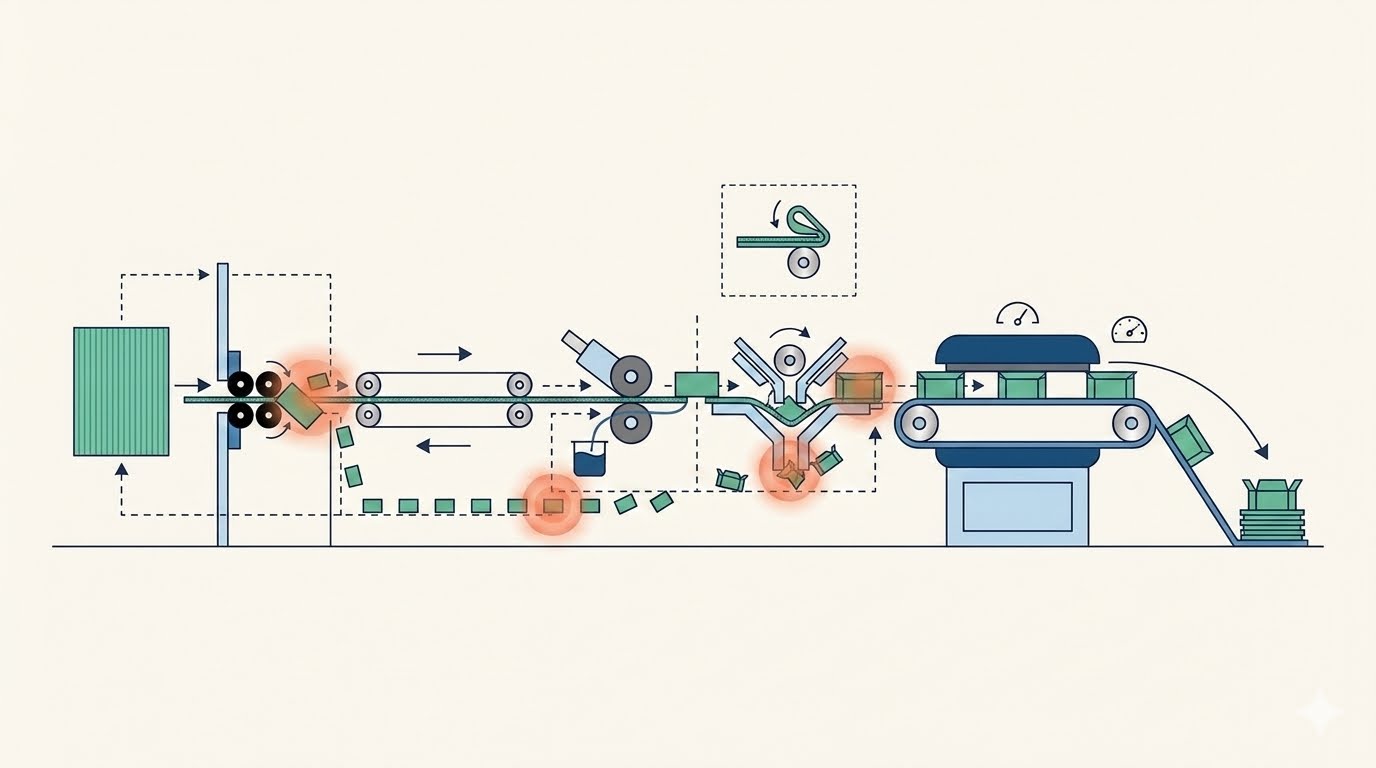
The glued seam is the second difficulty. On a compact box, the seam is a few tens of centimeters long. On a long-format carton, it runs along the full length of the box. Any variation in glue quantity shows up somewhere along that distance, as a thin patch that lifts at the edge or a heavy patch that squeezes out and marks the board. Conventional equipment, which is usually tuned for shorter seams, struggles to keep the glue film consistent over such a distance.
Handling the sheet is the third difficulty. Long, narrow board is less stable than a square blank. It tends to wander sideways as it feeds, and it can twist slightly during conveying and stacking. A carton formed from a skewed sheet leaves the machine out of square, and over a length of a meter or more even a small twist becomes visible. Out-of-square cartons are difficult to pack, difficult to palletize and difficult to seal. Plants that rely on manual correction or frequent stoppages to compensate lose output without gaining reliability.
Rod Cartons Across Tackle Manufacturing, Direct Shipping and Kit Assembly
Tackle manufacturers use long cartons as outer packaging for finished rods. Their requirement is consistency. Hundreds or thousands of cartons for a given rod model should share the same dimensions, so that rods fit properly and cartons stack evenly on pallets. A machine that holds the same fold positions from the first carton to the last meets that need, while one that drifts over a shift creates variation the packing line has to absorb.
Direct-to-consumer and e-commerce shipping places different demands on the same product. Rods travel through parcel networks, where cartons are dropped, stacked and compressed. The glued seam must stay closed under these conditions, and the carton must keep its shape. Here the quality of bonding along the entire seam is the critical measure, because a seam that opens at one point can let the carton collapse around the rod.
Rod and tackle sets add a further layer of variety. A manufacturer may ship a rod alone, a rod with a reel or a rod with accessories, and each combination can call for a slightly different carton. This pattern produces many carton sizes in modest quantities. For the corrugated plant making these boxes, the practical question is how quickly the machine can change from one format to the next without a long period of trial adjustment.
Feeding, Splicing and Patting Built Around Length
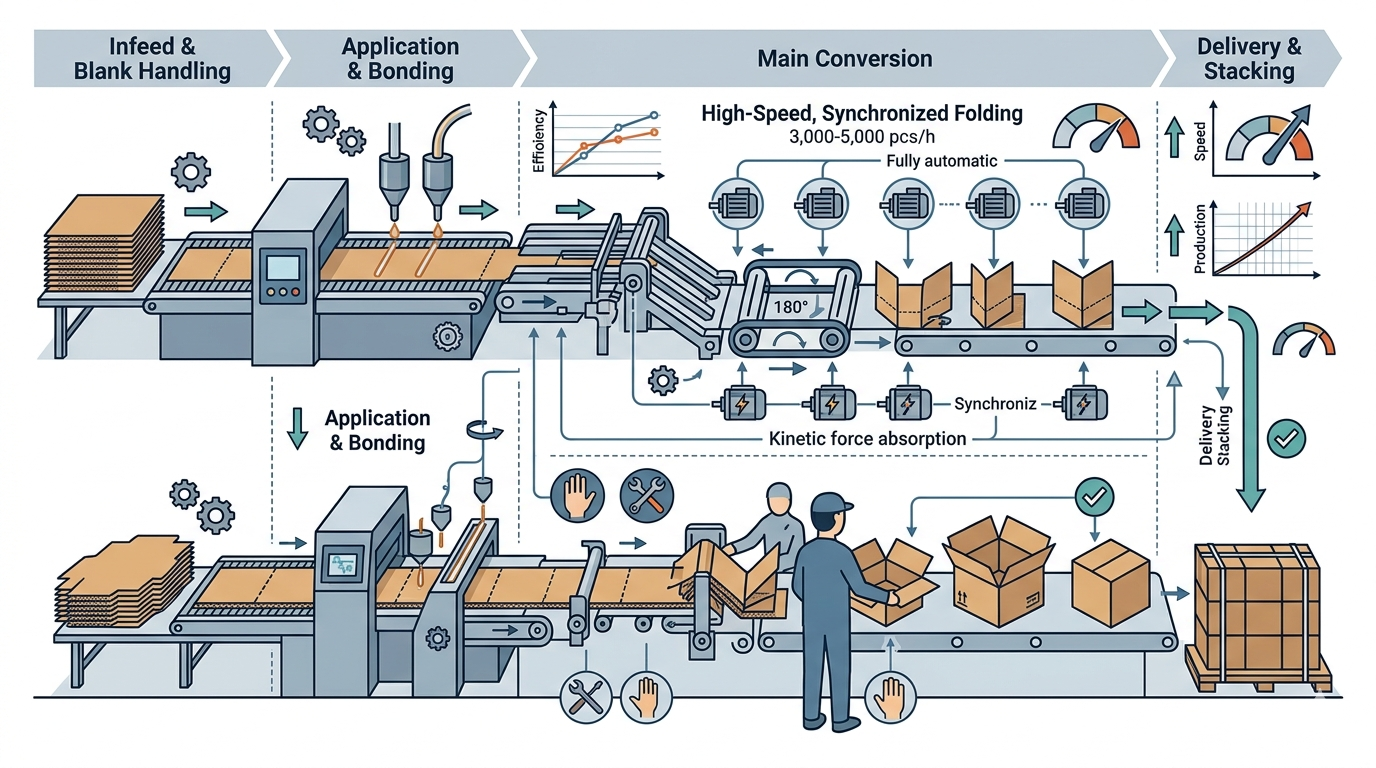
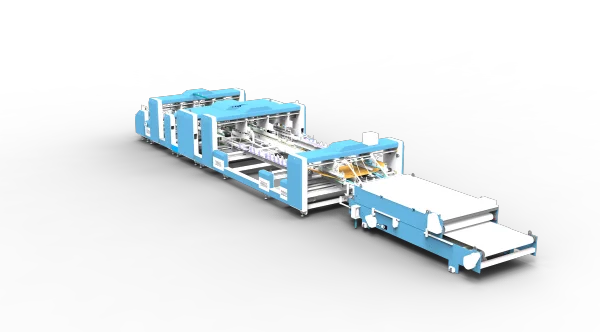
Our two-piece folding and gluing machine is designed with adjustable sections, which is what makes it suitable for long-format cartons. The feeding section uses a friction feeder driven by an independent servo motor, with side flaps adjustable across the width and a retractable rear support at the back of the paper stack. That rear support is specifically intended for longer cartons, and an air suction function helps to separate sheets and prevent double feeding. For a long, narrow blank, this keeps the sheet seated and square as it enters the machine.
The splicing section addresses the long seam directly. It uses a multi-guide-plate structure with electric screw adjustment, and the adjusted positions can be stored in memory. Belt conveyors in this section are driven by independent servo motors, steel-ball pressing holds the board while it bonds, and photoelectric detection guides the sheet into position. Hot and cold double coating at the splicing interface helps the glued area set firmly. Because the pressing and conveying act along the whole seam, the bond is more even from one end of a long carton to the other, which supports the strength that rods need in transit.
Patting and conveying complete the length-related design. The patting section is driven by its own motor, and its upper and lower guide plates are adjusted separately, so the section can be set to the carton length. The conveying section runs in manual or automatic follow-up mode, and its upper pressing part can be moved back and forth according to the carton length, with an optional cylinder pressure regulation. In practice, these features let a plant set the machine to the carton it is running, instead of forcing every carton through the same fixed arrangement.
Gluing follows the same principle of adaptability. The gluing section applies adhesive by mechanical roller, with hot and cold dipping options and an optional spray system. A plant making rod cartons can choose the method that suits its board and adhesive, aiming for a steady film along the full seam. Stored settings in the splicing section help repeat orders return to a known configuration, which shortens changeovers between rod models and kit variants.
Carton length is a point where specifications differ from plant to plant, so we do not describe a single fixed range. The machine can be customized and configured around the carton format a tackle maker or carton plant needs. Sharing the unfolded carton dimensions and board grade early in the discussion allows the configuration to be matched to the work.
Fewer Damaged Rods and Faster Order Changes
When a long carton leaves the machine square, with an evenly bonded seam, several downstream benefits follow. Rods fit consistently, and the carton resists the bending and crushing loads of transit better than one with a weak or twisted seam. Fewer damaged rods mean fewer returns and fewer disputes over packaging, which matters to manufacturers who ship across long distances and to sellers who deal directly with consumers.
Production planning also becomes easier. A plant serving rod and tackle customers typically handles many carton lengths in short runs, and the ability to recall stored settings and adjust the guide plates for length reduces time between orders. That time is production capacity returned to the plant, and it adds up across a year of mixed orders.
We build our two-piece folding and gluing machine to keep the board under control from the feeder to the delivery end, because long-format cartons leave little room for error. If you produce cartons for fishing rods, tackle sets or other long, narrow goods, send us your unfolded carton dimensions, board grade and daily output target. We will review them against the machine configuration and discuss the setup that fits your production.
 Technical Encyclopedia