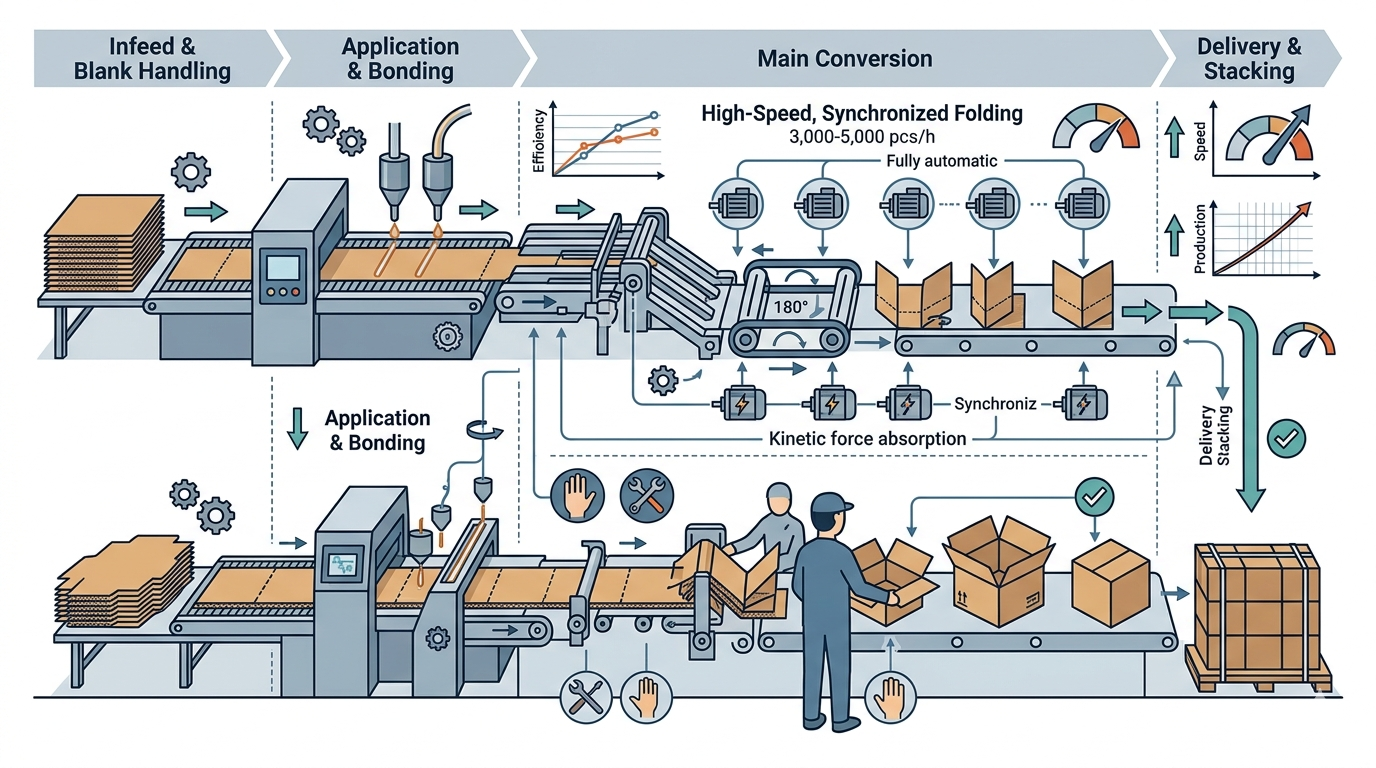
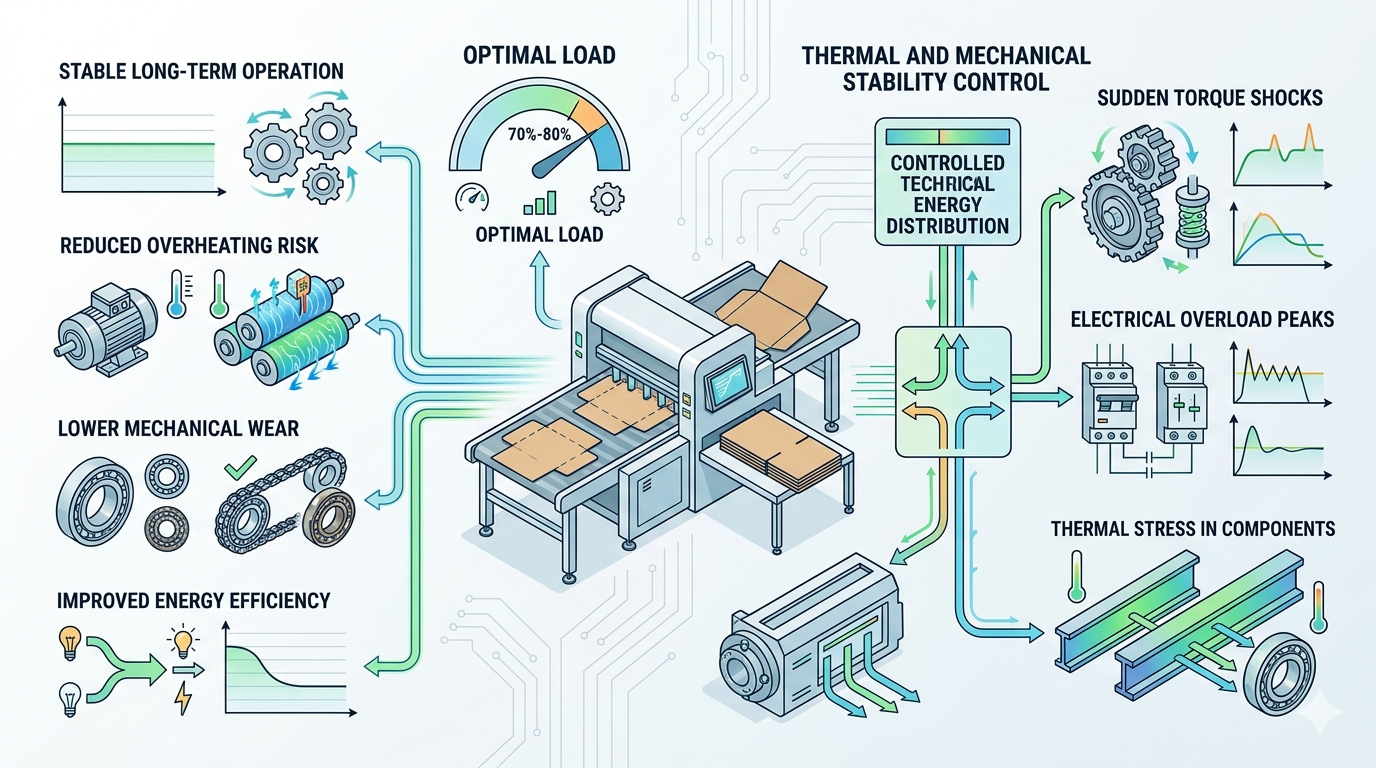
Bagged food products often rely on corrugated cases for outer packaging, storage and transportation. These cases hold multiple bags or pouches together and provide the strength needed for stable pallet stacking. Before filling begins, flat corrugated blanks must be folded and glued into correctly shaped cases. A two-piece folding and gluing machine handles this process for large-format cartons, helping maintain consistent box dimensions and reliable joints. Accurate case forming supports smoother operations throughout filling, sealing and palletizing.
What a Bagged Food Carton Must Do Before It Is Filled
Bagged food products depend on corrugated cartons for protection during handling, storage and transportation. If the outer carton is crushed or deformed, the bags inside may also be damaged. The carton must withstand repeated handling and stacking while maintaining its shape, and the quality of the glued joint plays an important role in keeping the box intact.
Food production lines often use automated case-packing equipment that relies on consistent carton dimensions and square corners. When a carton is out of shape, it may cause feeding problems, disrupt conveying or make pallet stacking less stable. Uneven folding, inconsistent blanks and changes in temperature or humidity can all affect carton geometry and stacking performance. For food manufacturers, maintaining consistent folding accuracy and joint strength helps keep cartons reliable throughout production and distribution.
Where Traditional Folding and Gluing Slows the Line
Manual and basic semi-automatic methods depend on operator judgment and on the condition of the rollers. A blank that enters the folding stage slightly crooked produces a box with a skewed corner, and the glued joint sits a little away from where it should be. Glue lines also vary. Too little adhesive leaves a joint that can open under the load of a stack, while too much is pressed out during compression, marks the carton and collects on belts. Food customers pay close attention to the appearance of their outer cartons, so visible glue residue is a quality concern as well as a mechanical one.
Variety adds another layer of difficulty. A single food manufacturer may run several bag sizes and case counts, and each combination calls for a different carton size. Quick and easy size changeovers are a key feature of modern secondary packaging automation, and a carton supplier faces the same expectation from its customers. When a folding and gluing line takes a long time to adjust, or is adjusted by feel, output changes from one setup to the next and idle time accumulates. The weak points of traditional equipment therefore come down to three: the alignment of large panels, the consistency of the glue line, and the speed of changeover.
The Place of a Two-Piece Folding and Gluing Machine in Food Carton Production
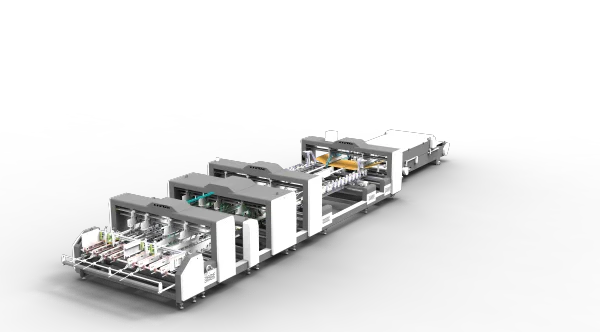
A fully automatic two-piece folding and gluing machine carries blanks through feeding, gluing, folding, splicing, patting and conveying in one continuous line. The defining feature is the two-piece construction. When a carton is too large to be formed from a single sheet, two boards are brought together at a splice and glued in the same pass, and the finished carton leaves the line ready to be bundled and stacked. For bagged food products with larger fill counts, such as multi-bag cases of grain products, snacks or frozen items, this removes much of the manual handling that would otherwise be needed to assemble the carton.
The match with the application is direct. Cartons for automated packing lines must be uniform, because a line that erects, fills and palletizes at speed has little tolerance for an irregular case. Plants that handle many product sizes need a carton supplier who can change between formats without long interruptions. Cartons that carry a stack above them rely on a strong joint. The machine does not change the carton style or the board grade chosen by the customer. Its role is to fold and bond that design in a repeatable way, so that the carton behaves the same on the hundredth order as on the first.
Splicing, Changeover and Gluing Features for Bagged Food Cartons
The splicing section plays an important role in maintaining carton squareness and structural stability. Two servo-driven belt conveyors guide the boards toward the joint, while photoelectric sensors help align them before joining. Precise alignment reduces skew in the finished carton and helps distribute loads more evenly when cases are stacked. The joint is reinforced through hot and cold double coating, followed by steel-ball board pressing to improve bonding where structural strength matters most.
The adjustment system makes changeovers easier when production switches between carton sizes. Electric lead screws move the guide plates, and the memory function stores settings for repeat orders. Instead of adjusting the guides manually each time, operators can recall saved parameters and return to a familiar setup more quickly. For carton manufacturers supplying food producers, this feature helps reduce preparation time when familiar carton formats return to production and supports more consistent results across repeat runs.
In the gluing section, mechanical rollers apply adhesive evenly, with hot glue and cold glue options available. A spray gluing system can also be added when the production requirements call for it. The appropriate adhesive depends on the board grade, carton design and expected storage conditions. Our machine is designed to maintain a consistent glue line throughout production, helping reduce weak joints caused by insufficient bonding and excess adhesive squeeze-out. These details matter for cartons that must withstand stacking, strapping and transportation.
Consistent performance also depends on how the carton moves through the entire machine. Stable suction feeding guides the blanks into the production process, while controlled folding and orderly pressing at the exit help keep the finished cartons uniform. Together, these operations support a smoother workflow and prepare cartons for the filling, sealing and palletizing stages that follow.
Cartons Ready for the Next Stage
After folding and gluing, cartons move on to filling, sealing or palletizing. Their condition at this stage affects how reliably they travel through downstream equipment and how securely they stack for shipment. Consistent dimensions, square corners and firm glued joints are therefore important throughout the production run, not just on the first few cartons.
Instead of standardized solutions, we translate your technical parameters into reliable production capacity. Whether you are handling specific board weights, unique carton dimensions, or specialized adhesives required for cold-chain bagged food, our in-house engineering team custom-configures each system to integrate seamlessly into your existing floor plan.
 Technical Encyclopedia