

Flowers and plants travel in corrugated board. Cardboard boxes are commonly used for cut, fresh and dried flowers, potted plants and larger arrangements, and the cartons are expected to protect the contents from harvest or nursery to the customer's door. The shape and size of these cartons vary widely, but they share one production step: flat blanks must be folded and glued into boxes that hold their form and stay closed. A corrugated box folder gluer machine carries out that step, and its consistency shapes how well the finished carton performs in transit.
Moisture, Airflow and Handling: What a Flower Carton Is Built to Survive
A flower carton faces conditions that a dry-goods carton rarely meets. Living material gives off moisture, and shipments are often cooled before dispatch. Carrier guidance for flower shipments advises choosing cartons made with moisture-resistant adhesive, because temperature and humidity during precooling can weaken the box. Potted plants add another source of dampness, and overly wet soil can weaken a corrugated tray. Ventilation is the usual response to this moisture. Flower boxes often include ventilation holes, internal cradles and tear strips, and adequate ventilation helps reduce excess moisture and condensation inside the pack.
Carton format depends on the product. Corrugated packaging can be produced in almost any size and shape, and vertical boxes suit potted plants because they help keep soil in the pot. Bulk cut flowers, in contrast, are generally shipped in telescoping boxes sized to the plant material. Across all of these formats, the carton has to stay square, hold its closure and resist handling and stacking in a damp environment. The quality of the glued joint is a central part of that.
Where Traditional Gluing Lets Floral Cartons Down
Manual and basic semi-automatic gluing depend on the operator and on the state of the equipment. Glue lines drift in thickness over a shift, and the first and last cartons of a run can differ noticeably. Thin glue leaves a joint that may open once humidity and handling stress arrive. Excess glue is pressed out under compression, marks the carton surface and builds up on belts and rollers, which then affects the next cartons.
Floral packaging adds a second difficulty in the rhythm of demand. Orders rise around holidays and growing seasons, and a single converter may supply cartons for cut flowers, potted plants and nursery stock in the same week. Each switch between carton sizes means readjusting the machine, and slow adjustment on traditional equipment turns into lost production time. A carton that leaves the line slightly out of square causes further trouble downstream, because it packs and stacks poorly and holds its contents less securely. These weaknesses, namely an unstable glue line, uncertain alignment and slow changeovers, are the ones a well-designed folder gluer is meant to reduce.
A Corrugated Box Folder Gluer Machine in the Floral and Nursery Supply Chain
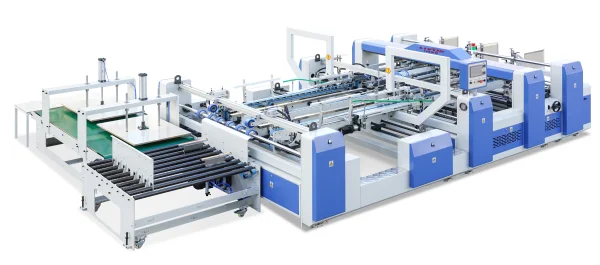
A fully automatic two-piece corrugated box folder gluer machine takes blanks through feeding, gluing, folding, splicing and delivery as a continuous line. For floral and nursery packaging, the main contribution is on large cartons, where two boards are joined and glued in one pass and the finished box is delivered ready to stack. The carton maker spends less time on repeated hand finishing and gains a more repeatable result from one order to the next.
The applications follow the needs described above. Cartons for bulk cut flowers are often large, and their squareness and joint strength matter when boxes are stacked and moved through cooled handling areas. Cartons for potted plants carry the weight of pots, soil and plant material, so the glued joints must hold under load. Converters serving seasonal peaks need to change between sizes and styles without long stoppages. In each case, the machine does not change the carton design chosen by the customer. It makes the folding and bonding of that design controlled and repeatable.
Gluing and Splicing Features Behind Consistent Floral Cartons
Two parts of our machine matter most for this work. The gluing section applies adhesive by mechanical roller and can run hot glue or cold glue, with a spray glue system available as an option. That range gives the carton maker a choice of method for each board and each adhesive. The choice of adhesive for humid or precooled shipments remains a decision for the carton maker and the glue supplier, and the machine's role is to apply whatever is chosen evenly, so that the glue film at the joint is uniform from the first carton to the last.
The splicing section is where the two boards of a large carton are brought together. Servo-driven belts and photoelectric guidance align the boards as they meet, which supports squareness in the finished box, and the guide plates adjust electrically with a memory function so that a repeat order can be restored quickly. Hot and cold double coating at the splice, together with steel-ball board pressing, reinforces the joint that carries the most structural load. The sections ahead of the splice help by presenting the blanks consistently: stable suction feeding, followed by steady folding and neat patting, keeps the carton regular from entry to exit. For floral converters with frequent changeovers, that combination of repeatable settings and aligned splicing reduces the time spent between orders.
Several features of finished flower cartons still depend on factors outside the folder gluer. Ventilation layout, board grade and adhesive formulation are specified by the carton maker, and we regard the machine as one link in a longer chain of decisions. Our aim is to make the folding, gluing and joining stages dependable enough that those decisions show up faithfully in the finished carton.
Carton Quality Starts on the Folder Gluer
A flower carton is judged by how it arrives, and its first test comes on the folder gluer, when two boards are joined into a box that must stay square and closed. Our corrugated box folder gluer machine is built for that stage. The machine frame is heat-treated to hold its alignment through long production runs, the gluing section works in hot or cold mode, and the splicing guides return to stored settings when a repeat order comes back. We build the machine in our own factory, and we keep refining it around the folding and bonding steps that growers and nurseries rely on when their cartons leave the line.
 Technical Encyclopedia