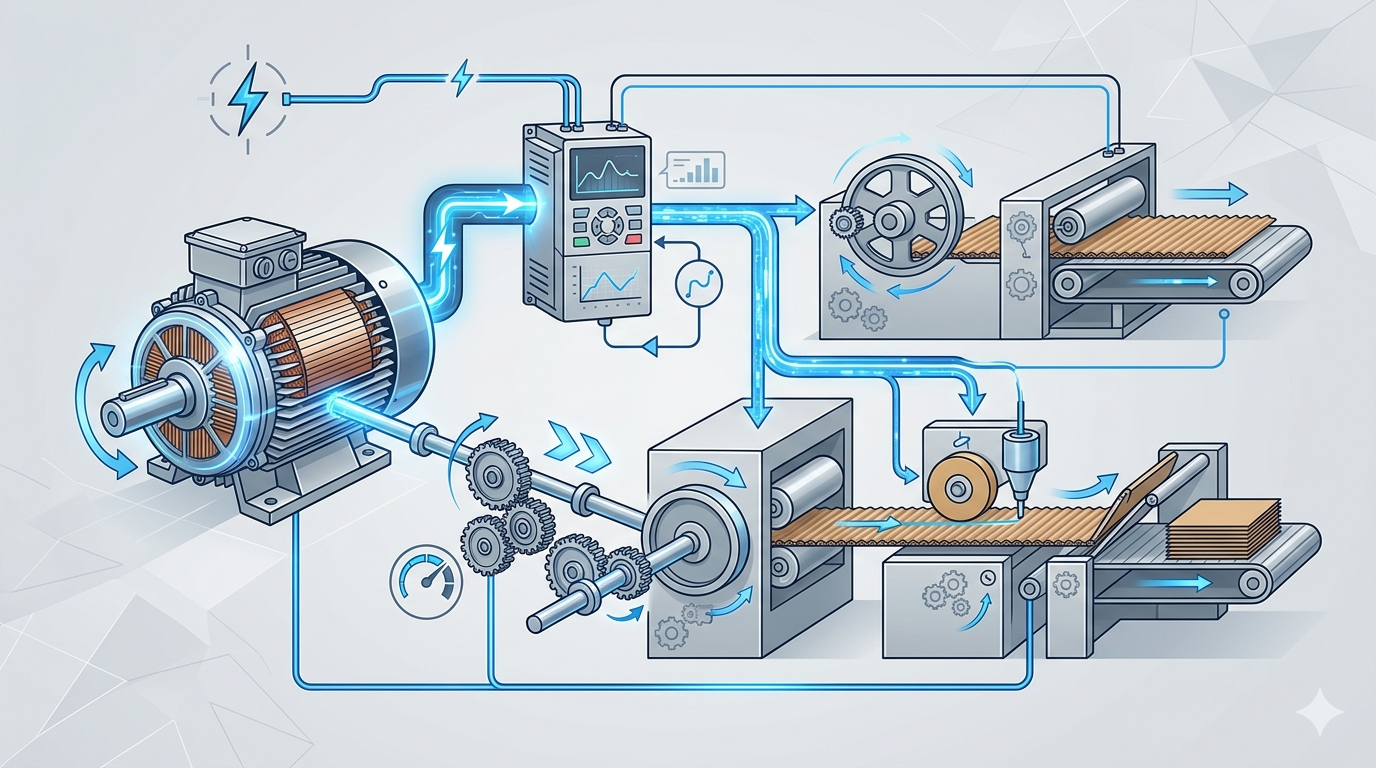
The strength of a glued carton depends on where the adhesive lands. A glue line that sits a few millimetres off its intended position can leave part of the flap unbonded or push adhesive beyond the edge of the board. Accurate gluing relies on the sheet being correctly located when it reaches the gluing station, and a position set at the feeder does not always hold through the sections that follow. In our semi-automatic folder gluer, a double glue system mounted at the side of the machine gives the sheet a second positioning reference at the gluing stage.
Why Glue Lines Drift Even After Accurate Feeding
A sheet changes position more than once on its way through a folder gluer. It is separated from the stack, carried by belts, guided toward the folding section, and then brought to the gluing station. Each of these steps can introduce a small shift. Individually, the shifts are minor, but they add together, and the sheet that arrives at the glue rollers may sit slightly differently from the way it left the feeder.
Many conventional gluing arrangements depend on a single positioning reference, which is set at the start of the line. If the sheet moves afterward, the glue unit has no independent means of correcting for it. The adhesive is applied where the sheet happens to be, not necessarily where the flap should be. Board condition adds to the problem, since slightly warped sheets, worn belts, and variations in board thickness all affect how a sheet tracks through the machine.
The consequences show up in the finished carton. Glue lines may run closer to one edge of the flap than the other, the bonded width may vary along the seam, and some sections may receive too little adhesive while others receive too much. Cartons with weak or uneven seams need rework or are scrapped, and adhesive is wasted when it spreads beyond the flap. Operators often respond by adjusting the glue position repeatedly during a run, which interrupts production and increases dependence on individual judgement.
Where Glue Placement Matters Most Across Carton Types
Different carton applications place different demands on the glued seam. E-commerce and parcel cartons are shipped in very large numbers and handled repeatedly, from filling to sorting to delivery. A seam that is only partly bonded may open under that handling, which leads to damaged contents and returned shipments. For these cartons, consistent glue placement contributes directly to the box staying closed through the supply chain.
Cartons for large appliances and furniture carry heavier contents and are often stacked in warehouses and on trucks. The glued flap bears part of that load. If the glue line deviates from its intended position, the effective bonded area shrinks at the point where the carton is under stress. A uniform glue line supports even load distribution along the seam, and this matters more as the box becomes larger and heavier.
Outer cartons for food and household goods are judged by appearance as well as strength. Glue that squeezes out of the seam or leaves visible marks on the board reflects poorly on the product inside, and buyers may reject cartons with obvious flaws. These customers require a machine that keeps adhesive within the flap and keeps seams neat across a full production run.
How the Side-Mounted Double Glue System Works
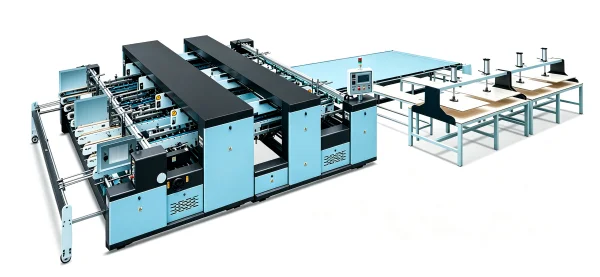
The gluing section of our machine uses mechanical roller gluing, with two sets of glue and paste cylinders. Both sets are available with hot and cold bonding, so the operator can choose the method that suits the board and adhesive in use, and a spray glue system can be added as an option. The double glue system is installed at the side of the machine. This arrangement is intended to provide a better secondary positioning of the sheet during gluing, which supports the placement of the adhesive after the position established at the feeder.
The reasoning is straightforward. The first positioning takes place when the sheet is fed and aligned. A second reference at the gluing stage allows the sheet to be located again before adhesive is applied, which narrows the gap between where the sheet was set and where it actually is. Because the adhesive is applied only after this second reference, the glue line is less dependent on whatever small shifts occurred earlier in the sheet's journey. The result is a glue line that follows the position of the flap more closely.
The same logic carries into the splicing section, where the stitching interface uses a hot and cold double coating to make the bond firmer. A photoelectric device guides the cylinders so that the splice is made at the intended point, and steel balls with a plastic cover press the board to strengthen the bond while reducing noise. These features continue the positioning work begun at the glue rollers and help the seam hold the accuracy that the gluing stage has set up.
No gluing system removes every source of variation. Sheets that are badly warped, boards stored under poor conditions, and adhesives that are unsuited to the board will still affect results. The side-mounted double glue system reduces one particular source of error, the shift between feeding and gluing, but good board handling and correct adhesive selection remain part of reliable production.
Consistent Glue Application for Everyday Production
Keeping glue within the intended seam helps control adhesive use and reduces the need for repeated adjustments during production. Consistent glue placement also helps maintain uniform bonding across a batch, whether the process uses hot or cold adhesive. The right setup depends on the board material, adhesive properties, and the seam requirements of each carton.
We manufacture our semi-automatic folder gluer in our own factory, with the gluing system designed around practical carton production needs. By understanding the materials you process and the bonding results you expect, we can discuss a machine configuration suited to your work.
 Application Scenarios