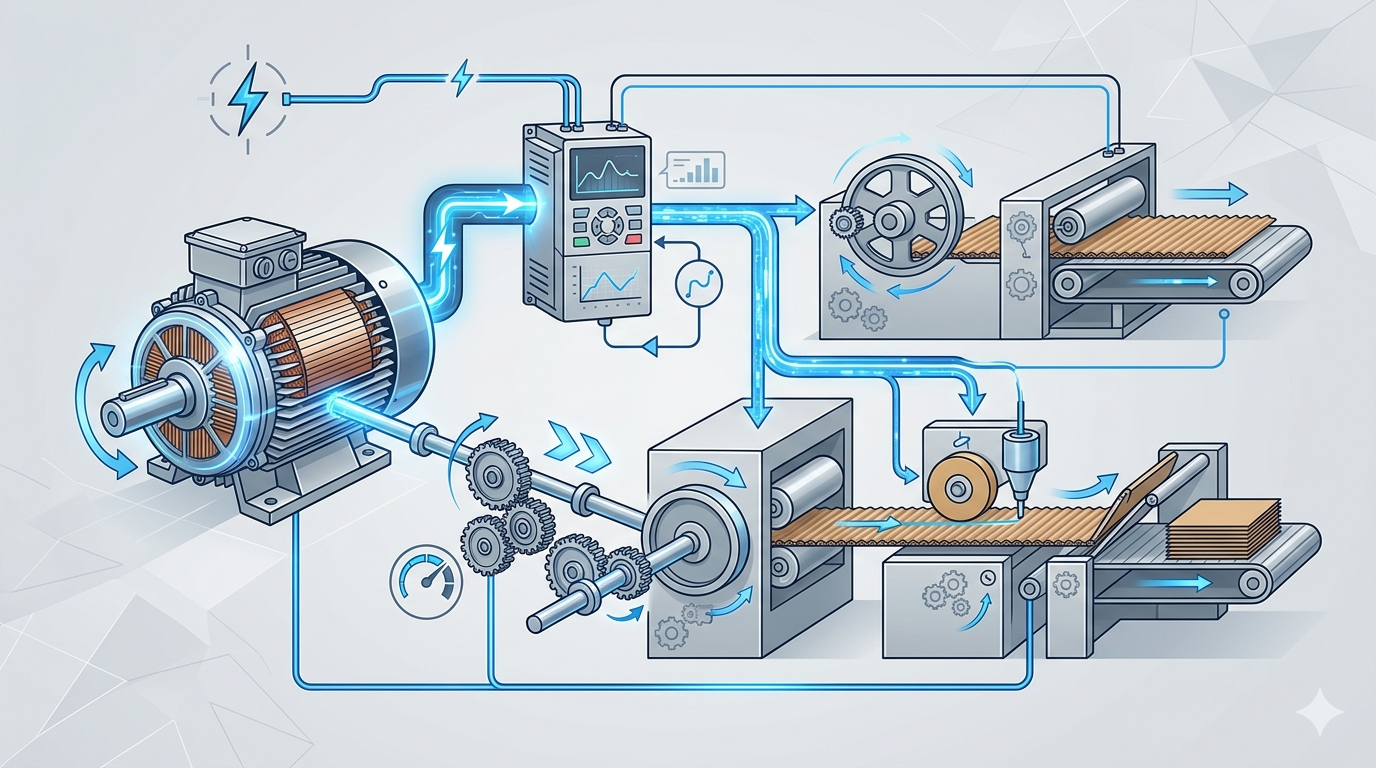
A corrugated box folder gluer machine converts die-cut and scored blanks into flat-folded cartons that are ready for erection. Two measures define its value on the production floor. One is the number of cartons delivered per hour. The other is how consistently each carton is folded, aligned and bonded. On conventional equipment, the two rarely improve together. Raising the line speed tends to loosen control over the board, while tightening control tends to slow the line.
Why Higher Line Speed Often Costs Accuracy
Corrugated board is not a perfectly uniform material. Warp, thickness variation and moisture differences all affect how a sheet behaves as it travels through the machine. At low speed, these irregularities are easy to absorb. At higher speed, they surface as skewed sheets, uneven spacing between blanks and folding lines that drift from their scores. Once a sheet enters the folding section out of position, the glue flap no longer meets the panel it was meant to bond with.
Adhesive application is the second pressure point. Glue must reach the flap in a controlled, even film. When the board moves faster, uneven roller contact or inconsistent glue supply produces thin spots, heavy patches and occasional stringing. A weak bond may pass the first inspection and still open later, during stacking, transport or box erection on a packing line. Rework and returns then erase whatever gain the faster speed seemed to offer.
Changeover is the third factor, and it is often overlooked. Many plants run short batches across several carton sizes. If each size change requires repeated manual adjustment and trial runs, the machine spends a large share of the shift idle. A high rated speed means little when setup time consumes the hours that should be productive.
Where the Trade-Off Shows Up in Carton Production
Different sectors feel this tension in different ways. E-commerce and parcel packaging favors large volumes and short lead times. Cartons from these lines usually pass through automatic case erectors and sealers, which need consistent squareness and flat, predictable bonded seams. A carton that is slightly out of square can jam downstream equipment and interrupt a packing line that was otherwise running well.
Household appliance outer cartons present a different challenge. They are larger, and they are built from thicker or heavier board. These boxes carry significant weight and are stacked high in warehouses and containers. The glued seam must hold under compression, so overlap position and pressing quality matter more than raw output. A conventional machine that struggles to hold large sheets flat will show the problem at exactly this point.
Fast-moving consumer goods, including beverages and household chemicals, combine long runs with frequent size variation. A plant may fill a shift with one carton format and then switch to several others in the same week. Here the demand is twofold: steady running over many hours, and quick, repeatable changeovers between formats. Machines that depend on operator feel for each adjustment tend to produce uneven results from one shift to the next.
How Our Corrugated Box Folder Gluer Machine Holds Both Together
We designed our two-sheet corrugated box folder gluer machine around one principle. Speed is only useful when the board is controlled at every stage. The process begins at the feeder, which uses a friction feeding design driven by an independent servo motor. Adjustable side flaps and a retractable rear support keep different sheet lengths properly seated, and an air suction function helps separate sheets and reduce double feeding. For e-commerce and beverage cartons, this means each blank enters the machine in a consistent position, which is the condition that makes higher throughput practical. Depending on carton style and board, the machine runs at roughly three to five thousand pieces per hour.
The splicing section is where our design addresses large appliance cartons most directly. It uses a multi-guide-plate structure with electric screw adjustment, and the settings can be stored in memory mode. Two independent servo motors drive the belt conveyors. Steel-ball pressing holds the board during bonding, and photoelectric detection guides the sheet into position before the seam is formed. Hot and cold coating at the splicing interface helps the glued area set firmly. Together, these elements keep the overlap accurate on larger and heavier sheets, where a small positional error would otherwise turn into a weak or crooked seam. The machine accepts sheets from 350 x 300 mm up to 1,250 x 1,300 mm in its larger configuration, which covers a wide range of carton formats.
Gluing and changeover are handled with mixed-order plants in mind. The gluing section applies adhesive by mechanical roller, with hot and cold dipping options and an optional spray system for operations that prefer it. The folding section runs on an independent motor, completing the second fold and the fourth fold at 180 degrees, while the left and right belts allow stepless speed adjustment. Because the guide plates and splicing settings can be recalled from memory, a plant that alternates between carton sizes can return to a known setup instead of rebuilding it by hand. This shortens setup time and gives the second shift of the week the same starting point as the first.
Beneath these functions sits the machine frame. We build it from 16 mm cold-heat-treated plate, which gives the structure the rigidity needed to hold alignment over long production hours. Rigidity matters here for a simple reason. Even a well-designed feeder and splicing section lose their precision if the frame flexes or vibrates at speed.
What Steady Output Delivers on the Packing Floor
When feeding, gluing and splicing work in step, the benefits reach beyond the folder gluer itself. Cartons arrive at the packing line with consistent dimensions and reliable seams. Downstream case erectors run with fewer interruptions, and finished boxes keep their shape under stacking loads. Plants running mixed orders spend less time on adjustment and more time producing. Over a full year, these small gains in uptime and first-pass quality have a larger effect on cost than a headline speed figure alone.
Our approach as a manufacturer is to treat speed and precision as a single design problem instead of two competing targets. Each section of the machine, from the servo-driven feeder to the memory-assisted splicing unit, is built to keep the board under control as output rises. If your plant produces e-commerce shippers, appliance cartons or high-volume consumer goods packaging, send us your board grades, carton styles and daily output targets. We will match them against the machine's capacity and configuration options, so that the corrugated box folder gluer machine you select fits the work it will actually do.
 Application Scenarios