Porcelain and fine ceramic tableware carry high aesthetic and functional value, and they break easily in distribution. Packaging guidance for ceramics comes back to one point: pieces that move inside a box are the pieces that break. The carton is the outer layer of that protection. Its internal dimensions, squareness and seam strength determine whether the cushioning and dividers placed inside it can do their job. A two-piece folding and gluing machine produces cartons with these qualities consistently.
Why the Outer Carton Decides Whether Porcelain Survives
Shipping guides for ceramics describe movement during transit as the primary cause of breakage. Patents for dinnerware cartons follow the same principle: the carton is dimensioned so that each item sits in a fixed position relative to the box, which prevents shifting and impact between pieces. This design logic assumes that the finished carton matches its drawing. If the box runs a few millimeters too large, the pieces gain room to move. If it runs too small, inserts and dividers will not seat properly, and packers force them in or leave them out.
Structure is the second concern. A set of plates, bowls and cups is dense and heavy, and a carton holding it carries that weight under stacking. The strength of corrugated board in compression depends on clean, accurate fold lines, and a score that sits off position or a box that leaves the machine slightly skewed loses part of its stacking capacity. Cartons at the bottom of a pallet then take the greatest load, which is precisely where a weakened box fails.
Product variety adds a commercial difficulty. A porcelain producer may offer tea sets with a pot, cups and a tray, gift boxes of matched pieces, and dinnerware sets in several counts. Each calls for a different outer carton, and orders are often split across many items. Conventional folder gluers handle this poorly. Frequent changeovers consume time, and every manual adjustment can introduce a small variation in carton dimensions that the packing line then has to absorb.
Three Ceramic Packaging Routes and What Each One Asks of the Carton
Tea sets and gift sets typically travel in a fitted gift box placed inside an outer shipping carton. The outer carton must hold the gift box without letting it shift, and it must present a clean, square appearance when it reaches a retailer or a customer. Variations in carton dimensions show up directly, because the gift box either sits snugly or rattles. For these products, repeatable dimensions are as important as strength.
Complete dinnerware sets, including plates, bowls and cups, are heavier and often exported. Packaging guidance for heavier ceramic items points toward stronger board constructions and careful box sizing, since the carton must withstand long journeys and stacked loads at ports and in containers. A seam that opens or a corner that collapses compromises the whole shipment. The glued overlap is a structural part of the carton, and its strength depends on accurate positioning and even bonding.
Online sellers and small ceramic producers ship directly to consumers through parcel networks. Their cartons pass through sorting equipment, conveyors and repeated handling, with little control over how each parcel is treated. Sellers in this segment rely on the carton to remain square and closed through the whole journey, and they feel every breakage as a refund, a replacement and a lost customer. Because their volumes per format are often modest, quick changeover on the carton maker's side matters as much as strength.
Fixed Dimensions and Firm Seams in Our Machine's Design
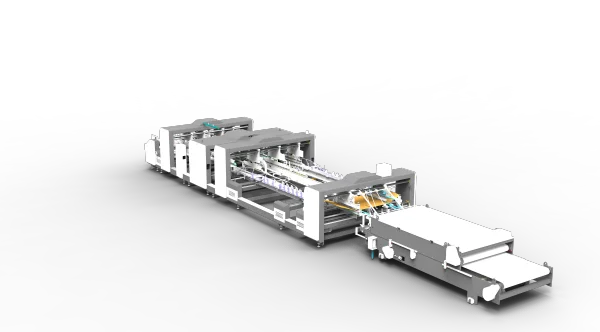
Our two-piece folding and gluing machine is built to give carton plants the dimensional consistency that fragile goods need. The process begins at the feeder, where a friction feeding system with an independent servo motor draws each blank forward. Adjustable side flaps keep the sheet aligned, and an air suction function helps separate sheets and reduce double feeding. A blank that enters square produces a carton with accurate internal dimensions, which gives the inserts and dividers inside the box a predictable space to occupy.
Folding is controlled by an independent motor, and the left and right folding belts can be adjusted steplessly in speed. This allows the folds to be matched to the board and carton format without relying on operator feel. Accurate folds protect the compression strength of the carton, which matters for dense sets that spend part of their journey stacked under other cartons. For gift-set outer boxes, the same accuracy keeps the box clean and square on the retail shelf.
The splicing section governs seam strength. Guide plates are adjusted electrically and can store their positions in memory, and two independent servo motors drive the belt conveyors. Steel-ball pressing holds the board during bonding, photoelectric detection guides the sheet into place, and hot and cold double coating helps the glued area set firmly. The overlap that results is accurate and evenly bonded, which supports heavy dinnerware cartons through stacking and long-distance transport. We select board grade according to the weight of the goods the carton will hold, and that choice rests with the carton plant and its customer.
The frame and the changeover features complete the picture. The machine walls are made of 16 mm cold-heat-treated plate, and the complete machine weighs in the ten-tonne range, which keeps vibration low and alignment steady through long runs. Stored settings let a plant return to a proven configuration when a repeat order arrives, so a producer switching between tea set cartons, dinnerware cartons and gift-set outer boxes spends less time on trial adjustment. The machine can also be customized around the carton formats a plant needs, and we suggest sharing unfolded carton dimensions and board grade early in the discussion so the configuration reflects the product range.
Fewer Breakages Start With a Carton That Repeats Itself
When cartons leave the machine square and consistent, the benefits follow along the supply chain. Internal dividers and cushioning fit as designed, so pieces stay in position. Stacked cartons carry load evenly, which protects the boxes at the bottom of a pallet. Seams stay closed through parcel handling, which reduces the number of opened or deformed boxes that arrive at the customer's door.
Production planning gains as well. Ceramic brands that offer many collections need carton suppliers who can move between formats without long delays. Stored splicing settings and adjustable sections shorten the interval between orders, and that time returns to the plant as productive capacity.
Fragile goods leave very little margin for a carton that varies from the drawing. We build our machine to keep the board controlled from feeding to delivery, because a precise box is the starting point for every other protective measure. If you make cartons for porcelain tea sets, dinnerware or ceramic gift boxes, send us your unfolded carton dimensions, board grade and daily output target. We will review them against the machine configuration and discuss the setup that fits your product range.
 Technical Encyclopedia