


Not every packaging or printing job needs a full production line running at top speed. Sample runs, custom gift boxes, short print jobs, and trade show materials all share a different requirement: consistent tape application without the setup time or investment that high-volume automation demands. This is the gap a manual double-sided tape applicator is built to fill.
Why Small-Batch Orders Don't Fit Neatly Into Either Extreme
Workshops handling frequent small orders tend to face a choice between two options that both come with trade-offs. Hand-applying tape keeps costs low at the outset, but pressure varies from one worker to the next, and fatigue over a long shift makes that variation worse. Weak spots, bubbling, and inconsistent bonding become more likely the longer a manual taping session runs, and quality tends to depend heavily on whoever happens to be doing the work that day.
Fully automatic multihead equipment solves the consistency problem but introduces a different one. These machines are built for continuous, high-volume output, so changeover between tape widths, paper sizes, or box formats can take enough time to make a short run impractical. The investment required to bring in automated equipment also assumes a production volume that many sample runs, custom orders, and small print jobs simply don't reach. For a business running frequent short batches rather than sustained high volume, that kind of equipment often sits underused between changeovers.
What small-batch production actually needs is something in between—more consistent than manual taping, more adaptable than a full automatic line. That's the specific role a manual double-sided tape applicator is designed to serve.
Where Manual Tape Applicators Fit Into Packaging and Print Workflows
Product sampling and prototype development illustrate this gap clearly. Before a new package design goes into full production, tape placement and specifications typically go through several rounds of adjustment. Reconfiguring an automated line for each iteration adds delay, while hand-applied tape at this stage can produce a bond that doesn't reliably reflect what the finished product will actually look like once it reaches production volume. A manual applicator lets a workshop test and refine tape placement while still working with a level of consistency close to what full production will eventually use.
Custom packaging and gift box manufacturers run into a related issue. Orders in this category are often small and highly varied—different box dimensions, envelope styles, and card sizes moving through the same workshop in a single week. Committing that kind of variety to a fixed automated line, built around narrower size and format ranges, limits flexibility more than it helps. A manual applicator with a wider working range accommodates this variety without demanding a separate machine setup for every format change.
Small and mid-sized print shops face a similar calculation from the equipment investment side. Order volumes in this segment are frequently too low to justify the cost and payback period of automatic multihead equipment, yet purely manual taping starts to strain capacity once order counts climb. A manual applicator offers a practical middle step—meaningfully faster and more consistent than hand taping, without the capital commitment that automation requires.
Trade show materials, promotional items, and small-scale e-commerce packaging round out this picture. Order volumes here tend to stay modest, but bond strength still matters, particularly when materials go through handling and shipping. Even at lower production volumes, mechanical tape application holds up better than manual taping when packages need to survive transit without the tape lifting or peeling.
Inside the Design of a Manual Double-Sided Tape Applicator
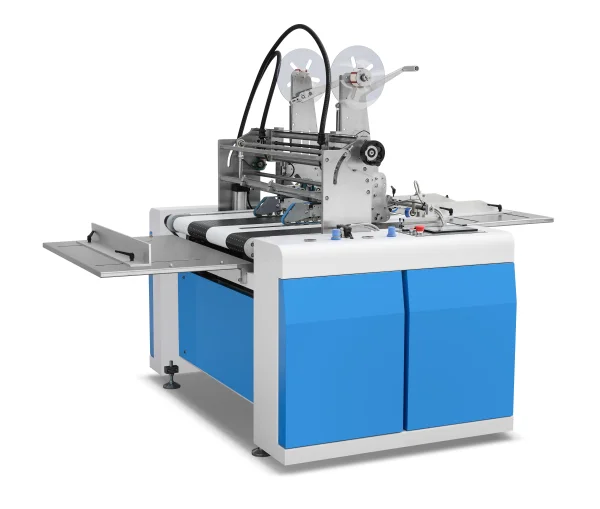
Our manual applicator built for this kind of work centers on a few structural choices that directly address the small-batch requirements described above.
Paper handling range is one of the more practical considerations for a shop juggling varied order types. Equipment in this category typically accommodates paper sizes from around 100 by 140 millimeters up to roughly 700 by 600 millimeters, which covers a meaningful spread of formats—from small cards and envelopes to larger sheets—without requiring a separate machine for each size class. For a workshop moving between order types throughout the week, that range removes one of the more common reasons for downtime.
Tape compatibility follows a similar logic. These machines are generally configured to run two double-sided tape sizes, commonly 5 by 35 millimeters and 10 by 60 millimeters, which lets an operator switch between narrower and wider tape formats as different jobs require rather than being locked into a single specification. Paired with an adjustable operating speed—typically somewhere in the range of 10 to 90 meters per minute—the machine can be run at a pace suited to the operator's experience level and the rhythm of a given order, which matters more in small-batch work than raw maximum throughput does.
Placement precision is where the mechanical advantage over hand taping becomes most apparent. Glue precision in this equipment category generally falls around plus or minus one millimeter, a level of consistency that's difficult to sustain manually across an extended run, particularly as fatigue sets in. Combined with a minimum distance tolerance between sticking ends of around 10 millimeters, this precision helps small-batch operations avoid the uneven bonding that tends to show up in hand-taped work once volume increases even modestly.
Physical footprint also plays into how well this equipment fits small and mid-sized operations. A compact frame with a straightforward operating interface keeps the learning curve manageable, which matters for workshops that don't have a dedicated operator solely for taping and instead need staff to move between tasks over the course of a shift.
A Manufacturer's Perspective on Where This Equipment Belongs
None of this is about positioning manual equipment as a replacement for automated multihead systems—the two serve different production realities. A manual double-sided tape applicator is built for the specific middle ground where order volume doesn't justify full automation but consistency still matters more than hand taping alone can reliably deliver. That's the segment it's designed to serve: sample development, custom and small-batch packaging, print shops working through frequent short runs, and any operation where flexibility across formats matters as much as output speed.
As a manufacturer building this equipment directly, we design around that specific use case rather than treating it as a scaled-down version of automated machinery. Paper handling range, tape compatibility, and placement precision are calibrated for workshops that need dependable bonding without the changeover time or capital investment that full automation requires. For businesses evaluating whether a manual applicator fits their current order volume and production mix, our team can walk through configuration details and how the equipment compares to both manual taping and automated alternatives.
 Application Scenarios





