


The demand for larger and more durable corrugated boxes continues to grow as industries such as logistics, export packaging, and industrial transportation require packaging solutions with higher structural reliability. For these applications, the quality of the joint area directly influences the overall performance of the finished carton.
In corrugated box manufacturing, the stapling tongue width is an important design factor that affects the available connection area between box panels. When producing large-format or heavy-duty cartons, limited tongue width may restrict box structure design and reduce production flexibility. A gluer stitcher machine with an optimized stapling structure, such as a maximum 40mm tongue width, provides manufacturers with greater capability to process different carton specifications while maintaining stable production performance.
Stapling Challenges in Large Corrugated Box Production
As carton sizes increase, manufacturers face higher requirements for box strength, forming accuracy, and production adaptability. Traditional stapling structures with limited tongue width may not provide enough space for wider joining sections, especially when processing large corrugated boxes or packaging that requires stronger connections.
The stapling area is a key part of carton construction because it connects different sections of the box body and helps maintain structural stability during transportation. If the connection area is too narrow, stress may become more concentrated around the joint section, which can influence the durability of the finished carton under different handling conditions.
For standard cartons, conventional stapling structures may satisfy general production requirements. However, manufacturers producing industrial packaging, export cartons, and customized large boxes often need equipment with a wider processing range. A machine that supports larger stapling tongue widths allows manufacturers to handle more diverse carton designs without being limited by the joining structure.
Another challenge in modern carton production is maintaining stable quality while increasing production efficiency. High-speed operations require accurate feeding, consistent positioning, and reliable stapling performance. If the machine structure cannot coordinate these processes effectively, production speed improvements may affect carton forming consistency. Therefore, advanced gluer stitcher machines need to combine flexible structural design with stable automation systems to meet the requirements of modern packaging production.
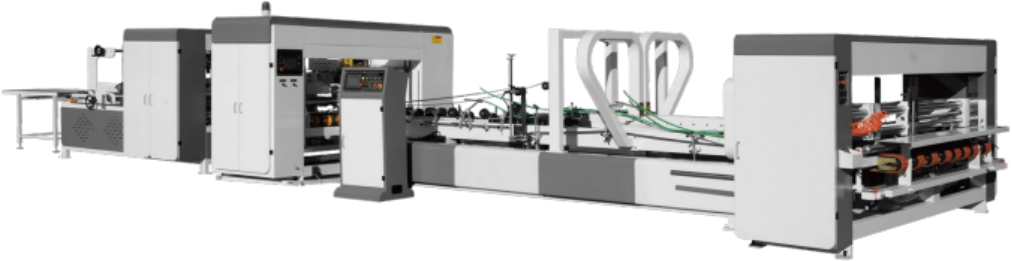
Advanced Max. 40mm Tongue Width Design for Improved Box Processing Capability
The stapling tongue width is more than a simple machine specification; it directly influences the types of cartons that manufacturers can produce. The automatic high speed gluing and stapling machine is designed with a maximum stapling tongue width of 40mm, providing a wider joining area for corrugated box production.
Compared with machines designed for smaller tongue widths, a 40mm maximum tongue width gives manufacturers greater flexibility when producing large cartons and heavy-duty packaging structures. A wider stapling section helps create a larger fastening area between connected panels, allowing the machine to better adapt to packaging applications where joint stability is an important consideration.
This design is particularly valuable for manufacturers that need to process different box styles within one production environment. Whether producing transportation cartons, industrial packaging boxes, or customized corrugated containers, a wider tongue width expands the available structural options and helps reduce limitations caused by narrow joining areas.
The machine also supports a maximum cardboard size of 1200 × 2500mm and a maximum stapling tongue length of 1200mm. The combination of large-format processing capability and wider stapling structure enables manufacturers to work with a broader range of corrugated box specifications while maintaining efficient production flow.
For packaging companies, this flexibility is important because customer requirements are becoming increasingly diverse. Instead of focusing only on standard carton sizes, manufacturers need equipment that can adapt to different dimensions, board structures, and application requirements. The optimized tongue width design provides additional production possibilities for these changing market demands.
Integrated Gluing and Stapling System for Efficient Corrugated Box Production
Modern corrugated box manufacturing requires more than a single stapling function. To improve workflow efficiency, the automatic high speed gluing and stapling machine integrates multiple production processes into one complete system, including automatic paper feeding, gluing, stapling, calibration, counting, and stacking.
By combining these functions within one machine, manufacturers can reduce the need for separate processing steps and improve production continuity. The integrated structure helps maintain consistent carton movement throughout the forming process, while automatic adjustment and calibration systems support stable operation during continuous production.
The gluing and stapling combination also provides advantages for customers producing different carton styles. Instead of transferring cartons between multiple machines, operators can complete key forming processes within one production line. This can help optimize factory space utilization and simplify production management.
In addition to structural flexibility, production speed is another important consideration for modern carton manufacturers. The machine supports a maximum stapling speed of 800 nails/min, allowing it to meet the requirements of high-volume carton production. Stable feeding and accurate positioning systems work together with the stapling unit to maintain consistent processing performance during high-speed operation.
The purpose of high-speed equipment is not only to increase output but also to maintain reliable carton quality throughout production. A well-designed gluer stitcher machine needs to balance speed, accuracy, and structural stability to provide practical value for packaging manufacturers.
Flexible Applications for Heavy-Duty Corrugated Packaging
The combination of a maximum 40mm tongue width and large-format processing capability makes the machine suitable for various corrugated packaging applications where stronger box structures and flexible production are required.
For heavy-duty industrial packaging, carton joints need to withstand greater handling pressure during transportation and storage. Wider stapling structures provide manufacturers with additional options when designing cartons for heavier products or larger package dimensions.
In export packaging and logistics applications, carton reliability is especially important because boxes may experience different transportation environments before reaching the final destination. Stable joining performance helps manufacturers produce packaging solutions that meet the practical requirements of long-distance shipping.
The machine is also suitable for customized corrugated box production. Many packaging customers require specific carton sizes and structures rather than standard designs. With a wider stapling tongue capability and flexible processing range, manufacturers can respond more effectively to customized orders and expand their production capabilities.
As packaging trends continue to move toward greater variety and specialization, equipment flexibility becomes an important factor in maintaining competitiveness. A gluer stitcher machine with advanced stapling capability allows manufacturers to support more application scenarios while improving production efficiency.
Our Automatic High Speed Gluing and Stapling Machine for Efficient Production
Selecting a suitable gluer stitcher machine requires careful evaluation of structural design, processing capability, automation level, and long-term production requirements. Parameters such as stapling tongue width, maximum cardboard size, and production speed all influence how effectively the equipment can support different carton manufacturing needs.
Our automatic high speed gluing and stapling machine combines a maximum 40mm tongue width design with integrated gluing and stapling functions, large-format processing capability, and automatic production control. Through optimized mechanical design and reliable manufacturing processes, the machine provides a practical solution for customers producing a wide range of corrugated boxes.
As a professional manufacturer of corrugated packaging machinery, we focus on developing equipment that addresses real production challenges in the packaging industry. By combining flexible structural solutions with stable automation technology, our gluer stitcher machines help customers improve production adaptability, expand packaging applications, and achieve consistent performance in modern corrugated box manufacturing.
'/%3e%3cpath%20id='Rectangle%20455'%20d='M0%2011.1428H5.57143L22.2857%2052H0V11.1428Z'%20fill='%23CE221D'/%3e%3c/g%3e%3cdefs%3e%3clinearGradient%20id='paint0_linear_888_3811'%20x1='0'%20y1='26'%20x2='401.607'%20y2='26'%20gradientUnits='userSpaceOnUse'%3e%3cstop%20stop-color='%23153B8A'/%3e%3cstop%20offset='1'%20stop-color='%23153B8A'%20stop-opacity='0'/%3e%3c/linearGradient%3e%3c/defs%3e%3c/svg%3e) Products
Products
'/%3e%3cpath%20id='Rectangle%20455'%20d='M0%2012H6L24%2056H0V12Z'%20fill='%23CE221D'/%3e%3c/g%3e%3cdefs%3e%3clinearGradient%20id='paint0_linear_769_2773'%20x1='0'%20y1='28'%20x2='432.5'%20y2='28'%20gradientUnits='userSpaceOnUse'%3e%3cstop%20stop-color='%23153B8A'/%3e%3cstop%20offset='1'%20stop-color='%23153B8A'%20stop-opacity='0'/%3e%3c/linearGradient%3e%3c/defs%3e%3c/svg%3e)


