


A corrugated box folder gluer machine depends on structural stability to maintain accurate feeding, folding, and gluing throughout production. When the frame, transmission system, or working units lose stability, precision can gradually deteriorate—even when the machine continues running normally. Small deviations in alignment, timing, or pressure may eventually appear as crooked folds, uneven seams, or poorly squared boxes. This is why recurring folding and gluing inconsistencies should not always be treated as isolated process issues. In many cases, the underlying cause lies in the machine’s structural design and its ability to maintain precision under continuous operation.
How Weak Frame Design Can Affect Folding Accuracy
Folder gluers built on bolted-frame construction carry an inherent weakness. Bolted joints can loosen gradually under the repeated mechanical stress of continuous operation, and once they do, the frame begins to flex rather than hold its geometry. At moderate speeds, this flex may go unnoticed. Push the same machine toward higher output, however, and the effects compound — vibration increases, folding angles drift, and glue placement becomes less consistent from sheet to sheet.
Thinner-gauge steel components compound the issue. A frame that lacks sufficient wall thickness or rigidity will struggle to stay true when processing heavier, multi-wall corrugated board, since the added mass and stiffness of the material itself places greater load on the structure supporting it. Over months of continuous use, wear accelerates at bearing housings and guide rails, and what began as a minor tolerance issue turns into a recurring maintenance concern.
Transmission design introduces a separate layer of risk. Machines that rely on a single main shaft to drive multiple stations — feeding, folding, pressing — depend on a long mechanical chain holding its timing across every station simultaneously. Any accumulated slack in that chain becomes magnified as line speed rises, and synchronization between stations can drift just enough to throw off the final fold.
The downstream consequences reach beyond the machine itself. Misaligned seams, uneven glue bonding, and boxes that are slightly out of square all trace back to structural instability, and these defects have real implications for the finished product's compression strength and shelf presentation. They also carry an operational cost: more frequent stoppages for readjustment, higher scrap rates, and output that falls short of the machine's rated capacity.
Why Structural Stability Anchors Everything Else
It helps to think of stability not as one specification among many, but as the foundation that every other performance metric rests on. Folding accuracy depends on a frame that holds its shape under load. Consistent output over a full shift depends on components that don't shift position as they warm up or wear in. Batch-to-batch uniformity — arguably the metric that matters most to converters filling large orders — depends on a machine that behaves identically at hour eight as it did at hour one.
This matters more today than it once did. E-commerce fulfillment and retail-ready packaging have pushed demand toward corrugated boxes that combine structural strength with a cleaner, more presentable finish, and buyers have grown less tolerant of the cosmetic and dimensional inconsistencies that instability produces. A folder gluer's mechanical design, in other words, is no longer judged only by how fast it runs, but by how faithfully it holds precision while running that fast.
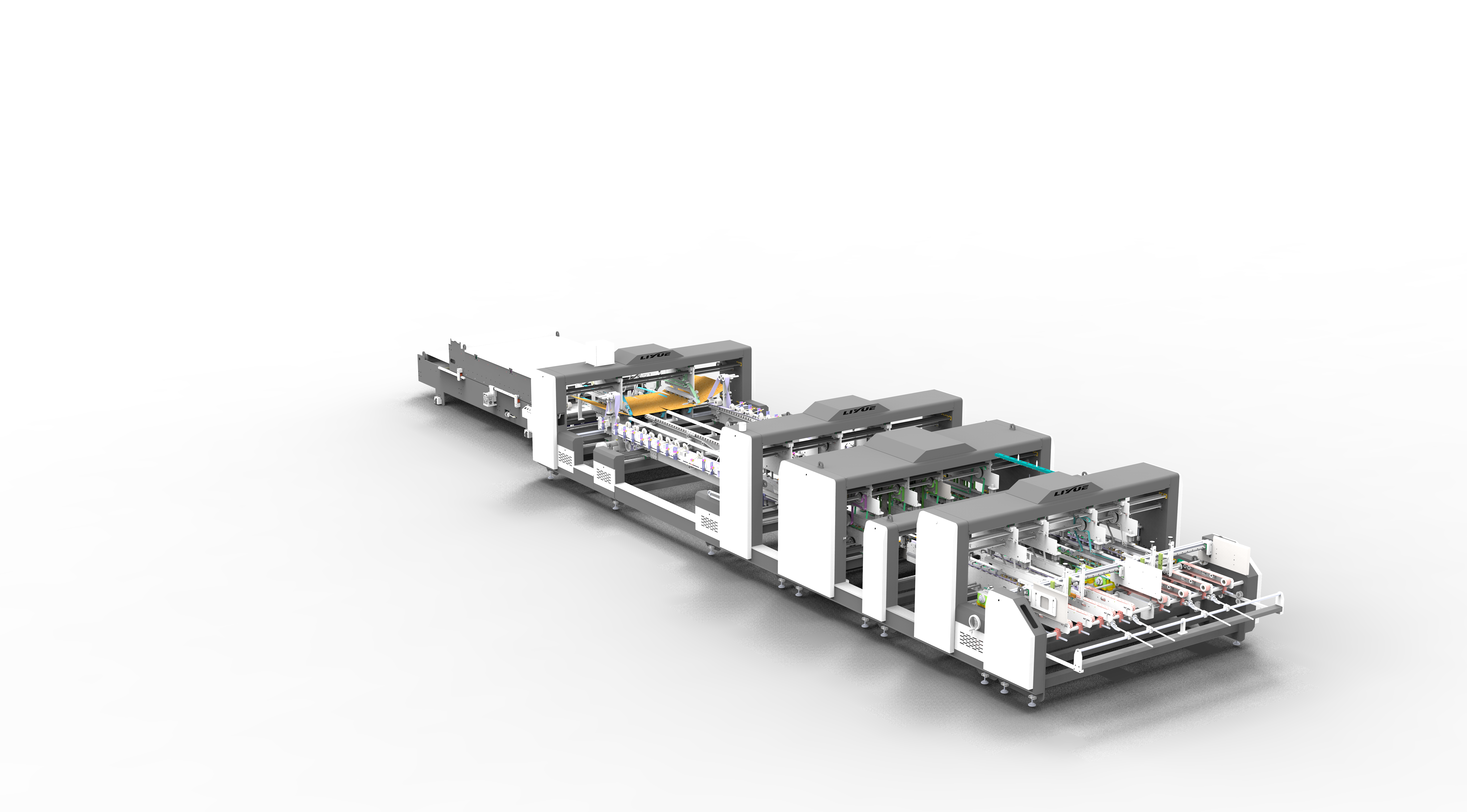
Building Stability Into the Frame Itself
Our approach starts with the machine's skeleton. Rather than assembling the frame from bolted sections, we build it as a welded steel structure, joining the primary frame members into a single continuous unit. Welding eliminates the loosening that bolted joints are prone to over time, and it distributes mechanical load more evenly across the frame rather than concentrating stress at individual connection points. The practical result is a chassis that resists flex even when the machine is running at higher speeds or handling heavier board.
This construction choice matters most in demanding production contexts — long runs of large-format sheets, or heavier multi-wall corrugated destined for export packaging, where dimensional accuracy has to hold up under repeated handling and stacking. A frame that stays true under that kind of load keeps folding lines consistent from the first sheet of a run to the last.
Independent Drive Architecture Across Key Stations
The second structural principle we apply addresses synchronization directly. Instead of routing power from a single main shaft through a long mechanical chain, we drive the core working stations — feeding, folding, and pressing — through their own independent motors. Each section maintains its own timing rather than inheriting accumulated slack from the stations before it, which keeps synchronization tighter as speed increases rather than looser.
For converters running large batch orders where consistent takt time matters as much as raw throughput, this architecture pays off in a subtler but meaningful way: the folding sequence that worked correctly on the first hundred sheets continues working correctly through the last thousand. Fewer adjustments mid-run translate into less downtime and a more predictable production schedule.
Other structural elements reinforce this foundation without needing separate treatment here — the splicing station's steel-ball pressing mechanism and photoelectric-guided alignment, for instance, help keep joint sections seated firmly during high-speed splicing. These details matter, but they function as extensions of the same underlying philosophy: build rigidity and synchronization into the machine's mechanics before asking it to run fast.
Where Structural Engineering Meets Manufacturing Discipline
None of these design choices exist in isolation. A welded frame only delivers its full benefit when paired with drive components that don't introduce their own instability, and precise motor synchronization only matters if the structure supporting those motors holds steady under load. Stability, in that sense, is less a single feature than the product of many engineering decisions working in concert.
That's the standard we hold ourselves to when engineering folder gluers for corrugated box production. Structural rigidity, coordinated drive systems, and precision in the details that connect them are not afterthoughts layered onto a finished design — they're the starting assumptions we build from. For converters weighing which machine will hold its accuracy shift after shift, that distinction tends to show up exactly where it counts: in the consistency of the boxes coming off the line. We continue refining these structural principles as production demands evolve, because a folder gluer's long-term value is measured less by its rated top speed than by how reliably it performs at that speed, run after run.
'/%3e%3cpath%20id='Rectangle%20455'%20d='M0%2011.1428H5.57143L22.2857%2052H0V11.1428Z'%20fill='%23CE221D'/%3e%3c/g%3e%3cdefs%3e%3clinearGradient%20id='paint0_linear_888_3811'%20x1='0'%20y1='26'%20x2='401.607'%20y2='26'%20gradientUnits='userSpaceOnUse'%3e%3cstop%20stop-color='%23153B8A'/%3e%3cstop%20offset='1'%20stop-color='%23153B8A'%20stop-opacity='0'/%3e%3c/linearGradient%3e%3c/defs%3e%3c/svg%3e) Products
Products
'/%3e%3cpath%20id='Rectangle%20455'%20d='M0%2012H6L24%2056H0V12Z'%20fill='%23CE221D'/%3e%3c/g%3e%3cdefs%3e%3clinearGradient%20id='paint0_linear_769_2773'%20x1='0'%20y1='28'%20x2='432.5'%20y2='28'%20gradientUnits='userSpaceOnUse'%3e%3cstop%20stop-color='%23153B8A'/%3e%3cstop%20offset='1'%20stop-color='%23153B8A'%20stop-opacity='0'/%3e%3c/linearGradient%3e%3c/defs%3e%3c/svg%3e)


