


Packaging structures are becoming more diverse as e-commerce, consumer goods, appliances, furniture, and industrial products require cartons with different dimensions and structural designs. Large products may need cartons that exceed the practical size of a single corrugated sheet, while customized packaging can involve multiple panels or reinforced structures. In these applications, splicing becomes an important part of carton forming. A corrugated box folder gluer machine with a well-designed splicing section can help align and join multiple board pieces while maintaining consistent positioning throughout production.
Splicing Challenges in Complex Carton Production
Standard cartons can often be formed from a single corrugated blank with relatively straightforward folding and gluing requirements. Complex or oversized cartons create additional demands because several board sections may need to be joined at specific positions.
Manual positioning can lead to variations in alignment. Uneven gaps, inaccurate joining positions, or board movement during splicing may affect the geometry of the finished carton and make subsequent folding more difficult. These issues become more noticeable when large panels or multiple joining points are involved.
Traditional mechanical adjustment can also make changeovers less convenient. Different carton sizes require different guide positions, and manually repositioning these components takes time. This can become a practical limitation when customized or small-batch orders require frequent changes.
Adhesive application is another consideration. Large cartons used for appliances, furniture, or industrial equipment can experience considerable loads during handling and transportation. The splice therefore needs suitable adhesive coverage and sufficient pressing to maintain a stable connection. Splicing accuracy, positioning, pressure, and gluing need to work together rather than being treated as separate operations.
Applications That Depend on Stable Splicing
Appliance and Furniture Packaging
Large appliances and furniture often require extended carton dimensions. Products such as refrigerators, cabinets, tables, and other bulky goods may not fit efficiently into a conventional single-piece carton.
Multi-piece construction provides more freedom in carton dimensions, but the joining position needs to remain consistent. A deviation at the splice can affect adjacent panels and make the following folding process less predictable.
For these applications, a corrugated box folder gluer machine needs stable conveying and accurate positioning during splicing. Consistent board alignment helps maintain the intended carton dimensions while the pressing and gluing sections support the connection between the joined pieces.
Heavy-Duty Industrial and Export Packaging
Industrial machinery and equipment often require customized cartons based on product size, weight, and handling conditions. These cartons may include extended panels, reinforced areas, or other structural features that increase the importance of accurate joining.
Export packaging can also involve longer transportation cycles and repeated handling. Although overall carton performance depends on board grade, structural design, adhesive selection, and storage conditions, the quality of the splice remains an important production factor.
A stable splicing process helps maintain the designed relationship between board sections, particularly when joining points are located in areas that contribute to the carton structure.
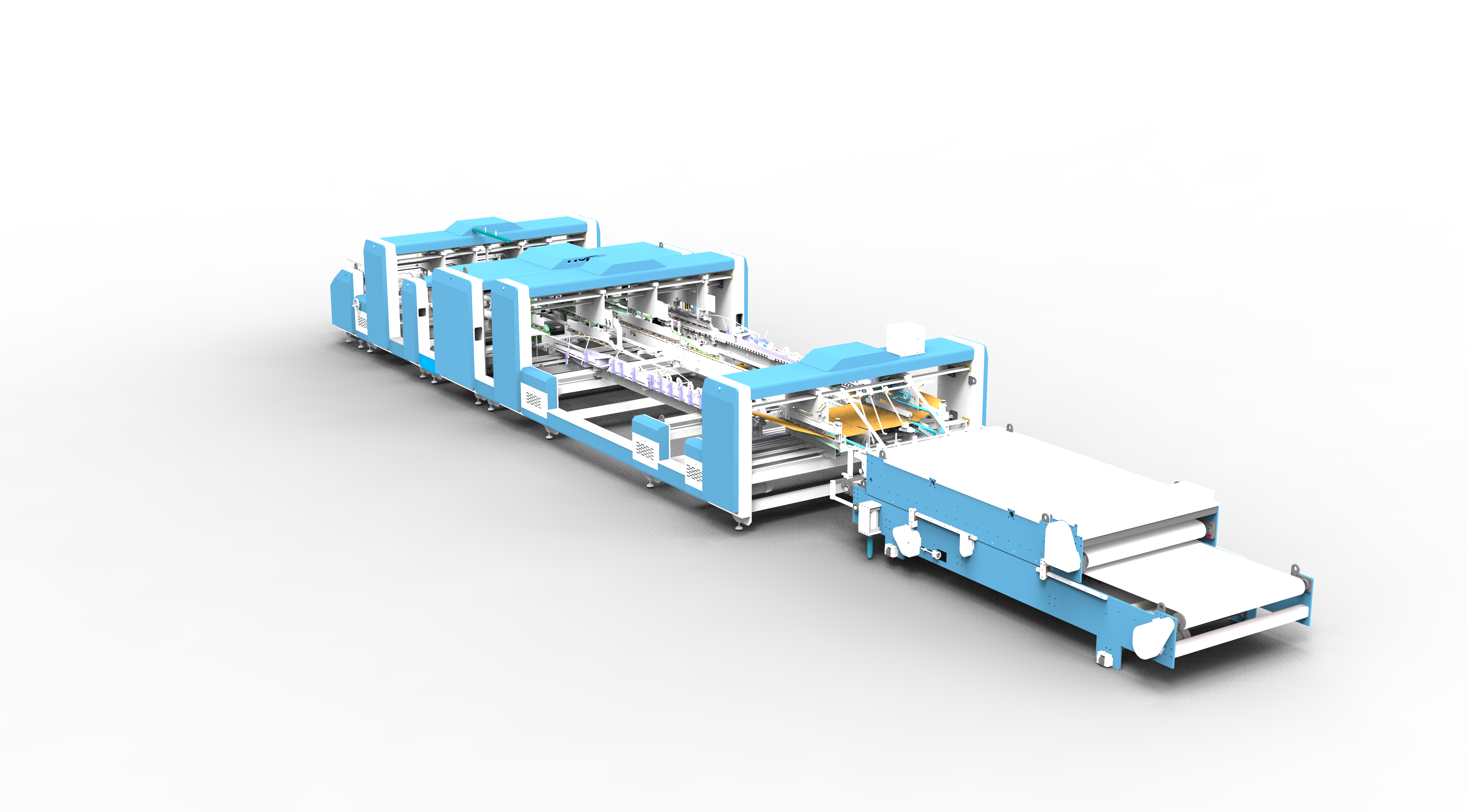
How Our Splicing Section Supports Complex Cartons
When developing a corrugated box folder gluer machine, we treat splicing as part of an integrated carton-forming process. Our splicing section combines electric adjustment, servo-driven conveying, pressing, photoelectric guidance, and flexible gluing options to address different production requirements.
Electric Adjustment With Memory Function
Different carton specifications require different guide positions. Our splicing section uses multiple guide boards with screw-driven electric adjustment, allowing operators to reposition the guides according to the carton dimensions.
A memory mode can retain established settings for specific carton specifications. When a repeat order returns, the stored parameters can be used as a reference instead of rebuilding the setup manually.
This is particularly useful for customized and small-batch production, where several carton specifications may be processed within the same production schedule. The ability to recall previous settings can make changeovers more structured and help reduce repeated trial adjustments.
Dual Servo-Driven Synchronous Conveying
Precise board positioning depends not only on the guide structure but also on stable movement through the splicing section. Our system uses dual servo-driven synchronous conveyor belts to coordinate board movement toward the joining position.
Servo-driven conveying allows the movement of the relevant sections to be controlled according to production requirements. Synchronized belts help maintain the relative position of the boards during splicing.
This function is useful for oversized cartons, where dimensional deviations can become more noticeable because of the larger board area. Stable conveying provides a controlled foundation for accurate joining before the carton proceeds to subsequent folding stages.
Steel-Ball Pressing for Consistent Contact
After adhesive is applied and the board sections meet, suitable pressure helps maintain contact at the joining area. Our splicing section uses a steel-ball paper-pressing structure to support even pressing along the splice.
The structure is designed to help reduce raised areas and movement at the joint while the adhesive sets. This is particularly relevant to larger cartons, where maintaining the intended connection is important during subsequent folding and handling.
Hot and Cold Gluing Options
Different corrugated boards and carton applications can require different adhesive methods. Our equipment can accommodate both hot and cold gluing processes, providing flexibility for different materials and production conditions.
The appropriate adhesive method depends on factors such as board characteristics, production requirements, and the intended carton application. Offering both options allows the splicing process to be configured according to the actual requirements rather than relying on one method for every carton.
Photoelectric Guidance for Positioning
Manual alignment can introduce variation when operators repeatedly position board sections by visual judgment. Our splicing section uses photoelectric guidance to assist with board position detection during the joining process.
By adding sensing to the positioning process, the machine can provide more consistent alignment support across repeated production runs. This is useful when customized cartons require the splice to remain within a defined position from one blank to the next.
Splicing Works With the Complete Folder Gluer Process
The splicing section is only one part of a corrugated box folder gluer machine. Feeding, folding, gluing, and carton transfer must also work together to preserve the geometry established during joining.
Accurate splicing provides a suitable foundation for subsequent folding, while stable feeding and folding help maintain the position of the joined sections. This coordinated operation becomes increasingly important when cartons contain multiple panels or customized structures.
For this reason, we focus on the relationship between individual working sections rather than treating splicing as an isolated function.
Supporting More Complex Carton Production
As carton designs become larger and more customized, reliable splicing plays an important role in maintaining dimensional consistency and production efficiency. Accurate positioning, synchronized conveying, controlled pressing, suitable adhesive application, and repeatable adjustment can work together to support more demanding carton structures.
As a corrugated box folder gluer machine manufacturer, we develop our equipment around these practical production requirements. Electric memory adjustment, dual servo-driven conveying, steel-ball pressing, photoelectric guidance, and hot or cold gluing options provide a flexible foundation for different carton specifications.
With experience in corrugated carton forming equipment, we continue to refine our machine structures around real customer applications, supported by technical development, patents, and CE certification. Our focus is to help packaging operations handle oversized, customized, and structurally complex cartons with greater control throughout the folding and gluing process.
'/%3e%3cpath%20id='Rectangle%20455'%20d='M0%2011.1428H5.57143L22.2857%2052H0V11.1428Z'%20fill='%23CE221D'/%3e%3c/g%3e%3cdefs%3e%3clinearGradient%20id='paint0_linear_888_3811'%20x1='0'%20y1='26'%20x2='401.607'%20y2='26'%20gradientUnits='userSpaceOnUse'%3e%3cstop%20stop-color='%23153B8A'/%3e%3cstop%20offset='1'%20stop-color='%23153B8A'%20stop-opacity='0'/%3e%3c/linearGradient%3e%3c/defs%3e%3c/svg%3e) Products
Products
'/%3e%3cpath%20id='Rectangle%20455'%20d='M0%2012H6L24%2056H0V12Z'%20fill='%23CE221D'/%3e%3c/g%3e%3cdefs%3e%3clinearGradient%20id='paint0_linear_769_2773'%20x1='0'%20y1='28'%20x2='432.5'%20y2='28'%20gradientUnits='userSpaceOnUse'%3e%3cstop%20stop-color='%23153B8A'/%3e%3cstop%20offset='1'%20stop-color='%23153B8A'%20stop-opacity='0'/%3e%3c/linearGradient%3e%3c/defs%3e%3c/svg%3e)


