


Global buyers rarely evaluate a corrugated carton on appearance alone. Compression resistance, seam integrity, and dimensional consistency have become baseline expectations across export markets, and any shipment that falls short risks rejection at the destination port or, worse, damaged goods claims further down the supply chain. As these expectations tighten, the equipment responsible for folding and gluing cartons has moved from a background production step to a decisive factor in whether a batch meets contractual quality terms. This connection makes it important to choose the right folder gluer from the start.
Where Export Orders Expose Equipment Limitations
Domestic-market cartons and export cartons are rarely held to the same scrutiny. A box destined for a nearby regional customer may tolerate minor seam misalignment or slight variance in glue coverage, but an export order inspected against international packaging standards leaves far less room for inconsistency. This is where the limitations of conventional folding and gluing equipment tend to surface.
Manual or semi-guided splicing is one common source of trouble. When operators rely on visual alignment to position the leading edge of a carton blank, even small deviations accumulate across a production run. In a domestic context, this might go unnoticed; in an export context, where a single container load may be inspected batch by batch, uneven seams can trigger quality holds that delay shipment and strain buyer relationships.
Adhesive application introduces a second layer of risk. Equipment limited to a single gluing method struggles to adapt when order specifications call for different bond strength, drying behavior, or environmental compliance depending on the destination market. A production line that cannot adjust its gluing approach order by order ends up treating every carton the same way, regardless of what the shipment actually requires.
Folding accuracy compounds both issues. Cartons that pass through folding sections with inconsistent pressure or angle control often develop compression weaknesses that are invisible until the box is stacked and loaded, which is precisely the moment export buyers care about most. A carton that looks acceptable on the production floor can still fail a stacking test overseas.
Structural Choices That Support Consistent Output
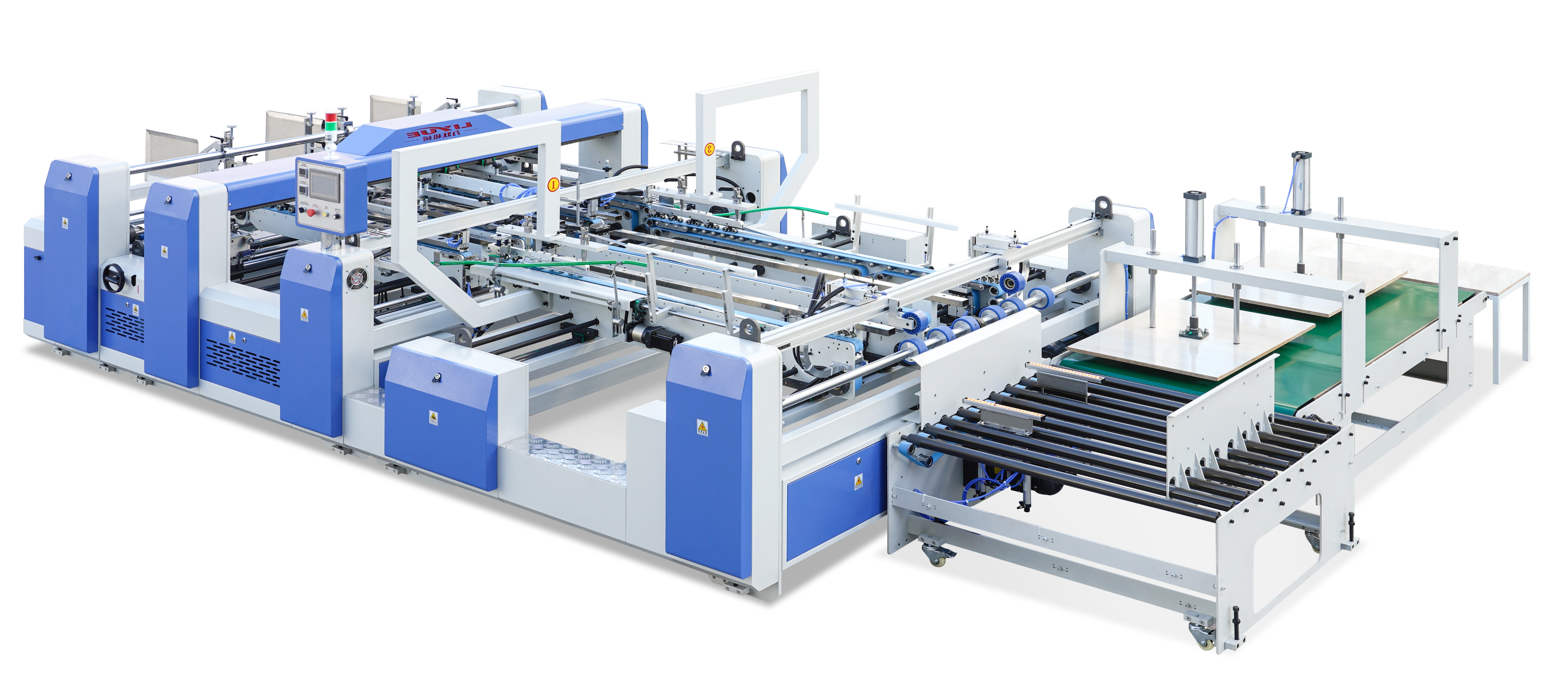
Addressing these pressure points is less about adding features and more about designing each functional section to behave predictably at scale. In our machines, the splicing section uses a multi-guide-plate configuration paired with an electrically adjustable leading mechanism that retains its position through a memory-based setting, rather than requiring operators to reset alignment manually for every run. Dual servo-driven belt conveyors keep the material moving at a matched pace through this section, while a steel-ball pressing mechanism and photoelectric-guided positioning work together to hold the seam accurate without depending on operator judgment. For cartons where the stitching interface also needs reinforced adhesion, a hot-and-cold double coating step at the splice further stabilizes the bond before the carton moves downstream.
Gluing flexibility follows a similar logic. Our machines apply adhesive through mechanical roller gluing, with both hot-melt and cold-glue dipping methods available, and an optional spray glue system for orders that call for a different coverage pattern. Rather than committing a production line to one adhesive approach regardless of the order, this configuration lets the coverage method match what a given export specification actually asks for.
Folding consistency is handled through an independently driven folding section that manages the second and fourth folding lines, the latter completing a full 180-degree fold, with left and right belt speeds adjustable to keep both sides of the carton folding in step. An optional servo upgrade tightens this synchronization further for buyers running higher-precision export product lines. Because each of these sections operates on its own motor drive rather than a shared mechanical linkage, adjustments made for one order do not force compromises elsewhere on the line.
Why Equipment Design Choices Translate Into Export Readiness
None of these mechanisms function as isolated selling points; their value shows up cumulatively, in how consistently a finished carton performs once it leaves the factory. A splicing section that holds its alignment run after run reduces the seam variability that inspectors flag most often. A gluing section that adapts to different bond requirements avoids the compromise of forcing every order through the same adhesive method. A folding section with independent, adjustable control keeps compression performance stable across a full production batch rather than only in the samples pulled for internal checks.
This is also where engineering credentials matter to buyers evaluating suppliers rather than just machines. Our equipment has been developed with an R&D team carrying an average of more than fourteen years of experience, supported by more than a dozen effective patents and patent applications that reflect ongoing refinement of these mechanical systems. The machines carry CE certification alongside recognized Chinese patent documentation, and they currently serve customers across more than thirty regions worldwide, many of whom operate under export quality requirements comparable to the ones described above. These are not abstract claims; they are the practical foundation that lets a folder gluer machine hold tolerances that export-grade cartons depend on.
Building Toward Reliable Export-Grade Output
Export carton quality standards will likely continue tightening as international buyers refine their own inspection processes, and equipment that cannot keep pace with those standards becomes a liability rather than a production asset. We design our folder gluer machines around the sections most responsible for that consistency: precise, memory-guided splicing, adaptable gluing methods, and independently controlled folding, all supported by a manufacturing background built on measurable engineering experience rather than assumptions about what "good enough" looks like.
For manufacturers preparing cartons for demanding export markets, the equipment behind the folding and gluing process deserves the same scrutiny given to the cartons themselves. We welcome inquiries from businesses looking to evaluate how our folder gluer machines can support their specific export quality requirements, and we are glad to walk through configuration options suited to the markets a given production line is meant to serve.
'/%3e%3cpath%20id='Rectangle%20455'%20d='M0%2011.1428H5.57143L22.2857%2052H0V11.1428Z'%20fill='%23CE221D'/%3e%3c/g%3e%3cdefs%3e%3clinearGradient%20id='paint0_linear_888_3811'%20x1='0'%20y1='26'%20x2='401.607'%20y2='26'%20gradientUnits='userSpaceOnUse'%3e%3cstop%20stop-color='%23153B8A'/%3e%3cstop%20offset='1'%20stop-color='%23153B8A'%20stop-opacity='0'/%3e%3c/linearGradient%3e%3c/defs%3e%3c/svg%3e) Products
Products
'/%3e%3cpath%20id='Rectangle%20455'%20d='M0%2012H6L24%2056H0V12Z'%20fill='%23CE221D'/%3e%3c/g%3e%3cdefs%3e%3clinearGradient%20id='paint0_linear_769_2773'%20x1='0'%20y1='28'%20x2='432.5'%20y2='28'%20gradientUnits='userSpaceOnUse'%3e%3cstop%20stop-color='%23153B8A'/%3e%3cstop%20offset='1'%20stop-color='%23153B8A'%20stop-opacity='0'/%3e%3c/linearGradient%3e%3c/defs%3e%3c/svg%3e)


