


Corrugated box quality depends on more than the performance of the board itself. Feeding accuracy, folding alignment, splice positioning, and glue consistency all influence whether finished boxes meet production requirements. When these variables are not properly controlled, small deviations can develop into skewed seams, uneven glue lines, poor folding, and increased rejection rates. For this reason, a corrugated box folder gluer machine should be evaluated not only by its running speed, but also by how consistently its mechanical and control systems maintain accuracy throughout a production run.
Where Conventional Folding and Gluing Equipment Can Lose Accuracy
Older folding and gluing equipment often relies heavily on manual adjustment. This becomes particularly noticeable during job changes, when operators need to reset guides, glue application, pressure, and feeding conditions for a different box size.
Manual glue adjustment can create inconsistent adhesive coverage. Too little glue may weaken the joint, while excessive application can cause squeeze-out, contamination, or unnecessary adhesive consumption. These variations become more difficult to control as production speed increases.
Splicing accuracy presents another challenge. If the folding section depends mainly on fixed mechanical stops, the overlapping joint can shift when sheet tension, board weight, or running speed changes. The result may be an angled or uneven seam, commonly described as a fishtail. Larger box formats can make this problem more noticeable because small positioning deviations become more visible along a longer joint.
Feeding errors can also affect every process that follows. Without effective double-sheet detection, two blanks may enter the machine together. Once an incorrectly fed sheet reaches the folding or gluing section, downstream adjustments cannot fully correct the original feeding error.
These problems are connected. A machine may have an accurate gluing system, for example, but still produce rejected boxes if feeding or folding alignment is unstable. Improving quality rate therefore requires control across the complete production path.
Why Production Conditions Affect Box Quality
Different production environments place different demands on a folder gluer machine.
Plants producing e-commerce and parcel packaging often handle frequent changes in box dimensions. For these applications, repeatable setup and stable adjustment after changeovers can be as important as maximum line speed. A machine that returns to accurate operating conditions consistently can help reduce setup-related waste.
Food and consumer goods packaging typically requires clean and uniform glued joints. Uneven adhesive distribution can affect seam appearance and bonding consistency, making glue control an important part of finished-box quality.
Export packaging can create additional challenges because large and deep boxes are more sensitive to alignment deviations. Longer joints and heavier board can place greater demands on feeding, guiding, folding, and pressing systems.
For manufacturers running mixed product batches, the key requirement is repeatability. The production objective is not simply to achieve high output for one box specification, but to maintain stable folding and gluing accuracy as products change.
Improving Splicing Accuracy Through Guided Positioning
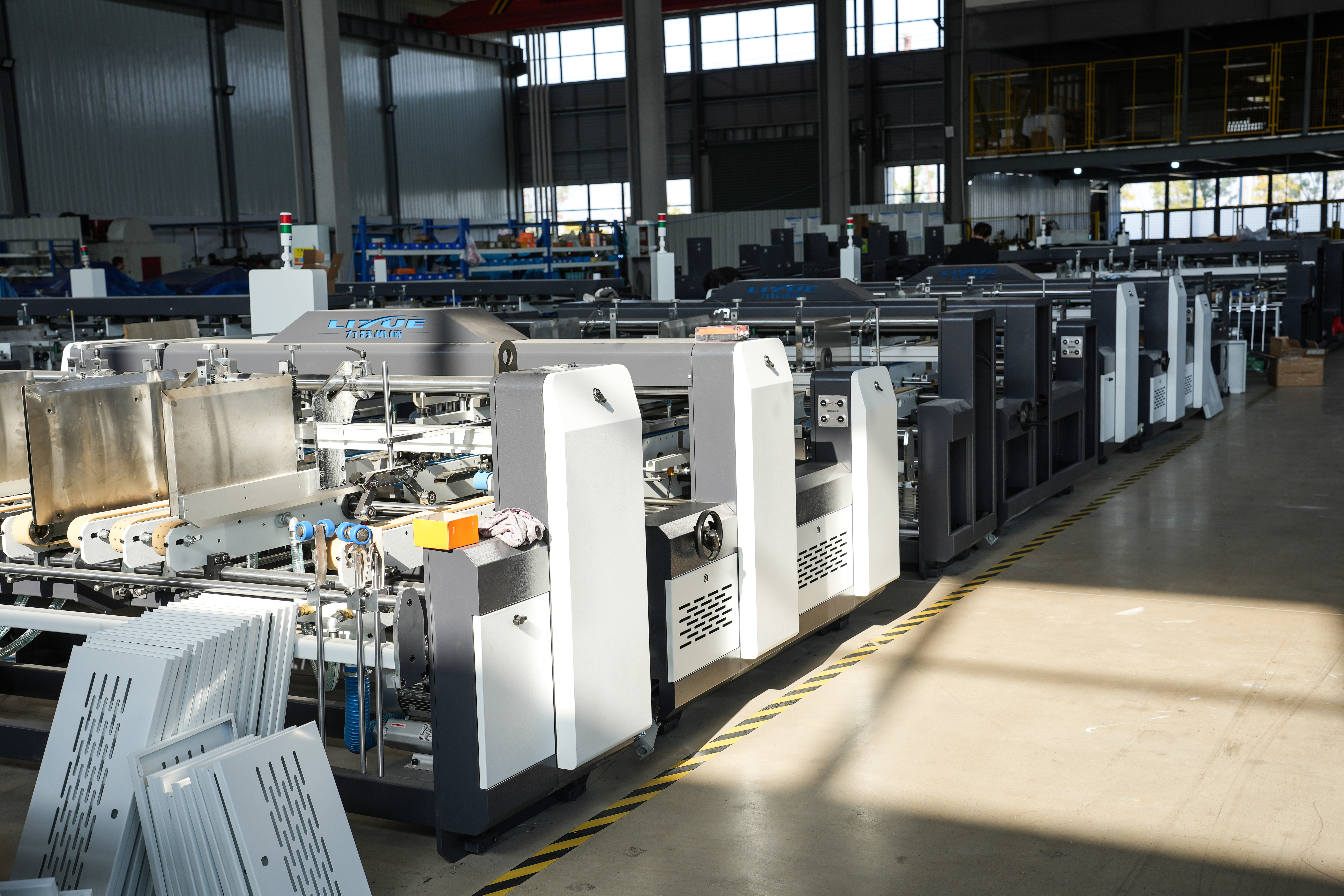
The splicing section is a critical area for controlling box geometry. Our folder gluer-stitcher machine uses a multi-guide-plate structure with electric lead-screw adjustment to provide more controlled positioning than a fixed-stop arrangement.
Adjustment positions can be stored in the control system, allowing repeat jobs to return to established settings without rebuilding the setup from the beginning. This is particularly useful for manufacturers handling multiple box specifications.
Dual servo-driven belt conveyors help maintain controlled sheet movement through the splicing section. Steel-ball pressing keeps the board positioned during high-speed travel, while a photoelectric guidance system monitors the joint position and supports real-time correction.
Together, these mechanisms address the main sources of splice deviation: inconsistent sheet positioning, movement during transfer, and changes in alignment during continuous production. The objective is not simply faster splicing, but more repeatable joint positioning across different box sizes and board conditions.
Maintaining Consistent Glue Application
Glue application is another direct contributor to corrugated box quality rate. A stable gluing system should provide sufficient adhesive coverage without creating excessive buildup or unnecessary consumption.
Our gluing section supports both hot- and cold-glue application methods, allowing the machine configuration to match different production requirements. Mechanical roller application provides controlled adhesive transfer, while an optional spray-glue system can distribute adhesive across the required bonding area.
This flexibility is useful when manufacturers work with different board specifications or adhesive processes. Instead of depending entirely on manual roller adjustment, the gluing system can be configured according to the production requirements of the box.
Consistent adhesive application also reduces the risk of localized glue shortages and excessive glue accumulation. When combined with accurate splicing, it helps maintain more uniform seam quality throughout a production run.
Servo Feeding Helps Prevent Upstream Errors
Feeding accuracy has a direct influence on every process downstream. If a sheet enters the folder gluer incorrectly, even a highly precise folding or gluing system cannot completely compensate for the initial deviation.
The feeding section of our machine uses independent servo drive control and suction feeding to maintain more consistent sheet movement. Air suction detection helps identify double sheets before they enter the main folding and gluing process.
This approach moves quality control upstream. Instead of relying on downstream inspection to identify every incorrectly fed blank, the machine incorporates detection at the feeding stage, helping prevent an initial error from being transferred through the rest of the production line.
Building a More Stable Quality Control Process
Improving corrugated box quality rate is not the result of one isolated component. Feeding, folding, splicing, pressing, and gluing must work together because an error in one stage can affect the accuracy of the next.
This is why our fully automatic high-speed folder gluer-stitcher machine combines servo-driven feeding, guided splicing, controlled glue application, and automated adjustment into one production system. The machine is designed to maintain repeatable processing conditions while reducing dependence on manual intervention during production.
Our equipment is CE certified and incorporates patented mechanisms developed through our engineering work. With experience supporting corrugated box producers in more than thirty countries and regions, we focus on matching machine configuration to actual box dimensions, board conditions, production volume, and changeover requirements.
For manufacturers dealing with splice deviation, inconsistent glue application, double-sheet feeding, or unstable folding accuracy, improving the machine structure and control system can provide a more practical path toward a higher and more consistent corrugated box quality rate.
'/%3e%3cpath%20id='Rectangle%20455'%20d='M0%2011.1428H5.57143L22.2857%2052H0V11.1428Z'%20fill='%23CE221D'/%3e%3c/g%3e%3cdefs%3e%3clinearGradient%20id='paint0_linear_888_3811'%20x1='0'%20y1='26'%20x2='401.607'%20y2='26'%20gradientUnits='userSpaceOnUse'%3e%3cstop%20stop-color='%23153B8A'/%3e%3cstop%20offset='1'%20stop-color='%23153B8A'%20stop-opacity='0'/%3e%3c/linearGradient%3e%3c/defs%3e%3c/svg%3e) Products
Products
'/%3e%3cpath%20id='Rectangle%20455'%20d='M0%2012H6L24%2056H0V12Z'%20fill='%23CE221D'/%3e%3c/g%3e%3cdefs%3e%3clinearGradient%20id='paint0_linear_769_2773'%20x1='0'%20y1='28'%20x2='432.5'%20y2='28'%20gradientUnits='userSpaceOnUse'%3e%3cstop%20stop-color='%23153B8A'/%3e%3cstop%20offset='1'%20stop-color='%23153B8A'%20stop-opacity='0'/%3e%3c/linearGradient%3e%3c/defs%3e%3c/svg%3e)


