


E-commerce has reshaped what modern packaging lines need to deliver. Order volumes can shift sharply between regular days and promotional peaks, box specifications may vary from one batch to the next, and downstream logistics networks leave little room for boxes with weak or inconsistent seams. Under these conditions, the corrugated box folder gluer machine becomes a critical part of production, influencing folding accuracy, gluing consistency, and the line’s ability to maintain stable output as demand changes.
Production Challenges with Conventional Folder Gluer Machines
Many folder gluers still in service were built for a steadier era of production, where run sizes stayed large and box specifications changed infrequently. That assumption breaks down against e-commerce demand. Frequent changeovers between box sizes expose machines that rely heavily on manual adjustment, since operators must reset guides and alignment points by hand each time a specification shifts, and every minute spent on setup is a minute the line isn't producing.
Precision is the other weak point. On older equipment, the splicing stage — where the leading and trailing edges of the board are joined into a finished box — depends on how consistently an operator can line things up at speed. Small misalignments here don't always show immediately, but they surface later as weak seams, boxes that separate under load, or product damage somewhere in the shipping chain. During a seasonal surge, when order volume climbs and shifts run longer, these small inconsistencies compound, and a line that can't hold precision at speed becomes the constraint on the whole facility's output.
Why Equipment Design Matters More for E-Commerce Packaging
A folder gluer must produce boxes with the consistency and flexibility that e-commerce fulfillment demands. A production line built around independent, motor-driven sections responds to changeover demands far more readily than one built around a single shared drive, because each stage can be adjusted without disrupting the others. That kind of structural flexibility is what lets a manufacturer move between box specifications without treating every changeover as a disruption.
Reliability under sustained output matters just as much. When a facility is pushing through peak-season volume, the folder gluer needs to hold its accuracy at high speed for hours at a stretch, not just during a slow test run. That's where the design of the splicing and feeding sections becomes the differentiator between a machine that merely produces boxes and one that produces boxes a packaging buyer can count on.
How Our Folder Gluer-Stitcher Meets E-Commerce Packaging Demands
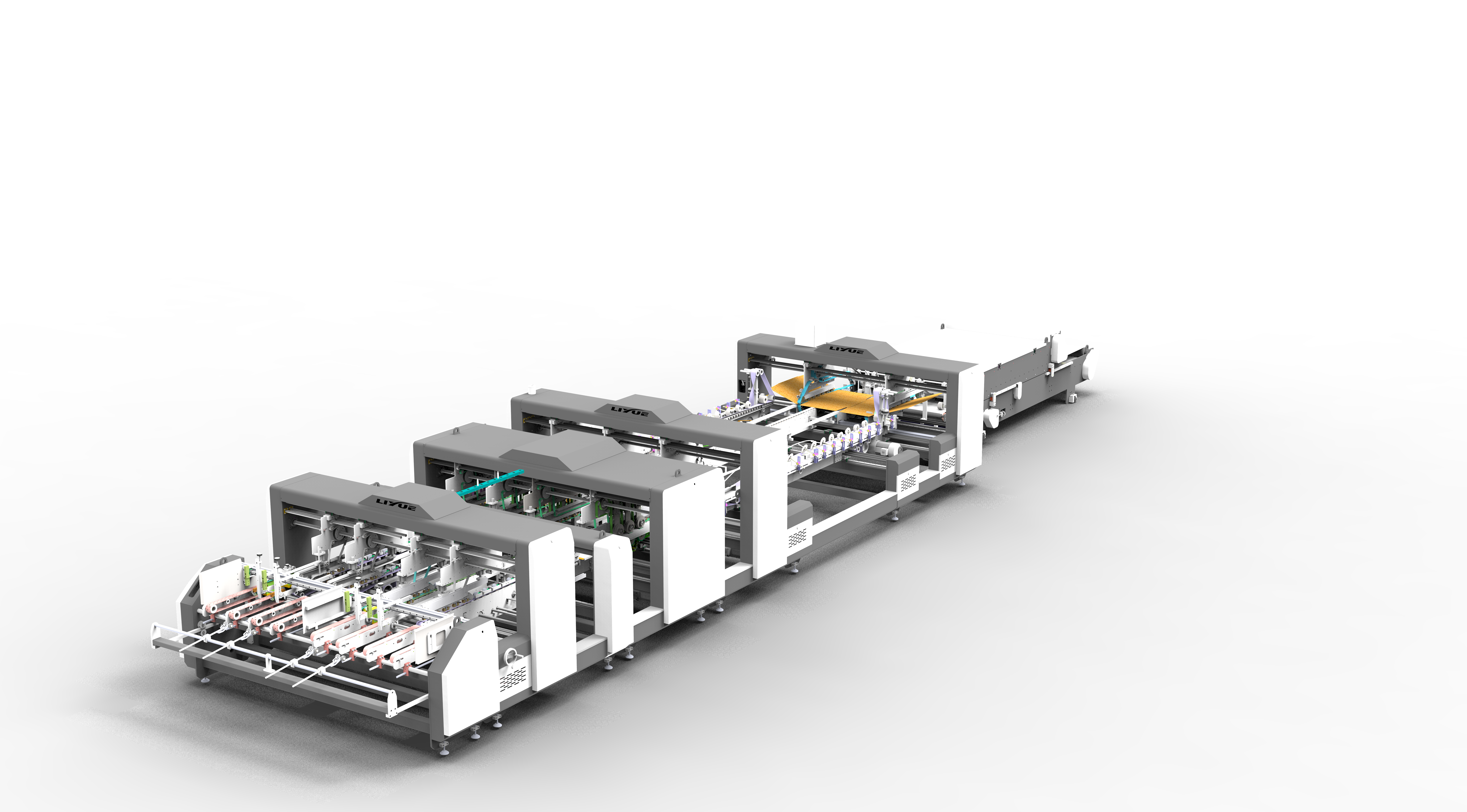
We designed our fully automatic high-speed folder gluer-stitcher machine around the two stages where precision and adaptability matter most for e-commerce-driven production: paper feeding and splicing.
At the feeding stage, the machine draws board in through an automatic suction feeder with its own independent servo drive, rather than sharing drive power across the whole line. Side flaps adjust to different board widths, and the rear support retracts to accommodate varying sheet lengths, so switching between box specifications doesn't require the kind of manual recalibration that eats into changeover time. Air suction control also helps prevent double-sheet feeding, which keeps the line from stalling on jammed or misfed board — a small detail that has an outsized effect on uptime when a facility is running long shifts through a demand spike.
The splicing section is where we put the most engineering attention, because it's the stage most responsible for the finished box's structural integrity. Our machine uses a multi-guide-plate structure with electric adjustment along a lead screw, and the position settings can be stored in memory and recalled for repeat jobs, so returning to a familiar box specification doesn't mean starting the alignment process from scratch. Dual servo-driven belt conveyors carry the board through this stage with steady, coordinated motion, while steel-ball pressing holds the cardboard firmly in place as it moves. Hot and cold coating applied at the splicing interface, combined with photoelectric guidance for accurate positioning, keeps the join consistent even as line speed increases. Together, these elements are built to hold splicing accuracy at a pace that matches high-volume, fast-turnaround production — which is exactly the environment e-commerce packaging demands.
The folding and gluing stages carry their own independent motor drives as well, with stepless variable-speed control across the folding belts, so the whole line moves as a coordinated system rather than a chain of stages each waiting on the one before it. That coordination is part of what keeps output steady when a facility can least afford a bottleneck.
Precision and Stability at Every Production Stage
Selecting a corrugated box folder gluer machine for an e-commerce packaging line comes down to a fairly practical question: can the equipment hold precision and speed at the same time, changeover after changeover, without the operator having to compensate for its limitations. Feeding accuracy and splicing quality tend to be where that question gets answered, because they're the stages most exposed to both specification changes and production speed.
We've built our machine with those two stages as the core of its design, backed by patented engineering and manufacturing practices that meet CE certification standards for export markets. For packaging producers supplying e-commerce fulfillment, that combination is what turns a folder gluer from a production bottleneck into a stage of the line they can build the rest of their operation around.
'/%3e%3cpath%20id='Rectangle%20455'%20d='M0%2011.1428H5.57143L22.2857%2052H0V11.1428Z'%20fill='%23CE221D'/%3e%3c/g%3e%3cdefs%3e%3clinearGradient%20id='paint0_linear_888_3811'%20x1='0'%20y1='26'%20x2='401.607'%20y2='26'%20gradientUnits='userSpaceOnUse'%3e%3cstop%20stop-color='%23153B8A'/%3e%3cstop%20offset='1'%20stop-color='%23153B8A'%20stop-opacity='0'/%3e%3c/linearGradient%3e%3c/defs%3e%3c/svg%3e) Products
Products
'/%3e%3cpath%20id='Rectangle%20455'%20d='M0%2012H6L24%2056H0V12Z'%20fill='%23CE221D'/%3e%3c/g%3e%3cdefs%3e%3clinearGradient%20id='paint0_linear_769_2773'%20x1='0'%20y1='28'%20x2='432.5'%20y2='28'%20gradientUnits='userSpaceOnUse'%3e%3cstop%20stop-color='%23153B8A'/%3e%3cstop%20offset='1'%20stop-color='%23153B8A'%20stop-opacity='0'/%3e%3c/linearGradient%3e%3c/defs%3e%3c/svg%3e)


